A tiny pair of custom-molded earbuds that record brain activity from inside the ear canal has passed its most demanding test yet against the gold standard of sleep medicine, according to a new validation study published in Bioelectronic Medicine. In overnight recordings of healthy volunteers, the in-ear electroencephalography system agreed with conventional scalp EEG sleep staging at a Cohen’s kappa of 0.77, a level of agreement the authors describe as substantial and one that approaches the agreement human scorers show with one another when reading full scalp recordings.
The study, led by researchers working with NextSense Inc. and Emory University, is the first to evaluate an in-ear EEG device against the Maintenance of Wakefulness Test, the clinical protocol favored for measuring how well patients with sleepiness disorders can stay awake, particularly when judging the effect of wake-promoting medications. It is also, according to the authors, the largest ear-EEG sleep-staging validation to date, spanning 142 scored sessions: 126 daytime test trials plus 16 overnight sleep recordings across 24 participants.
The hardware itself is a study in miniaturization. Each earbud is 3D printed from biocompatible resin using a high-resolution laser scan of the wearer’s ear canal, accurate to roughly a tenth of a millimeter, and coated with a proprietary conductive polymer where it touches the canal wall and the cymba of the outer ear. Two electrodes sit on each bud, and the buds connect through a micro-HDMI cable to a small recording unit containing an analog-to-digital converter, a battery and a synchronization output that lets the device’s data stream be aligned precisely with a clinical polysomnography system. Proper insertion requires almost no preparation beyond avoiding excess earwax.
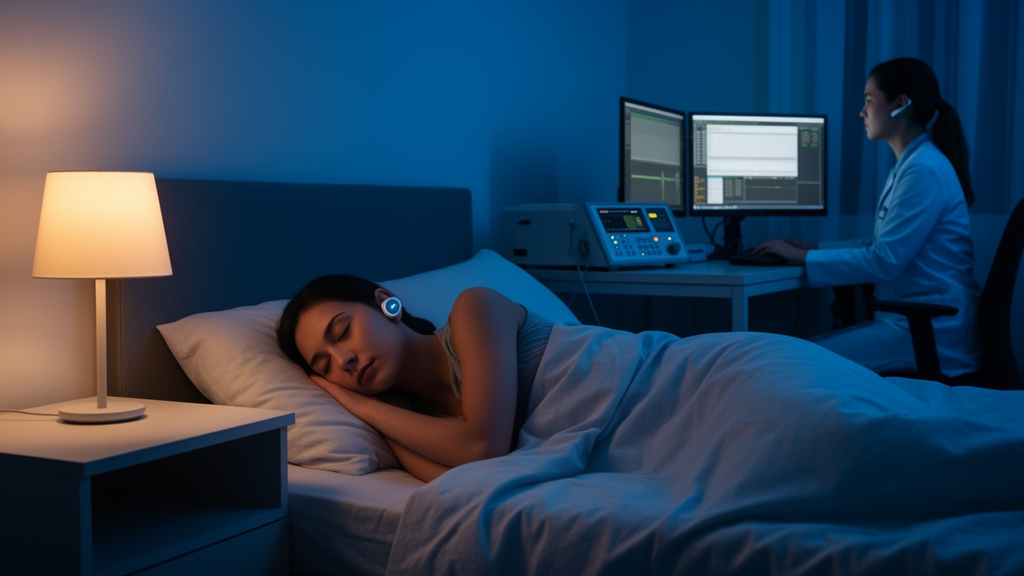
For the validation, 16 healthy adults spent a single night in the Emory University sleep laboratory wearing both the earbuds and a full 10-20 scalp montage. Sleep was deliberately restricted to a four-hour window, with lights out at 2 a.m. and lights on at 6 a.m., so that the following day’s four Maintenance of Wakefulness Test trials would be performed under elevated sleep pressure. Three certified sleep technologists, blinded to participant identity and clinical condition, independently scored both the scalp and in-ear recordings in 30-second epochs according to American Academy of Sleep Medicine rules, and a consensus hypnogram was built for each modality by majority vote.
The overnight results were strong across the board. Total sleep time correlated at r = 0.94 between the two modalities with an intraclass correlation coefficient of 0.85, sleep efficiency also correlated at 0.94, and wake after sleep onset at 0.93. The biases were small and consistent: in-ear scoring yielded about five minutes less total sleep and five minutes more wake, a pattern the authors attribute to reduced sensitivity for the faint, transitional N1 stage. At the individual stage level, agreement was more moderate, with the earbud system systematically reclassifying roughly 12 minutes of scalp-scored N3 slow-wave sleep as N2, because the attenuated slow-wave amplitude in the ear canal makes the 20-percent slow-wave threshold that defines N3 harder to cross.
Daytime testing proved the harder challenge. Across all 126 Maintenance of Wakefulness Test trials, epoch-level agreement between the modalities was moderate, at kappa 0.50, though the authors note this figure is depressed by the flood of wake epochs in a test where participants are actively trying to resist sleep. Sleep onset latency, the primary endpoint, showed a mean absolute difference of 7.6 minutes across all trials with a mean bias of 4.7 minutes, and an intraclass correlation of 0.55. But when both devices detected sleep in the same trial, which happened in 37 of the 126 trials, the latency estimates were closely concordant, with an intraclass correlation of 0.82 and a mean absolute difference of just 1.9 minutes. In healthy controls that conditional agreement rose to 0.95 with a difference of 1.2 minutes.
The real story lay in the discordant trials. In 22 trials, scalp EEG detected sleep onset while the earbuds recorded nothing but wake, and 15 of those came from just 5 of the 8 patients with central disorders of hypersomnolence, a cohort including narcolepsy and idiopathic hypersomnia. The missed sleep was predominantly brief, subtle N1, the transitional stage that is notoriously difficult to score even with full scalp electrodes. Treating scalp EEG as truth, the in-ear system’s per-trial sensitivity for detecting any sleep was 0.63 overall, but split sharply between cohorts: 0.73 in healthy controls versus 0.55 in the patient group, while specificity was nearly identical at around 0.90 in both.
The clinical cohort also demonstrated something no prior ear-EEG study had: sensitivity to medication effects. Eight patients completed a randomized crossover of their usual wake-promoting regimen versus a medication holiday, and in the seven evaluable subjects the earbud-derived sleep onset latency rose by a mean of 8.8 minutes on the medicated day, with three participants crossing from below to above the healthy-control mean. The two narcolepsy type 1 patients showed the smallest improvements, consistent with the known partial pharmacological response in that condition. The authors are careful to frame this as a preliminary observation about the clinical endpoint rather than proof of the device’s ability to track drug effects on the EEG signal itself.
Context matters for judging the shortfalls. A separate analysis cited in the paper found that two expert scorers using full scalp EEG disagree on the Maintenance of Wakefulness Test outcome in up to a third of patients, and within the present study the scalp scorers themselves agreed with their own consensus at only kappa 0.78 during daytime trials. The authors also report that when the most deviant of their three in-ear scorers was excluded in a sensitivity analysis, overnight agreement rose to kappa 0.883, suggesting the published consensus figures are conservative. A censoring-aware statistical model indicated the headline agreement metrics, if biased at all, understate the true correspondence between the devices.
The authors are explicit about the limits: the study was small, conducted entirely in a supervised laboratory, and the overnight architecture analysis covered healthy controls only. Home use, self-application and multi-night reliability remain untested and are not claims of this data. But the combination of substantial overnight staging agreement, strong per-subject sleepiness measurement, and demonstrated deployment inside a pharmacological trial protocol positions the earbud EEG as a credible candidate for the longitudinal, out-of-laboratory sleep monitoring that current tools, from costly repeated lab studies to actigraphy, which has been shown to overestimate sleep in idiopathic hypersomnia by up to nearly two hours, handle poorly. Larger confirmatory studies, including home-based monitoring in populations with altered sleep architecture, are the stated next step.
Subject of Research: Validation of a wearable in-ear EEG system against polysomnography for sleep staging and daytime sleepiness testing
Article Title: A novel, wearable, in-ear EEG technology to assess sleep and daytime sleepiness
Article References: Berent, J., Saini, P., Stewart, A. X., Bheda, D., Borodin, K., Paul, A., Tracey, B., Dong, C., Volfson, D., Buhl, D. L., & Rye, D. B. (2026). A novel, wearable, in-ear EEG technology to assess sleep and daytime sleepiness. Bioelectronic Medicine, 12(1), Article 13. https://doi.org/10.1186/s42234-026-00207-x
Image Credits: AI Generated
DOI: 10.1186/s42234-026-00207-x
Keywords: in-ear EEG, sleep staging, polysomnography, Maintenance of Wakefulness Test, narcolepsy, idiopathic hypersomnia, sleep onset latency, wearable technology, sleep architecture, N1 sleep, clinical validation, Bioelectronic Medicine
News Source: Denise Maddox. (October 29, 2026). Earbud EEG matches lab sleep study in first head-to-head validation. Scienmag.