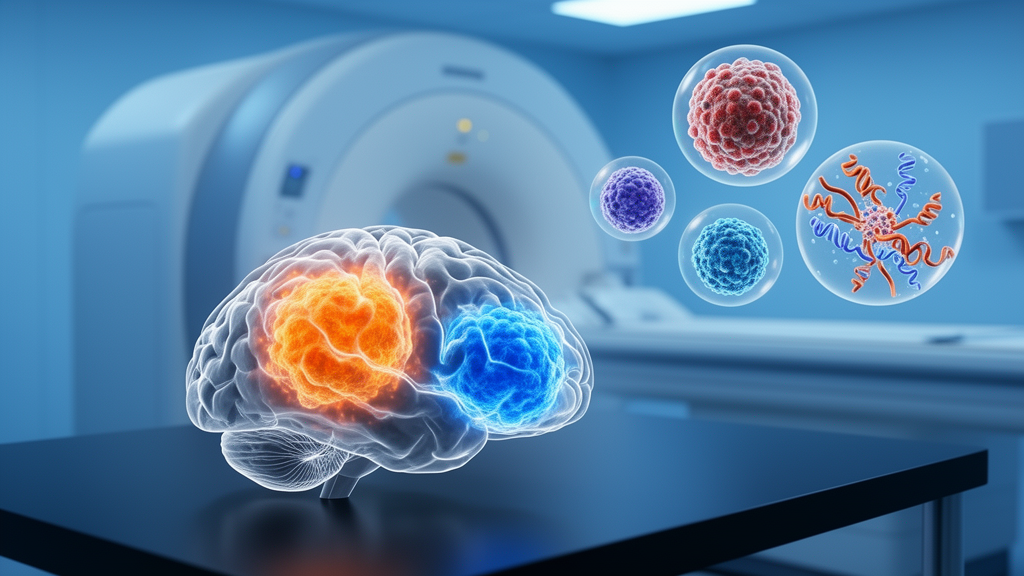
Noninvasive assessment of isocitrate dehydrogenase (IDH) mutation status and Ki-67 labeling index in non-enhancing gliomas is challenging. A single-center retrospective study now reports that time-dependent diffusion MRI (TDD-MRI) showed preliminary value over conventional diffusion-weighted imaging (DWI) for discriminating prespecified IDH/Ki-67 strata of non-enhancing gliomas.
The research, published in the Journal of Translational Medicine, enrolled 173 patients with non-enhancing gliomas. The team divided the cohort chronologically into a development set of 99 patients and a temporal validation set of 74 patients, a design intended to test whether the models hold up in patients scanned at a later time rather than simply on randomly split data. Each tumor was assigned to one of three prespecified subgroups: IDH wild type, IDH-mutant with a low Ki-67 index, or IDH-mutant with a high Ki-67 index.
From the imaging data, the researchers extracted histogram features from seven parameter maps derived from TDD-MRI and from a conventional apparent diffusion coefficient (ADC) map computed from standard DWI. Feature selection relied on least absolute shrinkage and selection operator (LASSO) regression together with the Boruta algorithm, and the selected features were compared across the three subgroups. Several TDD-MRI and conventional ADC histogram features differed significantly among the subgroups in both cohorts, suggesting that the diffusion behavior captured at different time scales carries information about tumor genotype and proliferative activity.
Three types of models were then built for three one-versus-rest binary classification tasks: conventional ADC (cADC) models, uni-parametric histogram models (UPMs) using single TDD-MRI maps, and multi-parametric histogram models (MPMs) combining several TDD-MRI maps. The MPM approach achieved the highest area under the curve (AUC) among the imaging models. In the development cohort, MPM AUCs were 0.892, 0.852, and 0.836 for the three tasks, compared with 0.875, 0.809, and 0.825 in the temporal validation cohort. The corresponding cADC and UPM figures were lower, indicating that conventional DWI alone provided less discriminative power than the multi-parametric TDD-MRI approach.
To test whether TDD-MRI adds value beyond routine clinical information, the investigators incorporated the probability output of the best-performing model into a Clinical model built from patient age and tumor location. The resulting Clinical + TDD model yielded numerically higher AUCs than the Clinical model alone for all three classification tasks. In the development cohort, the combined model reached AUCs of 0.929, 0.858, and 0.836 for identifying IDH wild type, IDH-mutant low Ki-67, and IDH-mutant high Ki-67 tumors, versus 0.789, 0.689, and 0.636 for the Clinical model. In the temporal validation cohort, the combined model achieved 0.951, 0.830, and 0.828, compared with 0.860, 0.693, and 0.644 for the clinical variables alone.
The pattern of improvement was most pronounced for the IDH-mutant low Ki-67 and IDH-mutant high Ki-67 groups, where the clinical model performed weakest and the addition of TDD-MRI features produced the largest gains.
The authors describe the findings as preliminary. The study was retrospective and conducted at a single center, and the subgroup sizes were modest, with, for example, only 18 IDH wild type tumors in the development cohort and 15 in the validation cohort. The article was also shared as an early, peer-reviewed accepted version subject to further edits before the final Version of Record.
Subject of Research: Time-dependent diffusion MRI for noninvasive classification of IDH mutation status and Ki-67 labeling index in non-enhancing gliomas
Article Title: Time-dependent diffusion MRI versus conventional DWI for dual-parameter assessment of non-enhancing gliomas: IDH mutation and Ki-67 labeling index
Article References: Wang, Y., Zhang, J., Xi, Y., Li, C., Feng, L., Lyu, Z., & Han, Y. (2026). Time-dependent diffusion MRI versus conventional DWI for dual-parameter assessment of non-enhancing gliomas: IDH mutation and Ki-67 labeling index. Journal of Translational Medicine. https://doi.org/10.1186/s12967-026-09114-w
Image Credits: AI Generated
DOI: 10.1186/s12967-026-09114-w
Keywords: glioma, TDD-MRI, diffusion MRI, IDH mutation, Ki-67 labeling index, DWI, ADC, machine learning, radiomics, neuroimaging, biomarkers, temporal validation
News Source: Ophelia Keating. (October 29, 2026). Research report: Time-dependent diffusion MRI versus conventional DWI for dual-parameter assessment of non-enhancing gliomas: IDH mutation and Ki-67 labeling index. Scienmag.