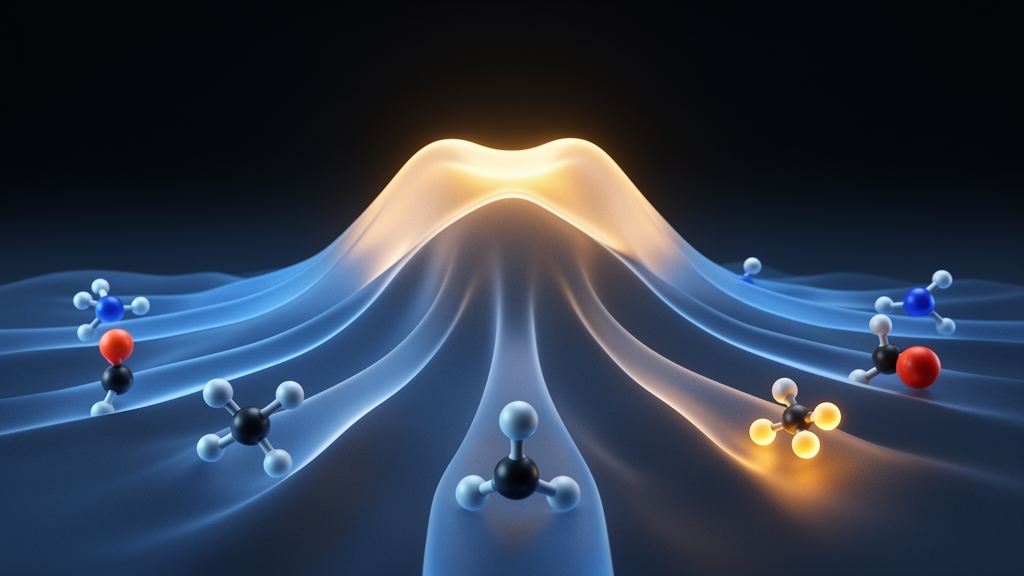
Chemical reactions are usually taught as a simple story: molecules climb over a high-energy saddle point called a transition state and then slide down a single downhill path to one product. A new computational study from Saitama University shows how often that story is incomplete. Using a technique known as the double-ended string method, a research team led by Professor Toshiyuki Takayanagi of the Graduate School of Science and Engineering identified alternative reaction pathways that conventional quantum chemical calculations overlook entirely, revealing how a single transition state can lead to two or even three different products.
The phenomenon at the heart of the study is called post-transition-state bifurcation, or PTSB. After molecules pass through the same transition state, the energy landscape can split, sending them along different routes toward distinct molecular products. Molecular dynamics simulations can expose this branching, but they typically demand hundreds or thousands of individual trajectories, making them computationally expensive. Conventional reaction-path calculations, such as standard intrinsic reaction coordinate calculations, trace only one pathway and may miss alternative connections altogether.
The team applied the double-ended string method, a computational technique that optimizes pathways connecting two specified molecular structures, to 33 reaction systems, including reactions that produce two or three different products. By combining machine-learning-based energy calculations with quantum chemical methods, they examined whether alternative products could be reached from the same transition state without crossing an additional energy barrier higher than that transition state. The study was published online on 28 September 2026 in the Journal of Computational Chemistry.
The results were striking. In all 27 intramolecular cycloaddition systems examined, the method identified downhill connections between a transition state and alternative products that conventional reaction-path calculations had overlooked. In one cycloaddition reaction, the researchers found a small additional energy barrier of just 0.27 kcal/mol above the original transition state, demonstrating the method’s ability to distinguish genuinely downhill routes from those requiring a slight extra push. In two reactions capable of producing three distinct products, the approach clarified which alternative pathways were downhill and which involved an additional barrier.
The method was not limited to cycloadditions. It also proved applicable to three non-pericyclic reactions, including radical addition and nitrene insertion, demonstrating its usefulness beyond cycloaddition reactions.
“Conventional calculations generally follow only one pathway from a transition state, but our results show that important alternative connections can remain hidden,” explains Keita Yamaki, a doctoral student at the Graduate School of Science and Engineering at Saitama University and the first author of the paper. “By examining these alternative pathways directly, we can build a more complete picture of how chemical reactions proceed and better understand why a single transition state may lead to different molecular products.”
An important limitation is built into the approach. The string method identifies pathways on a calculated energy landscape rather than predicting how frequently each product will actually form. It therefore complements, rather than replaces, molecular dynamics simulations, which remain necessary to quantify branching probabilities.
Looking ahead, the researchers argue that a more complete understanding of competing reaction pathways could contribute to the development of more selective and efficient chemical synthesis. Such advances may eventually benefit pharmaceutical manufacturing, fine chemicals, and advanced materials, where controlling reaction outcomes is particularly important. The team hopes that integrating the approach with automated reaction-path searches and molecular dynamics simulations will make it easier to understand and predict complex chemical transformations.
“By identifying alternative reaction pathways that might otherwise be overlooked, this methodology could ultimately support the design of more selective chemical processes, contributing to the development of new medicines and functional materials,” says Professor Takayanagi. “Further research will be needed to translate these computational insights into practical applications.”
By drawing those hidden connections directly, the string method offers a practical way to reveal the full branching structure of a reaction before committing to expensive trajectory simulations, adding a new tool to the computational chemist’s toolkit for understanding why one transition state can yield many products.
Subject of Research: Computational chemistry methods for detecting post-transition-state bifurcation in chemical reactions
Article Title: Saitama University researchers reveal hidden pathways behind chemical reactions that produce multiple products
Article References: Saitama University researchers reveal hidden pathways behind chemical reactions that produce multiple products. Original publication (Bibliographic details unavailable.)
Image Credits: AI Generated
DOI: Not provided
Keywords: post-transition-state bifurcation, double-ended string method, computational chemistry, transition state, reaction pathways, cycloaddition, Journal of Computational Chemistry, Saitama University, machine learning, quantum chemistry, chemical synthesis, selectivity
News Source: Bethany Barker. (October 29, 2026). One Transition State, Many Products: String Method Exposes Hidden Reaction Pathways. Scienmag.