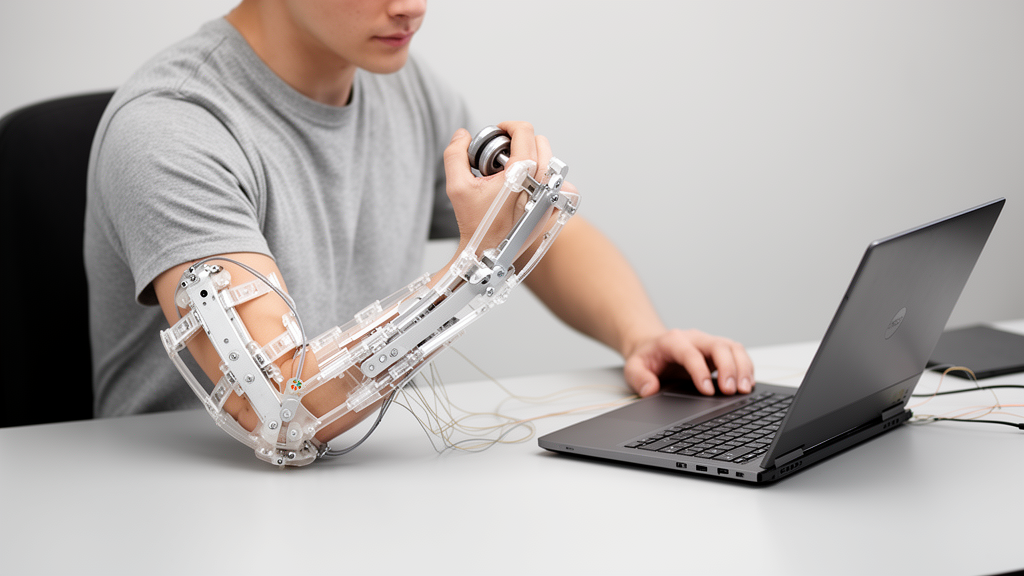
Researchers at Chulalongkorn University have built and tested a low-cost, two-degree-of-freedom upper-limb exoskeleton and used it to map, in detail, how human muscle activity changes as a function of joint angle and the torque applied by a robot. The study, published in Discover Robotics, recorded surface electromyography (sEMG) from ten healthy male participants as they performed shoulder and elbow movements under six different loading conditions, ranging from fixed resistive and assistive torques to a computed gravity-compensation mode that offsets most of the weight of the arm and the device itself.
The prototype was deliberately simple. Two brushless DC motors with integrated controllers and absolute encoders actuate revolute joints at the shoulder and elbow, mounted on a stationary stand with a lightweight five-bar linkage at the elbow to reduce moving inertia. Movement is restricted to the sagittal plane: shoulder flexion and extension and elbow flexion and extension are actively controlled, while forearm pronation and supination and hand movements remain free. By relying on the motors’ internal sensing of angle, angular velocity, and torque, the team avoided secondary external sensors, keeping the platform inexpensive and mechanically uncomplicated.
The exoskeleton operates in two modes. In the constant single joint torque mode, one joint receives a fixed torque command while the other is either locked or left unactuated, allowing isolated evaluation of the elbow or the shoulder. In the gravity compensation mode, actuator torques are computed in real time from the instantaneous joint angles and the user’s body mass and height, using standard anthropometric scaling of segment weights, lengths, and centers of gravity. The gravitational load of the exoskeleton’s own structure was characterized empirically rather than modeled analytically: the elbow actuator’s structural torque was approximated by a constant mean of 0.130 newton-meters, while the shoulder actuator’s torque followed a quadratic profile fitted to experimental data with an R-squared value of 0.949. The user-facing assistance torque is scaled by a directional factor of 0.9, so the controller counteracts roughly ninety percent of the upper limb’s gravitational load.
Ten healthy men aged 21 to 40, with heights of 165 to 180 centimeters and weights of 50 to 80 kilograms, took part after ethical approval and written informed consent. Each had to demonstrate unconstrained active range of motion of at least 165 degrees of shoulder flexion, 40 degrees of shoulder extension, and 140 degrees of elbow flexion. Wireless sEMG sensors were placed on the anterior deltoid, posterior deltoid, biceps, and triceps of the right arm. Each participant completed three sagittal movement tasks, front shoulder flexion to minus 165 degrees, back shoulder extension to 40 degrees, and elbow flexion to minus 140 degrees, each starting and ending at a neutral zero-degree posture. Every task was performed at six torque levels: a zero newton-meter baseline, four fixed torques of minus 3, minus 1, plus 1, and plus 3 newton-meters, and the gravity-compensation profile, with five continuous repetitions per level, totaling 90 repetitions per subject.
Raw sEMG was sampled at 2000 hertz, and a linear RMS envelope with a 100-millisecond window was logged at 150 hertz alongside joint kinematics from the motor controllers. To handle inter-subject variability, the data were standardized with a z-score transformation using each participant’s own zero-torque baseline for the corresponding task, rather than maximum voluntary contraction normalization. This choice precludes direct comparison of absolute activation amplitudes across subjects but provides a robust basis for evaluating relative changes across torque conditions. Static holding phases were excluded, and each movement was split into outbound and return phases, because the constant directional torque assists a movement on one stroke and resists it on the other. First-degree polynomial trendlines were then fitted to the pooled multi-subject data for each task and muscle, with box plots summarizing median, mean, and interquartile range.
The central finding concerns the agonist muscles, those primarily responsible for a given movement. Across all conditions, primary agonists showed a strong, angle-dependent increase in sEMG activity that scaled monotonically with opposing external torque. In graphical terms, changing the applied torque mainly shifted the torque-angle trendline vertically, with subtle changes in slope. During elbow flexion, for example, extreme flexion produced a peak-to-baseline agonist differential of 5.42 standardized units, about 1.6 times the control reference, and a 3 newton-meter resistive torque shifted mean biceps activity by 3 to 3.5 times the control interquartile range. During front shoulder flexion, anterior deltoid activity scaled cleanly from minimum values under minus 3 newton-meters of assistive torque to peak values under plus 3 newton-meters of resistance, with stable trendline slopes that diverged mainly at the extremes of the range of motion.
Non-agonist muscles behaved far less predictably. The triceps, antagonistic during elbow flexion, remained inconclusive in that task but showed a predictable, displacement-dependent rise during elbow extension, peaking under the maximum opposing load of minus 3 newton-meters. For most non-agonist cases, the interquartile range exceeded the differences observed in mean and median values, and looking across loads revealed mostly random, inconsistent patterns. Even among agonist groups during shoulder rotations, the 68 percent confidence intervals overlapped severely, particularly between the zero newton-meter control sets and the moderate plus or minus 1 newton-meter loading sets. The authors attribute this dispersion to inter-subject heterogeneity in baseline physiology and muscle architecture, concluding that individual recruitment strategies exerted a more powerful influence on sEMG amplitude than the discrete variations in externally applied torque.
The gravity compensation mode produced a clear signature that depended on movement direction. During anti-gravity trajectories, elbow flexion, front shoulder flexion, and back shoulder extension, the controller systematically attenuated both agonist and antagonist muscle activity, visible as a downward translation and reduced slope of the sEMG-angle trendlines. Mean agonist activity for the biceps and anterior deltoid fell by 1.5 and 0.2 times the control interquartile range, corresponding to absolute reductions of 0.94 and 1.67 standardized units respectively, while posterior deltoid activity during back shoulder extension declined by 0.1 times the control interquartile range, or 1.71 units. The largest antagonist reduction was in the triceps during elbow flexion, 1.4 times the control interquartile range, or 0.26 units. During gravity-assisted downward movements, however, the controller primarily suppressed antagonist activity while slightly elevating agonist activity, apparently to manage deceleration and stabilization. The anterior deltoid during front shoulder extension dropped by 1.4 times the control interquartile range, while some directional anomalies appeared, such as an elevated mean anterior deltoid activity despite a downward trendline shift during back shoulder flexion.
The authors are careful about the limits of these results. The sample was small, restricted to healthy men performing sagittal-plane movements, so individual variation in muscle mass, force output, and movement mechanics in broader populations and clinical patients was not captured. Pathological motor control, such as abnormal synergy patterns, spasticity, or weakness common after stroke or spinal cord injury, may substantially alter the activation dynamics observed here. The framework also assumes that the motor angle matches the user’s anatomical joint position and that actuator torque represents the net external torque on the limb, neglecting structural deflection and soft-tissue deformation under high torque. The anterior deltoid sensor was placed slightly off its theoretical midpoint to avoid physical interference with the exoskeleton, which may reduce absolute signal amplitude, though the study focused on relative trends between conditions.
What the study offers, within those constraints, is a predictive behavioral framework: quantified relationships between joint angle, applied torque, and muscle activation that could let therapists design targeted interventions with adjustable mechanical loading profiles, without real-time electromyography or external force sensing. Because exoskeletons can modulate joint torque independently across the range of motion, unlike elastic bands or free weights, the same platform can assist, resist, or offload gravity as needed. The team suggests that future control architectures incorporate joint angular velocity and acceleration to dynamically modulate assistance and prevent over-compensation during gravity-aligned movements, and that future studies adopt standardized normalization such as maximum voluntary contraction for rigid cross-participant comparison. As a low-cost testbed for studying control algorithms and neuromuscular response during active human-robot interaction, the prototype fills a gap the authors say existing low-complexity exoskeleton research has left open, while caution remains warranted before extrapolating the findings directly to clinical rehabilitation.
Subject of Research: Muscle activity, joint kinematics, and joint torque relationships during upper-limb exoskeleton-assisted range of motion exercises
Article Title: EMG-based evaluation of relationship between muscle activity, joint kinematics, and joint torque in an upper limb exoskeleton supporting range of motion exercises
Article References: Thanasit, K., & Chaichaowarat, R. (2026). EMG-based evaluation of relationship between muscle activity, joint kinematics, and joint torque in an upper limb exoskeleton supporting range of motion exercises. Discover Robotics, 2(1), Article 29. https://doi.org/10.1007/s44430-026-00045-1
Image Credits: AI Generated
DOI: 10.1007/s44430-026-00045-1
Keywords: upper-limb exoskeleton, surface electromyography, rehabilitation robotics, gravity compensation, joint torque, muscle activation, shoulder flexion, elbow flexion, range of motion exercises, human-robot interaction, sagittal plane movement, z-score normalization
News Source: Denise Maddox. (October 28, 2026). Low-cost upper-limb exoskeleton maps how muscle activity shifts with joint torque. Scienmag.