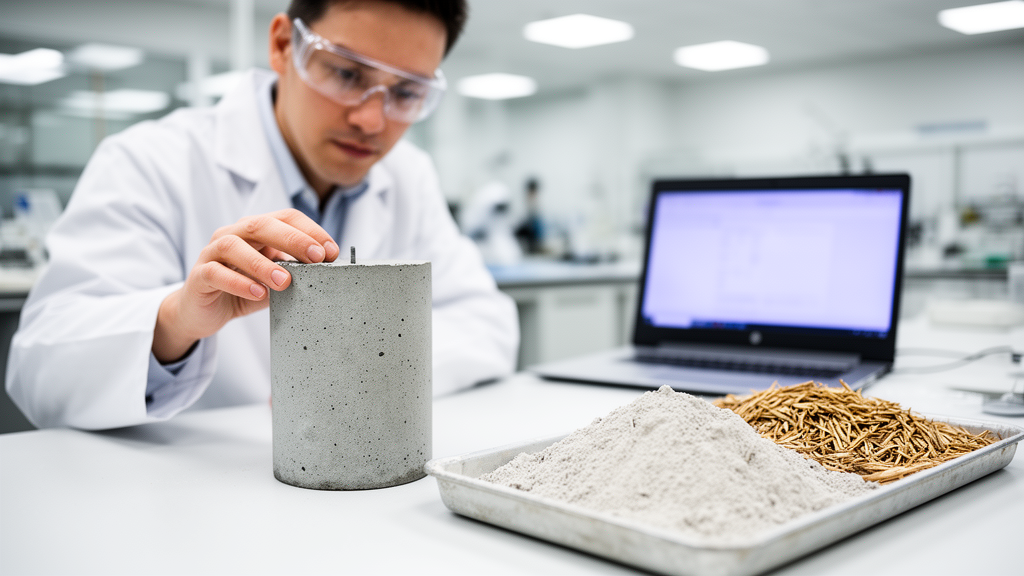
Engineers have built a machine-learning framework that predicts the compressive strength of concrete made with rice husk ash, a supplementary cementitious material that can partially replace ordinary Portland cement. The study, published in Discover Materials on 28 October 2026, draws on published experimental data to train and compare five regression algorithms, aiming to reduce the time and resources consumed by conventional laboratory trial mixes.
Rice husk ash has long attracted interest as a way to make concrete production more sustainable, but optimizing its compressive strength is difficult because mix-design and curing variables interact in complex ways. The research team, led by Kaushal Kumar with co-authors including Nikolai Ivanovich Vatin and Saurav Dixit, compiled a dataset described by nine input variables: rice husk ash replacement level, water-to-cement ratio, curing time, aggregate size, superplasticizer dosage, cement content, fine aggregate content, coarse aggregate content and water content. Compressive strength served as the target variable.
The framework tested four increasingly challenging validation scenarios using five algorithms: linear regression, decision tree, random forest, support vector machine and k-nearest neighbors. Hyperparameters were tuned with GridSearchCV using five-fold cross-validation. In the final optimized comparison, the support vector machine performed best, achieving an R² of 0.875641, a root-mean-square error of 5.919637 MPa and a mean absolute error of 4.813035 MPa. Random forest showed almost similar performance with an R² of 0.860683 and a lower mean absolute percentage error.
Interpretability analysis played a central role in the study. Using SHAP values, partial dependence plots and individual conditional expectation analysis, the researchers found that curing time and the water-to-cement ratio were influential predictors of strength. The authors are careful to frame these findings as associations rather than causal relationships, because several of the mix-design variables are physically coupled to one another, which complicates any causal reading of the model’s behavior.
Performance dropped significantly in the most difficult validation scenario, in which both the cement content and the aggregate size differed from those seen during model training. This result marks the practical limits of the framework: it is intended as a decision-making tool within the range of parameters studied, not as a universal predictor for any rice husk ash concrete mix. The authors state that independent experimental verification is needed before the model is adopted in engineering practice.
The study also emphasizes that the published version is being shared early as peer-reviewed, accepted research, citable with a permanent DOI, and subject to further edits before the final version of record appears.
Subject of Research: Machine learning prediction of compressive strength in rice husk ash concrete
Article Title: Data-driven prediction of compressive strength in rice husk ash concrete using machine learning for sustainable construction
Article References: Kumar, K., Chaudhary, P., Singh, C., Dhanda, A., Sharma, K., Vatin, N. I., Pandey, H., Salmani, R., & Dixit, S. (2026). Data-driven prediction of compressive strength in rice husk ash concrete using machine learning for sustainable construction. Discover Materials. https://doi.org/10.1007/s43939-026-00996-7
Image Credits: AI Generated
DOI: 10.1007/s43939-026-00996-7
Keywords: rice husk ash, concrete, compressive strength, machine learning, sustainable construction, support vector machine, random forest, SHAP, water-to-cement ratio, cement replacement, Data-driven, prediction
News Source: Alan Morgan. (October 29, 2026). Machine learning model predicts strength of rice husk ash concrete. Scienmag.