A bacterium recovered from the Yamuna River in Delhi has been shown in laboratory tests to remove roughly 69 percent of the amoxicillin in a minimal growth medium within 14 days, according to an open-access study published on 20 May 2026 in the journal Discover Bacteria. The strain, designated Burkholderia sp. WA, was isolated using a selective enrichment procedure in which amoxicillin served as the only carbon source, and its removal performance was tracked with ultra-performance liquid chromatography. The authors report that an abiotic control containing the antibiotic but no bacteria showed very little loss over the same period, pointing to the bacteria as the agent of removal rather than spontaneous chemical breakdown.
The work addresses a persistent gap in the treatment of antibiotic pollution. Antibiotic contamination of environmental matrices is described in the study as a major worldwide issue contributing to the spread of antibiotic resistance genes, and although amoxicillin is frequently detected in the environment, the authors note that little is known about its bioremediation. Conventional wastewater treatment techniques are characterized as insufficient to eliminate antibiotics from wastewater, which is why bacteria-based remediation technologies have emerged as a candidate sustainable approach. The new study is presented as the first to use a Burkholderia species demonstrating amoxicillin removal in M9 minimal media.
Amoxicillin’s environmental persistence is well documented in the literature the authors cite. In a closed bottle test referenced in the paper, only 5 percent of amoxicillin was broken down after 28 days of incubation, leading earlier researchers to conclude that the antibiotic would not be effectively degraded in surface water or wastewater treatment plants compared with other antibiotics. The drug is also excreted extensively by users: the paper states that almost 80 percent of an amoxicillin dose is eliminated through urine, with an average half-life of about 1.5 hours, meaning a large fraction of each dose reaches sewage systems in active form.
The sampling site was the Wazirabad region of the Yamuna River, at coordinates 28°40’5.53″ N, 77°15’0.35″ E, chosen because the river carries untreated and partially treated domestic and industrial wastewater from numerous drains into the Wazirabad barrage, which supplies drinking water to Delhi. The paper notes that more than 70 percent of the water supply for the Delhi region is stored in the Yamuna River. Water samples were collected at a depth of approximately 100 centimeters below the surface using a sterile sampling bottle attached to a graduated rope, lowered carefully to minimize surface contamination. Physicochemical parameters including temperature, pH, electrical conductivity, total dissolved solids, and dissolved oxygen were assessed; the measured pH of 7.3 ± 0.27 falls within the US-EPA guideline range of 6.5 to 8.5.
Isolation relied on enrichment rather than direct plating. The autoclaved M9 minimal medium, prepared with defined salts at pH 7.4, was amended initially with 5 mg/L of amoxicillin, and the concentration was subsequently raised stepwise to 50 mg/L, with the antibiotic supplied as the sole carbon source throughout. Purification of the resulting strain was carried out by repeated streaking, and bacteria showing distinct colony morphology were selected. On LB agar, strain WA produced yellowish-brown colonies. Biochemical testing with a Hi-Media KB003 kit showed the strain to be positive for hydrogen sulfide and indole production and negative for sugar utilization reactions.
Antibiotic susceptibility testing by the Kirby-Bauer disc diffusion method on Mueller Hinton agar revealed a multidrug resistance profile. The bacteria were found to be resistant to ampicillin, amikacin, cefadroxil, ciprofloxacin, and amoxicillin; the abstract additionally lists chloramphenicol among the resistances. The minimum inhibitory concentration of amoxicillin against strain WA, determined by broth microdilution in a 96-well plate, was 128 µg/mL, the lowest concentration at which no bacterial growth occurred. Resistance of this kind matters beyond the laboratory: the authors note that wastewater containing amoxicillin-resistant bacteria may allow these organisms to multiply and transfer resistance genes into the wider microbial community.
Molecular identification was performed by amplifying the 16S rRNA gene with the universal bacterial primers 27F and 1492R, followed by Sanger sequencing of the roughly 1.5-kilobase amplicon. BLAST analysis showed the strain’s sequence relationships differently depending on the database used: the results section reports 100 percent similarity to Burkholderia cenocepacia, while the abstract reports 100 percent similarity to Burkholderia cepacia and Burkholderia sp. strain TJ13, and the EZTaxon database placed the strain at 99.93 percent similarity to Burkholderia aenigmatica LMG 13014(T). A Neighbor-Joining phylogenetic tree was constructed in MEGA 12 with 1000 bootstrap repetitions, and the strain was deposited in GenBank under accession number MK 346267.
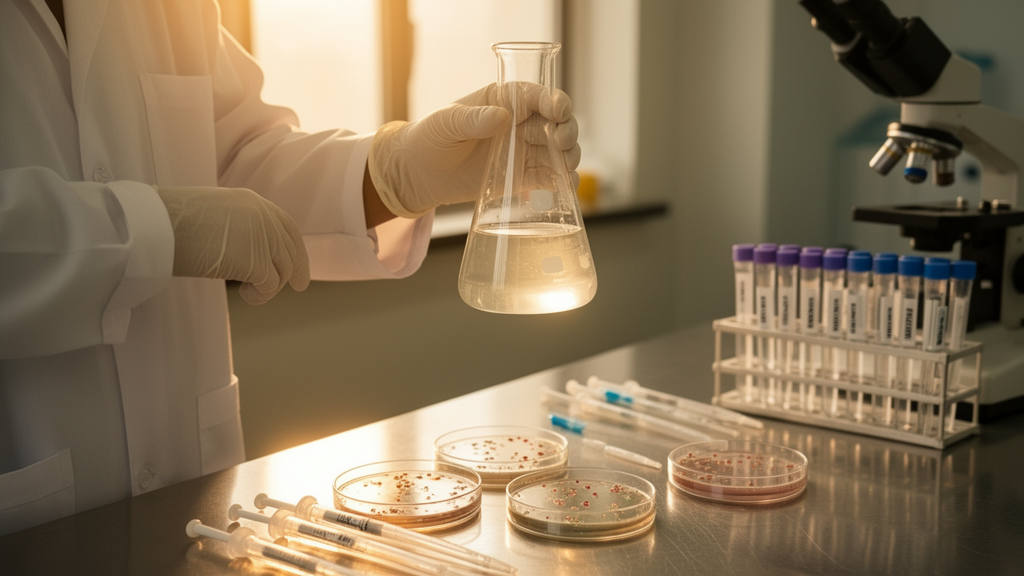
The removal experiment itself was tightly controlled. Because strain WA could not grow in M9 minimal medium beyond 14 days, degradation was monitored over that window at 30 °C and 120 rpm, with aliquots taken on days 0, 7, and 14, filtered through 0.22 µm filters, and analyzed by UPLC on a C18 column with detection at 220 nm. After two weeks, Burkholderia sp. WA had eliminated 68.9 percent of the amoxicillin initially present at 5 mg/L, while the abiotic control showed negligible clearance. Growth in the antibiotic-stressed medium was followed by optical density at 595 nm on days 1, 3, 5, 7, 10, and 14. The authors frame this as a viable method for minimizing antibiotic pollution in soil and water, though the result remains a defined laboratory demonstration in minimal medium rather than a test in real wastewater.
A second line of testing examined the strain’s tolerance of heavy metals, motivated by evidence that metal exposure can co-select for antibiotic resistance. When grown in LB medium supplemented with copper, cadmium, chromium, nickel, or zinc, with optical density measured at 24, 48, and 72 hours, the bacteria showed maximum growth in the presence of zinc and copper, intermediate growth with chromium and nickel, and the least growth with cadmium, identifying cadmium as the most toxic of the five metals to this strain. The authors connect this pattern to the broader literature on co-resistance, noting that shared efflux pumps of the resistance-nodulation-division family, such as acrB, mdtA, and czcA, can export both metals and antibiotics, and that in Burkholderia cepacia the DsbA-DsbB disulfide bond formation system mediates resistance to several antibiotics as well as zinc and cadmium ions.
The findings sit within a small but growing body of work on antibiotic-degrading bacteria. The authors’ own previous studies reported amoxicillin removal by Stenotrophomonas sp. WA5 and Alcaligenes sp. MMA, and other groups have identified degrading strains including Sphingobacterium changzhouense TC931, Serratia marcescens, Stenotrophomonas maltophilia DT1, and Klebsiella sp. strain TR5. A related study cited in the paper isolated a Burkholderia cepacia strain capable of degrading oxytetracycline with an efficiency of 79.20 ± 0.32 percent and other tetracyclines at 82.31 ± 0.62 percent. The authors caution that further research is needed on the coexistence of heavy metal and antibiotic resistance in bacteria, and they suggest that additional in silico work, modeling, and simulation of the underlying metabolic pathways could clarify how bioremediation of amoxicillin at contaminated sites might be improved. For now, the study’s concrete contribution is a characterized river isolate, its resistance profile, its genetic identification, and a measured 68.9 percent removal of amoxicillin under laboratory conditions.
Subject of Research: Bioremediation of the antibiotic amoxicillin by a resistant Burkholderia bacterium isolated from the Yamuna River
Article Title: Characterization and application of Burkholderia sp. WA in mitigating amoxicillin pollution
Article References: Sodhi, K. K., Singh, C. K., & Singh, D. K. (2026). Characterization and application of Burkholderia sp. WA in mitigating amoxicillin pollution. Discover Bacteria, 3(1), Article 14. https://doi.org/10.1007/s44351-026-00052-y
Image Credits: AI Generated
DOI: 10.1007/s44351-026-00052-y
Keywords: Burkholderia, amoxicillin, bioremediation, antibiotic resistance, Yamuna River, water pollution, MIC, UPLC, heavy metals, antimicrobial resistance, M9 minimal medium, 16S rRNA
News Source: Morgan Morrow. (October 29, 2026). River Yamuna Bacterium Removes Most Amoxicillin in Lab Test. Scienmag.