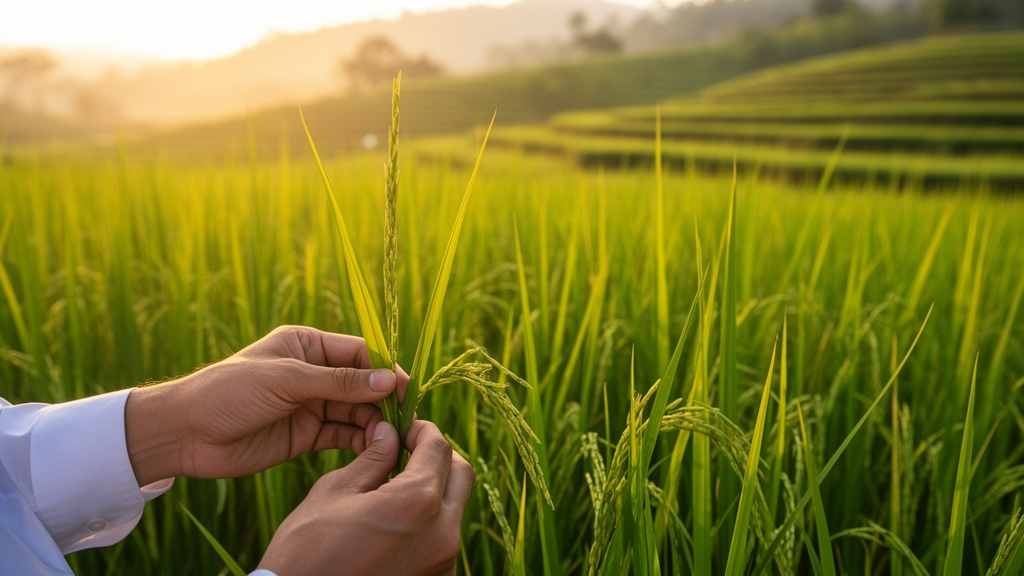
Rice feeds more than half of humanity, and every incremental gain in yield matters as the global population continues to climb. A team of researchers at Anhui Agricultural University in Hefei, China, has now uncovered a key genetic lever that governs one of the most architecturally important traits in the rice plant: the angle at which its uppermost leaves emerge from the stem. In a study published in BMC Plant Biology, the researchers report the identification of a gene named FLBOA9, which they demonstrate acts as a negative regulator of leaf angle in the functional leaves of rice. The discovery, confirmed through genome-wide association analysis and validated with CRISPR/Cas9 gene editing, opens a new avenue for breeding rice plants with more compact canopies that capture sunlight more efficiently and, ultimately, produce more grain.
The angle of the top three leaves on a rice plant, known as the functional leaves because they perform the bulk of the photosynthesis that fills the grain, directly determines the structure of the plant canopy. When these leaves stand more upright, sunlight penetrates deeper into the canopy and reaches lower leaves, improving light-use efficiency across the entire population of plants in a field. When the leaves droop outward at wider angles, the canopy becomes denser at the top, shading the lower layers and wasting incident light. Optimizing these angles is therefore considered a central strategy for developing what breeders call an ideal plant type, an architecture that maximizes photosynthetic capacity and yield. Despite decades of research, the genetic architecture underlying this trait remains incompletely understood, which is precisely the gap the new study set out to close.
To dissect the genetic basis of functional leaf angle, the team assembled a diverse panel of 437 rice accessions, a collection broad enough to capture substantial natural variation in the trait. Each accession was phenotyped for the base angle and the opening angle of the top three leaves, yielding six related traits for analysis. The researchers then genotyped the panel using an exceptionally dense marker set: 3,172,711 high-quality single nucleotide polymorphisms, or SNPs, spread across the rice genome. This resolution allowed them to conduct a genome-wide association study, or GWAS, a statistical approach that scans the entire genome for genetic variants that correlate systematically with differences in a measurable trait. Because leaf angle is a quantitative trait, shaped by many genes each contributing a modest effect, GWAS is particularly well suited to mapping the loci involved.
The association analysis was run under two complementary statistical frameworks, a general linear model and a mixed linear model, to guard against false positives arising from the population structure inherent in a diverse rice panel. Loci that reached the significance threshold in both models were considered robust. In total, the screen identified 44 significant loci associated with the leaf angle traits, and notably, 36 of these were newly discovered in this study, representing a substantial expansion of the known genetic inventory for this trait. Among the significant signals, two sites were co-located in the region controlling both the base angle and the opening angle of the third leaf from the top, suggesting these genomic positions harbor genes with pleiotropic influence over multiple components of leaf geometry. The researchers renamed these two loci qFLBOA3 and qFLBOA9.
With the significant loci in hand, the team moved from statistical association to biological identification. They examined the genes located within the physical intervals of the quantitative trait loci, using functional annotation to predict what each candidate gene might do and haplotype analysis to test whether natural variations in each gene tracked with differences in leaf angle across the 372 accessions and beyond. This filtering process converged on a gene they designated Functional Leaf Base and Opening Angle 9, or FLBOA9, corresponding to the annotated rice gene Os09g0421800 on chromosome 9. Haplotype analysis showed that rice accessions carrying different major versions of this gene displayed statistically significant differences in the angles of their top three functional leaves, consistent with the gene playing a causal role in shaping the trait.
Correlation alone, however, is not proof of function, and this is where the study made its decisive step. Using CRISPR/Cas9 gene-editing technology, the researchers created rice lines in which FLBOA9 was deliberately disrupted. The edited plants showed altered leaf angles compared with unedited controls, confirming that the gene genuinely influences the trait rather than merely sitting near a causal variant. Critically, the direction of the effect established FLBOA9 as a negative regulator of leaf angle: when the gene’s function is removed, the leaf angle changes in a way that indicates the gene normally acts to restrain or widen the angle. In practical breeding terms, a negative regulator is an attractive target because suppressing its activity can push the trait in the desired direction, in this case toward more erect functional leaves and a more compact plant architecture.
The researchers also examined where and how FLBOA9 is expressed, with supplementary data showing its expression pattern across various rice tissues and organs, and they performed off-target analysis for the guide RNA used in the editing experiment, a standard biosafety and specificity check confirming that the CRISPR intervention was precisely directed. Together, these lines of evidence, from genome-wide association through haplotype analysis to targeted mutagenesis, form a coherent chain of proof that satisfies the rigorous standards modern plant genetics demands before a candidate gene is accepted as a validated regulator of an agronomic trait.
What elevates the study beyond single-gene discovery is its forward-looking breeding application. Rather than stopping at FLBOA9, the team considered four genes together: FLBOA9, along with LG5, LC2, and FIB, each contributing to leaf-related architecture. For each gene, they identified the elite allele, the version of the gene associated with the most favorable leaf angle phenotype across the diversity panel. They then performed multi-gene pyramiding prediction, a computational breeding strategy that models what happens when elite alleles from multiple genes are combined in a single line. Using the elite alleles of the four genes, the researchers simulated three different crossing strategies, evaluating which combination scheme would most effectively stack the favorable variants together. The theoretical projections indicated that lines carrying the combined elite alleles would show further reductions in leaf angle beyond what any single gene could achieve, pointing toward the compact plant type that breeders seek.
The significance of this work lies in how it connects fundamental genetics to food security. Leaf angle is not a cosmetic feature; it is a determinant of how efficiently a rice field converts sunlight into grain. Semidwarf varieties with erect upper leaves underpinned the yield gains of the Green Revolution, and the next leap in yield potential is widely expected to come from further optimization of canopy architecture, including through ideal plant type design. By adding FLBOA9 to the breeder’s toolkit and demonstrating a rational, simulation-guided path to combining it with other favorable alleles, the study provides a concrete molecular entry point for that optimization. Because the work relied on natural allelic variation already present in rice germplasm, the favorable haplotypes identified can in principle be introduced into elite cultivars through marker-assisted selection or accelerated with gene editing, approaches that avoid the regulatory and public-acceptance complexities sometimes associated with transgenic methods.
The study, conducted by Yizhuo Ding, Hui Jiang, Yu Geng, Yanan Zhang, and colleagues under the correspondence of Erbao Liu at the School of Agronomy, Anhui Agricultural University, was funded by the Natural Science Foundation of Universities of Anhui Province, the Talent Project of Anhui Agricultural University, and the National Natural Science Foundation of China. As the global population grows and arable land remains fixed, the pressure on staple crops to yield more from the same fields will only intensify. Discoveries like FLBOA9 illustrate how modern genomics, dense SNP panels, association mapping, and precision gene editing can be woven together to translate raw genetic diversity into actionable breeding knowledge. If the multi-gene pyramiding predictions hold up in the field, the erect-leaf rice of the future may trace its lineage directly back to the 437 accessions and 3.1 million genetic variants analyzed in this study, a quiet but consequential step toward feeding a crowded planet.
Subject of Research: Genetic regulation of functional leaf angle in rice by the FLBOA9 gene identified through genome-wide association study and CRISPR/Cas9 validation
Article Title: Candidate gene FLBOA9 identified by genome-wide association acts as a negative regulator for leaf angle of functional leaves in rice
Article References: Ding, Y., Jiang, H., Geng, Y., Zhang, Y., Li, B., Yao, Q., Ang, Y., Yang, Z., & Liu, E. (2026). Candidate gene FLBOA9 identified by genome-wide association acts as a negative regulator for leaf angle of functional leaves in rice. BMC Plant Biology. https://doi.org/10.1186/s12870-026-10017-7
Image Credits: AI Generated
DOI: 10.1186/s12870-026-10017-7
Keywords: rice, FLBOA9, leaf angle, genome-wide association study, GWAS, CRISPR/Cas9, plant architecture, quantitative trait loci, haplotype analysis, gene pyramiding, food security, plant genetics
News Source: Juliet Wilcox. (October 15, 2026). Rice Gene FLBOA9 Revealed as Master Switch Controlling Leaf Angle for Higher Yields. Scienmag.