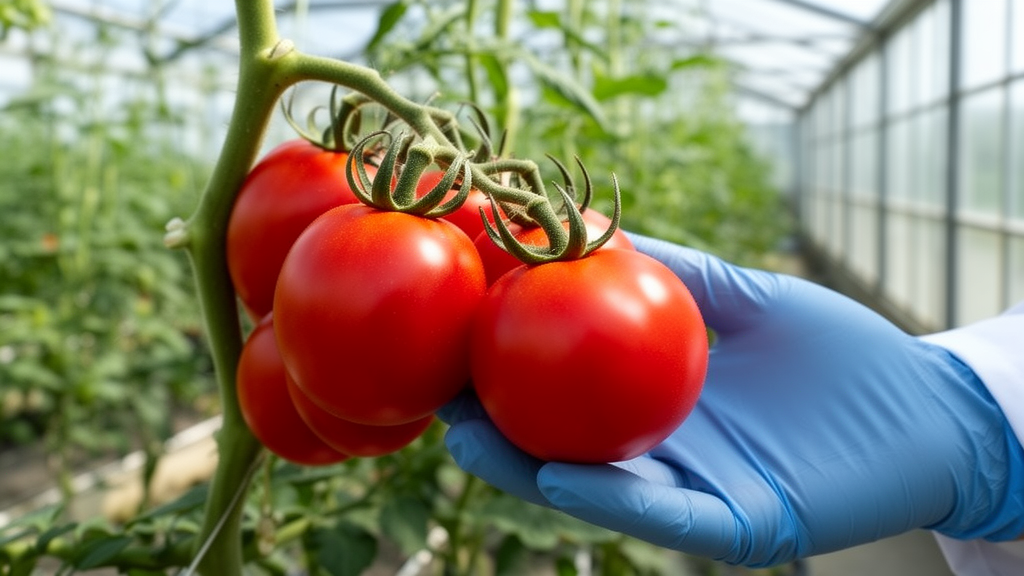
Tomatoes have long been bred to look perfect on the shelf, but a new study shows that the very mutation breeders chose to make the fruit ripen evenly quietly stripped away some of its nutritional value. Now, researchers at the Japan International Research Center for Agricultural Sciences (JIRCAS) have used CRISPR genome editing to switch that lost gene function back on, restoring the fruit’s green shoulder, boosting its sugar and vitamin E content, and demonstrating a striking new way to undo the hidden costs of crop domestication. The work, published in Plant Cell Reports, offers the first proof of concept that a simple, conventional genome editing technique can revive a gene that crop improvement had inadvertently silenced.
The gene at the heart of the story is SlGLK2, a transcription factor that controls the development of plastids, the tiny compartments inside plant cells where chlorophyll is built and where many of the compounds that make fruit nutritious are synthesized. In wild tomatoes, SlGLK2 is fully functional, and the fruit develops a pronounced green shoulder at the stem end, a patch of chlorophyll-rich tissue that signals healthy plastid development. But during the twentieth century, breeders selected a mutation called uniform ripening, or u, a single-base insertion in the SlGLK2 coding sequence that throws the gene’s reading frame out of alignment. The insertion creates a premature stop codon, truncating the protein before it can reach its DNA-binding and dimerization domains. The result is fruit that ripens into an even red without any green patches, a trait consumers found appealing, but one that comes with fewer plastids and lower levels of sugars and tocopherols in the ripe fruit.
That trade-off is a textbook example of what plant scientists call domestication-associated genetic trade-offs, where selecting for one desirable trait inadvertently fixes alleles that compromise others. The u allele has been widely adopted across cultivated tomato varieties, and its effects on fruit quality have been documented since Powell and colleagues first cloned the gene in 2012. But the JIRCAS team, Kentaro Ezura and Cheolwoo Park, wondered whether the damage could be repaired not by restoring the original wild-type sequence, which would require a precise repair template, but by introducing a second, compensatory mutation nearby that would shift the reading frame back into alignment. If the protein could tolerate a few extra or missing amino acids in a disordered linker region, the gene might be reactivated without ever needing to recreate the exact ancestral sequence.
To test the idea, the researchers turned to a temperature-tolerant version of LbCas12a, a CRISPR nuclease derived from a Lachnospiraceae bacterium, which carries a single D156R mutation that enhances its activity at low temperatures. Cas12a is particularly well suited to targeting A/T-rich sequences, and the insertion site in the u allele sits within just such a region, which had proven difficult to target with standard Cas9. The team built a genome editing vector carrying a crRNA directed against the SlGLK2 target site and introduced it into the Micro-Tom tomato cultivar, a miniature model system that carries the non-functional u allele. Agrobacterium-mediated transformation produced three independent T0 lines carrying mutations near the target site.
One of those lines, CR-Slglk2 #2, immediately caught the researchers’ attention because its mature green fruit developed green shoulders at the stem end, a phenotype resembling that of the functional U allele. Direct sequencing revealed that the plant carried biallelic mutations: a 4-bp deletion on one chromosome and a 13-bp deletion on the other. The 13-bp deletion, designated CR-Slglk2-4, caused a frameshift that restored the normal reading frame, while the 4-bp deletion, CR-Slglk2-3, produced another premature stop codon. The researchers then generated homozygous T1 lines for each allele and compared them side by side with unedited Micro-Tom. Fruits of the CR-Slglk2-3 line, which did not restore the reading frame, looked essentially identical to unedited fruit. But fruits of the CR-Slglk2-4 line, carrying the frame-restoring deletion, produced the green shoulder phenotype consistently, and accumulated significantly more chlorophyll at the immature green stage than either the unedited control or the CR-Slglk2-3 line.
Biochemical analysis of fully ripe fruit confirmed that the frame restoration had real consequences for fruit quality. Total soluble solids, measured as degrees Brix, rose from 6.3 in unedited Micro-Tom to 7.4 in the edited line, a significant increase that reflects higher sugar content. Total tocopherol content, comprising the α, β, γ, and δ forms of vitamin E, increased from 37.25 to 62.05 micrograms per gram of fresh weight, driven mainly by higher α- and γ-tocopherol levels. In contrast, lycopene and β-carotene contents, fruit weight, and fruit dimensions remained unchanged, suggesting that the restoration selectively enhanced several quality-related traits without substantially altering fruit morphology. Off-target analysis using Cas-OFFinder-bulge, which searched the tomato SL4.0 reference genome under both mismatch-only and bulge-permissive conditions, detected only the intended target site under standard conditions, and direct sequencing confirmed that the single additional candidate site identified under the bulge-permissive condition remained unedited.
To validate that the frame-restored allele had genuinely recovered SlGLK2 protein function, the researchers turned to a battery of molecular assays. Quantitative RT-PCR showed that SlGLK2 transcript levels were consistently higher in CR-Slglk2-4 fruit than in unedited fruit at all examined positions along the stem-to-tip axis, and that the characteristic spatial gradient of SlGLK2 expression, higher at the stem end than at the stylar end, was preserved in the edited line. This suggests that the uniform ripening phenotype of the u allele results primarily from loss of SlGLK2 protein activity rather than from an altered expression pattern, and that the frame-restored allele recovered protein function while maintaining the gene’s native spatial regulation. Full-length cDNA sequencing confirmed that the mutation did not affect splicing patterns, and predictions using LOCALIZER and NLStradamus showed that the additional deletion did not alter the nuclear localization signal upstream of the MYB-like DNA-binding domain.
Subcellular localization assays using sfGFP-tagged proteins expressed in Nicotiana benthamiana leaves showed that both the functional SlGLK2-U protein and the frame-restored SlGLK2-CR4 protein localized to the nucleus, whereas no fluorescent signal was detected for the truncated SlGLK2-u protein. Transcriptomic analysis of immature green fruit pericarps, performed with RNA-seq on an Illumina NovaSeq X Plus platform, identified 161 genes upregulated and 26 genes downregulated in the stem end of CR-Slglk2-4 fruit compared with the u allele. Of the 161 upregulated genes, 62 overlapped with genes upregulated in a previously published SlGLK2-overexpression line, and 34 of those 62 genes carried significant SlGLK2 binding signals in prior chromatin immunoprecipitation sequencing data, making them candidates for direct regulation. Gene ontology enrichment analysis of the commonly upregulated gene set revealed overrepresentation of chloroplast- and photosynthesis-associated terms, including chlorophyll biosynthetic process, photosystem I light harvesting, and chloroplast thylakoid lumen, confirming that the frame-restored allele had reactivated the downstream transcriptional program associated with plastid biogenesis.
Quantitative RT-PCR validation of seven genes present in both the transcriptomic and ChIP-seq datasets confirmed their elevated expression in CR-Slglk2-4 fruit. These included protochlorophyllide reductase B (SlPORB), Mg-protoporphyrin IX monomethyl ester cyclase (SlMPEC), geranylgeranyl diphosphate reductase (SlGGDR), chlorophyll a-b binding protein 1C (SlCAB1C), light-harvesting complex B2 (SlLHCB2), lycopene epsilon-cyclase (SlLCYE), and a CONSTANS-like zinc finger transcription factor. To directly test whether the frame-restored SlGLK2-CR4 protein retained transcriptional activation activity, the researchers performed a transient dual-luciferase reporter assay in Nicotiana benthamiana leaves using the promoter of SlLHCB2, a previously identified direct target of SlGLK2. Co-expression of SlGLK2-CR4 significantly increased the firefly-to-Renilla luciferase ratio compared with the sfGFP negative control, providing functional evidence that the reframed protein can activate a representative photosynthesis-related target gene.
The broader significance of the work lies in what it says about the latent potential hiding in crop genomes. Many domestication and improvement events have silently disabled genes through frameshift mutations and premature stop codons, converting them into non-processed pseudogenes whose transcripts may still be detectable even though the protein is truncated. The JIRCAS team notes that cultivated tomatoes carry several such disabled alleles, including an in-frame six-base insertion in the SlHAK20 transporter associated with salt tolerance loss, a C-to-T substitution in SlBBX18 that increases drought sensitivity, and a deleterious mutation in the SUPPRESSOR OF SP2 gene that was recently repaired by base editing to enable early fruit yield. The reframing strategy demonstrated here, which requires neither a repair template nor precise restoration of the wild-type sequence, offers a technically accessible route to recover useful gene functions directly within cultivated genetic backgrounds, avoiding the linkage drag that complicates conventional introgression from wild relatives. Its broader applicability will depend on the location and type of the original mutation, the availability of suitable target sites, and the structural tolerance of the encoded protein, but the approach expands the conventional use of nuclease-based genome editing from gene disruption to functional gene reactivation, opening a new chapter in the effort to recover traits lost during plant domestication.
Subject of Research: Restoration of the tomato uniform ripening gene SlGLK2 by compensatory frameshift genome editing
Article Title: Reactivation of a loss-of-function SlGLK2 allele by frame-restoring genome editing in tomato
Article References: Reactivation of a loss-of-function SlGLK2 allele by frame-restoring genome editing in tomato. (n.d.). https://doi.org/10.1007/s00299-026-04024-z
Image Credits: AI Generated
DOI: 10.1007/s00299-026-04024-z
Keywords: SlGLK2, tomato, uniform ripening, CRISPR-Cas12a, genome editing, plastid development, chlorophyll, tocopherol, domestication trade-offs, Plant Cell Reports, Reactivation, loss-of-function
News Source: Juliet Wilcox. (October 15, 2026). CRISPR frame-restoring edit revives lost tomato gene and boosts fruit nutrition. Scienmag.