• HOME
  • NEWS
  • EXPLORE
    • CAREER
      • Companies
      • Jobs
    • EVENTS
    • iGEM
      • News
      • Team
    • PHOTOS
    • VIDEO
    • WIKI
  • BLOG
  • COMMUNITY
    • FACEBOOK
    • INSTAGRAM
    • TWITTER
Tuesday, July 7, 2026
BIOENGINEER.ORG
No Result
View All Result
  • Login
  • HOME
  • NEWS
  • EXPLORE
    • CAREER
      • Companies
      • Jobs
        • Lecturer
        • PhD Studentship
        • Postdoc
        • Research Assistant
    • EVENTS
    • iGEM
      • News
      • Team
    • PHOTOS
    • VIDEO
    • WIKI
  • BLOG
  • COMMUNITY
    • FACEBOOK
    • INSTAGRAM
    • TWITTER
  • HOME
  • NEWS
  • EXPLORE
    • CAREER
      • Companies
      • Jobs
        • Lecturer
        • PhD Studentship
        • Postdoc
        • Research Assistant
    • EVENTS
    • iGEM
      • News
      • Team
    • PHOTOS
    • VIDEO
    • WIKI
  • BLOG
  • COMMUNITY
    • FACEBOOK
    • INSTAGRAM
    • TWITTER
No Result
View All Result
Bioengineer.org
No Result
View All Result
Home NEWS Science News Chemistry

Respiratory droplet motion, evaporation and spread of COVID-19-type pandemics

Bioengineer by Bioengineer
June 30, 2020
in Chemistry
Reading Time: 3 mins read
0
IMAGE
Share on FacebookShare on TwitterShare on LinkedinShare on RedditShare on Telegram

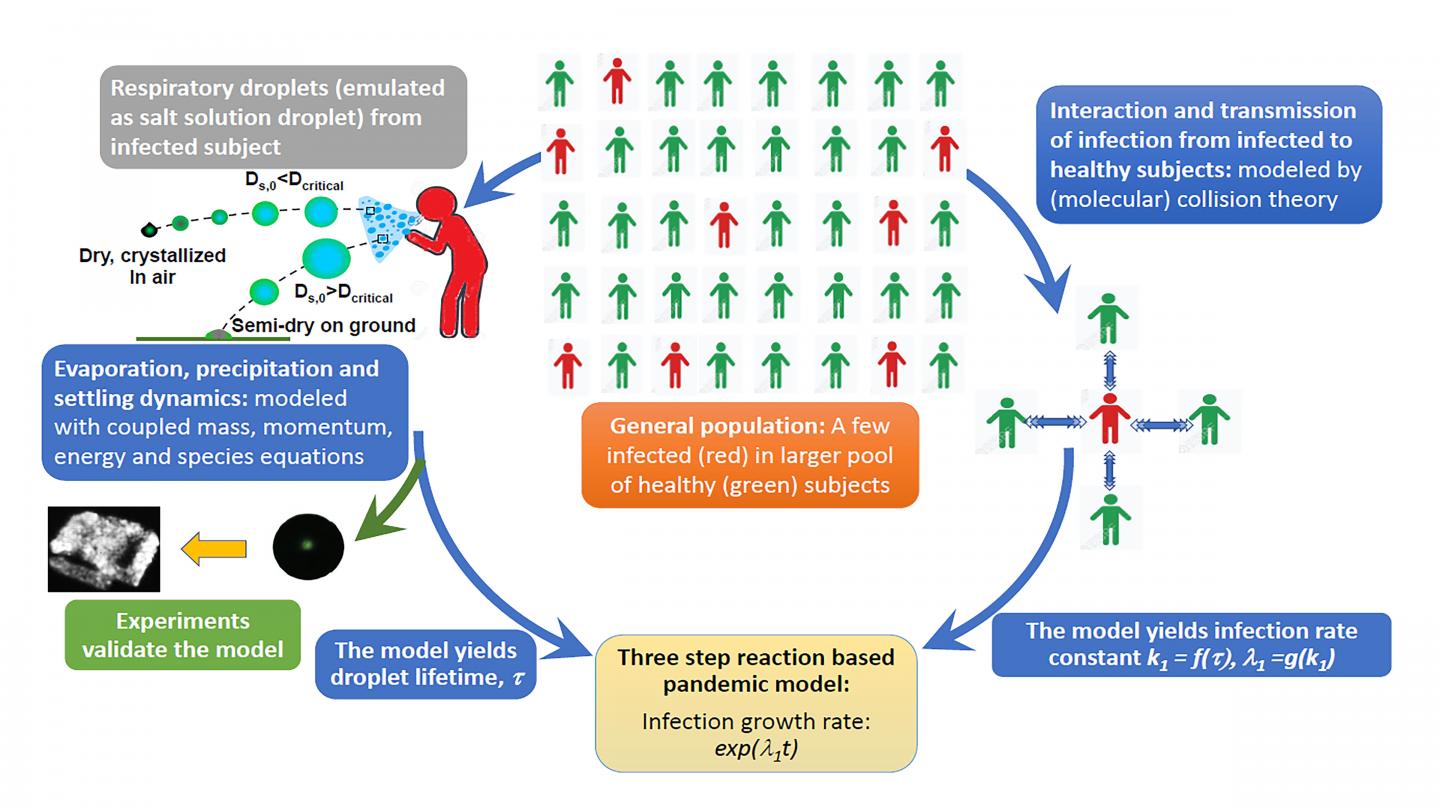
Mathematical model sheds light on the motion and evaporation of respiratory droplets responsible for disease transmission
IMAGE

Credit: Swetaprovo Chaudhuri, Saptarshi Basu, Prasenjit Kabi, Vishnu R Unni and Abhishek Saha

WASHINGTON, June 30, 2020 — It is well established that the SARS-CoV-2 virus responsible for the COVID-19 disease is transmitted via respiratory droplets that infected people eject when they cough, sneeze or talk. Consequently, much research targets better understanding droplet motion and evaporation to understand transmission more deeply.

In a paper in Physics of Fluids, by AIP Publishing, researchers developed a mathematical model, proceeding from first principles, for the early phases of a COVID-19-like pandemic using the aerodynamics and evaporation characteristics of respiratory droplets.

The researchers modeled the pandemic dynamics with a reaction mechanism, wherein each reaction has a rate constant obtained by calculating the droplet collision frequency. They then compared the droplet cloud ejected by an infected person versus one by a healthy person.

“The size of the droplet cloud, the distance it travels, and the droplet lifetimes are, therefore, all important factors that we calculated using conservation of mass, momentum, energy and species,” said Swetaprovo Chaudhuri, one of the authors.

The model could be used to estimate approximately how long droplets can survive, how far they can travel, and which size of droplet survives for how long. Though, as Chaudhuri adds, “The actual situation could be complicated by wind, turbulence, air-recirculation or many other effects.”

“Without wind and depending on the ambient condition, we found droplets travel between 8 to 13 feet before they evaporate or escape,” said Abhishek Saha, a co-author.

This finding implies that social distancing at perhaps greater than 6 feet is essential.

Furthermore, the initial size of the longest surviving droplets is in the range of 18-50 microns, meaning masks can indeed help. These findings could help inform reopening measures for schools and offices looking at student or employee density.

“This model is not claiming to predict the exact spread of COVID-19,” said Saptarshi Basu, another author. “But, our work shows that droplet evaporation or desiccation time is highly sensitive to the ambient temperature and relative humidity.”

More broadly, this multiscale model and the firm theoretical underpinning that connects the two scales — macroscale pandemic dynamics and the microscale droplet physics — could emerge as a powerful tool in clarifying the role of environment on infection spread through respiratory droplets.

###

The article, “Modeling the role of respiratory droplets in Covid-19 type pandemics,” is authored by Swetaprovo Chaudhuri, Saptarshi Basu, Prasenjit Kabi, Vishnu R. Unni and Abhishek Saha. The article will appear in Physics of Fluids on June 30, 2020 (DOI: 10.1063/5.0015984). After that date, it can be accessed at https://aip.scitation.org/doi/10.1063/5.0015984.

ABOUT THE JOURNAL

Physics of Fluids is devoted to the publication of original theoretical, computational, and experimental contributions to the dynamics of gases, liquids, and complex or multiphase fluids. See https://aip.scitation.org/journal/phf.

Media Contact
Larry Frum
[email protected]

Related Journal Article

http://dx.doi.org/10.1063/5.0015984

Tags: BiologyBiomechanics/BiophysicsChemistry/Physics/Materials SciencesInfectious/Emerging DiseasesMedicine/HealthVirology
Share12Tweet8Share2ShareShareShare2

Related Posts

Salt adaptation linked to higher disease risk, Mizzou study finds

Salt adaptation linked to higher disease risk, Mizzou study finds

July 6, 2026
Intelligent Microgrid Management Promises Lower Household Energy Bills and Reduced Diesel Emissions — Chemistry

Intelligent Microgrid Management Promises Lower Household Energy Bills and Reduced Diesel Emissions

July 4, 2026

Graz University of Technology Deciphers the Structural Secrets of MOF Thin Films

July 2, 2026

Breaking Thermodynamic Limits: Wavelength-Driven Catalysis Advances Ammonia Synthesis

July 2, 2026
Please login to join discussion

POPULAR NEWS

  • Detection of EDCs in Breast Milk and Infant Urine Up to Six Months Highlights Early Exposure Risks

    77 shares
    Share 31 Tweet 19
  • New Drug Candidate Developed at McMaster Shows Potential for Treating Brain Cancer

    58 shares
    Share 23 Tweet 15
  • Saying Goodbye to PGY-6: Pediatric Fellowship Realities

    103 shares
    Share 41 Tweet 26
  • KTU Researchers Explore Ultrasound’s Role in Enhancing Blood Flow Beyond Diagnostics

    53 shares
    Share 21 Tweet 13

About

We bring you the latest biotechnology news from best research centers and universities around the world. Check our website.

Follow us

Recent News

Flame retardant BDE-209 targets molecularly linked to ulcerative colitis

Ultra-high frequency particle impacts mimic rockbursts to shatter hard rock

Kidney transplant outcomes in older adults studied by German researchers

Subscribe to Blog via Email

Enter your email address to subscribe to this blog and receive notifications of new posts by email.

Join 83 other subscribers
  • Contact Us

Bioengineer.org © Copyright 2023 All Rights Reserved.

Welcome Back!

Login to your account below

Forgotten Password?

Retrieve your password

Please enter your username or email address to reset your password.

Log In
No Result
View All Result
  • Homepages
    • Home Page 1
    • Home Page 2
  • News
  • National
  • Business
  • Health
  • Lifestyle
  • Science

Bioengineer.org © Copyright 2023 All Rights Reserved.