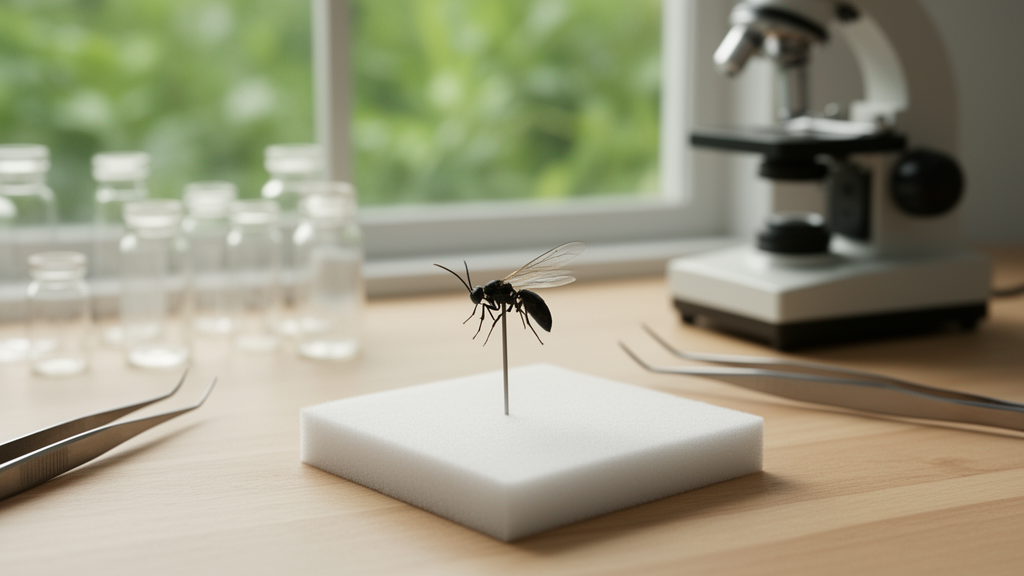
A tiny parasitoid wasp genus never before recorded in South Korea has turned up there in two forms: one entirely new to science and one already known from Japan and Russia. The genus Paralipsis, a specialized group of endoparasitoid wasps in the braconid subfamily Aphidiinae, is restricted to the Palaearctic region and, unlike most of its relatives, attacks aphids living hidden underground on plant roots rather than on the parts of plants above ground. Until now, only one of its six described species, Paralipsis eikoae, had been recorded from the Eastern Palaearctic. A new study reports both P. eikoae and a newly described species, P. triangulata, from South Korea, along with detailed observations of how these wasps live inside ant colonies.
The new species was named Paralipsis triangulata after a distinct triangular lamellate projection on the outer basal margin of its fore femur, a structure not seen in P. eikoae. The propodeum and scutellum bear strong, deep rugosities, and the antennae are sixteen-segmented with longitudinal placodes beginning at the fourth flagellomere.
All specimens of P. triangulata were collected from unidentified root-aphid colonies on the roots of Miscanthus grass, attended by the ant Lasius koreanus. The parasitized aphids formed black mummies attached to the roots and basal subterranean parts of the plants. P. eikoae, by contrast, was collected from within nests of Lasius japonicus, where no aphids were observed at the time of collection. The specimens were gathered during April and May of 2024, 2025, and 2026, either by collecting aphid mummies from Miscanthus roots or by turning over stones and hand-collecting adults found beneath them together with ants.
To characterize the new species, the researchers provided morphological descriptions with high-resolution photographs and sequence data for seven gene regions: the mitochondrial genes COI, COII, Cytb, and ND1, and the nuclear genes 28SD2, EF1-alpha, and Wingless. For comparisons among Paralipsis species, only COI was used, because comparable sequences were available in GenBank for other members of the genus. The analysis combined two Korean COI sequences generated in this study with fifteen GenBank sequences representing four additional Paralipsis species, yielding seventeen ingroup sequences across six species, with two Pauesia sequences as outgroups.
The resulting COI gene tree recovered two strongly supported ingroup clades. The first contained P. enervis as sister to P. brachycaudi, and P. tibiator as sister to the new P. triangulata. The second clade paired P. eikoae with P. rugosa. Mean intraspecific COI distances ranged from 0.000 to 0.027, averaging 0.012, while interspecific distances spanned 0.042 to 0.089, averaging 0.065. The distance between P. triangulata and P. tibiator averaged 0.042, and the pairwise distance between P. eikoae and P. rugosa was 0.069. Species delimitation analyses using ABGD and bPTP produced largely congruent results, although bPTP further split P. brachycaudi and P. tibiator each into two groups. The authors treat these subdivisions as provisional molecular groups, noting that the divergences remain lower than typical interspecific distances and do not by themselves establish additional species.
The behavioral observations, conducted in laboratory colonies maintained in breeding dishes with honey water, revealed a striking repertoire of myrmecophilous adaptations in both species. P. triangulata repeatedly mounted the dorsal surface of ant workers in a characteristic riding posture: fore legs flexed mantis-like, the body positioned between the ant’s legs, fore legs grasping the petiole and fore coxa while the middle tibia sawed repeatedly against the ant’s gaster. The ridden ants generally stopped moving and lowered their posture, apparently accepting the behavior, which lasted up to six minutes when uninterrupted. Riding was frequently followed by the ants grooming the wasp’s body and by trophallaxis, the direct exchange of liquid food, which occurred especially often after honey water was provided. The wasps actively solicited trophallaxis by tapping the ants’ mandibles with their antennae and fore legs.
Both species also showed a distinctive antenna-cleaning behavior, licking the fore tibial spur with their mouthparts and then hooking the base of the antennae with the spur, pushing it distally to clean the antenna with a dense comb of setae on the basitarsus. P. eikoae displayed the same riding, scraping, grooming, and trophallactic interactions. These behaviors echo earlier work on P. eikoae in Japan, where riding and rubbing against ant workers were suggested to facilitate the acquisition and maintenance of colony-specific chemical cues, and where similarities between the cuticular hydrocarbon profiles of accepted females and resident ant workers were reported. The authors caution, however, that behavioral similarity alone does not demonstrate a shared chemical function, and hydrocarbon transfer was not chemically tested in the present study.
Perhaps the most intriguing observations concern the wasps’ wings. Truncated wings have long been reported in Paralipsis and traditionally attributed to mutilation by aphid-attending ants, but direct observation of ant-mediated wing cutting has never been reported, and earlier studies questioned whether ants are the sole cause. In the new study, one female P. eikoae was collected with fully intact wings and was subsequently observed repeatedly pulling its wings posteriorly with the apical parts of the hind tibiae; although the actual loss of wing tissue was not witnessed, part of the posterior margin of the forewing was later found missing. All examined P. triangulata females were already wing-damaged when collected in late April, and these individuals were seen pulling their ragged wings with the hind tibiae, which reached approximately the damaged regions. Neither ant-mediated removal nor direct self-removal of wing tissue was observed, so the mechanism behind the wing damage remains unresolved.
A single cross-colony transfer experiment added a further layer of complexity. On 9 May 2026, one adult P. triangulata was introduced into a different Lasius koreanus colony roughly 300 meters from its origin. Workers surrounded the newcomer, repeatedly bit and pulled its legs and antennae, and after about three hours the wasp was found dead with antennae and legs severed. A worker from the wasp’s source colony introduced alongside it was killed in the same manner. The authors emphasize this rests on a single trial, but it suggests that successful integration may depend on colony-specific recognition cues rather than ant species identity alone, a pattern resembling earlier reports that foreign-colony P. eikoae females could eventually be accepted after riding and rubbing.
Based on prior seasonal studies of P. eikoae, the authors propose a possible female life-history sequence: fully winged females emerge from overwintered mummies in spring, disperse, enter an ant-attended root-aphid colony, undergo colony integration and wing reduction, and then enter a resident phase before reproductive maturation and oviposition later in the season. The wing-damaged P. triangulata females found in late April, together with their riding, grooming, and trophallactic interactions, suggest this species may undergo a comparable transition. Much remains unknown, however: neither the timing of colony entry nor wing loss was directly observed, all specimens examined were female, mating was not witnessed, and the reproductive diapause, seasonal ovarian development, and overwintering biology of P. triangulata have yet to be studied. Confirming whether the two species share the same annual cycle will require direct seasonal observations.
Subject of Research: First record of the myrmecophilous root-aphid parasitoid wasp genus Paralipsis in South Korea, with a new species description and behavioral observations
Article Title: First record of the genus Paralipsis Förster, 1863 ( Hymenoptera , Braconidae , Aphidiinae ) from South Korea, with description of a new species and report of a newly recorded species
Article References: Kim, S., Yoon, S., & Kim, H. (2026). First record of the genus Paralipsis Förster, 1863 (Hymenoptera, Braconidae, Aphidiinae) from South Korea, with description of a new species and report of a newly recorded species. Journal of Hymenoptera Research, 99, 1187-1213. https://doi.org/10.3897/jhr.99.208537
Image Credits: AI Generated
Keywords: Paralipsis, Braconidae, Aphidiinae, parasitoid wasps, myrmecophily, Lasius ants, root aphids, South Korea, new species, COI barcoding, trophallaxis, wing damage
News Source: Drew Townsend. (October 29, 2026). Research report: First record of the genus Paralipsis Förster, 1863 ( Hymenoptera , Braconidae , Aphidiinae ) from South Korea, with description of a new species and report of a newly recorded species. Scienmag.