


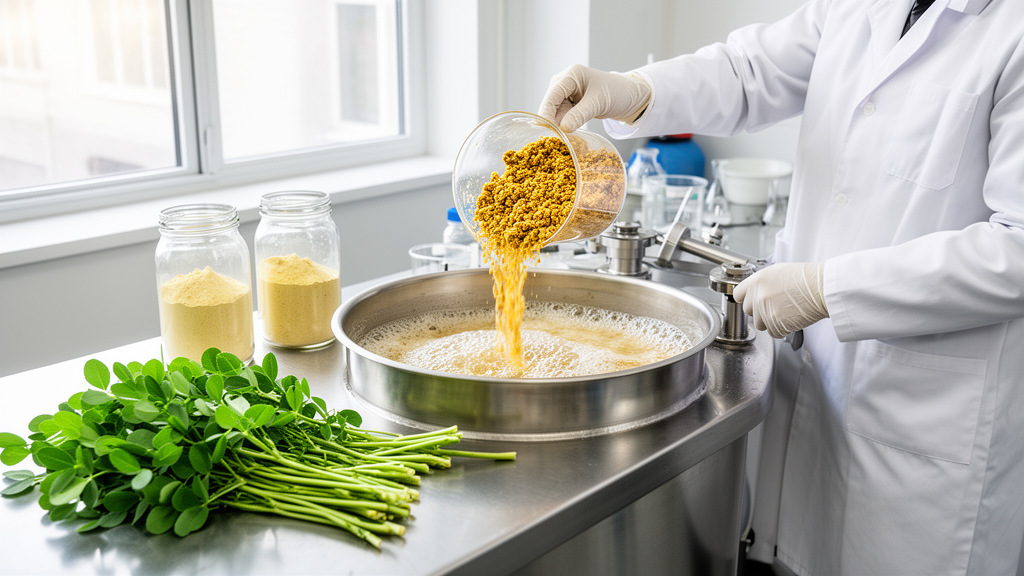
Alfalfa, one of the world’s most widely grown forage crops, carries substantial carbohydrate fractions that largely go unused in animal feed. A new laboratory study reports that these sugars can be converted into a protein-rich yeast product, raising the crude protein content of the biomass roughly 2.1-fold to about 40 percent. The work, published in AMB Express, optimized enzymatic hydrolysis of alfalfa biomass and then evaluated single-cell protein production using two yeasts, Candida utilis and Komagataella pastoris.
The hydrolysis step showed biphasic sugar release kinetics, meaning sugars came off the biomass in two distinct phases. By tuning enzyme loading, the researchers raised the monomeric sugar yield from 18.5 percent to a maximum of 33.0 percent, a 78 percent relative increase, achieved at an enzyme loading of 22 mg protein per gram of biomass. That figure sets the ceiling on how much fermentable sugar the process can currently extract from the raw material.
The two yeasts then revealed clearly different metabolic strengths. Candida utilis consumed 23 percent more total sugars than Komagataella pastoris, with particularly enhanced pentose utilization: it consumed 45 percent more xylose, the five-carbon sugar abundant in hemicellulose that many industrial microbes handle poorly. Komagataella pastoris, by contrast, grew 51 percent faster than C. utilis. Notably, both yeasts produced comparable protein yields per unit of sugar consumed, so the choice of organism may hinge on sugar spectrum and speed rather than final protein output.
Nutritional profiling of the resulting product showed meaningful gains. Fermentation substantially improved several essential amino acids relative to FAO/WHO reference values, particularly lysine, threonine and methionine, based on profiling that excluded tryptophan. However, the combined methionine-plus-cysteine ratio remained below the FAO reference in both yeasts, at 0.99 for K. pastoris and 0.87 for C. utilis. Sulfur-containing amino acids therefore remain the limiting factor despite the overall nutritional improvement, a detail that matters for any future feed application.
At the integrated process level, the team reported a 27.6 percent carbohydrate-to-biomass conversion efficiency and an 11.3 percent carbohydrate-to-protein conversion efficiency, calculated from measured monomeric sugars. The authors note that oligosaccharide utilization during fermentation was not independently quantified, so these efficiencies rest on the monomeric sugar fraction alone.
The researchers frame the work as a promising lab-scale strategy for alfalfa valorization rather than an industrial recipe. Techno-economic analysis, animal feeding trials and scale-up studies are all required before cost-effectiveness or industrial readiness can be established. Enzyme costs, sugar yields and fermentation performance at laboratory scale do not automatically translate to economically viable production.
Even so, the study addresses a real bottleneck. Alfalfa’s carbohydrate fractions are underutilized in feed, and microbial protein offers a route to upgrade low-value forage into a more balanced protein source without relying on dedicated protein crops. The comparison between the two yeasts also gives follow-up work a clear direction: pairing C. utilis’s superior pentose consumption with faster-growing strains could push conversion efficiencies higher.
For now, the headline numbers stand as measured observations from a controlled laboratory bioprocess: a 78 percent relative gain in sugar yield, roughly 40 percent crude protein in the final product, and a defined amino acid limitation that future strain engineering or co-fermentation strategies will need to solve.
Subject of Research: Lab-scale production of single-cell protein from enzymatically hydrolyzed alfalfa biomass using two yeast species.
Article Title: Single-cell protein production from alfalfa biomass using Candida utilis and Komagataella pastoris
Article References: Kousar, S., Hussain, S., Ali, Q., Islam, M. Z., Zhang, Y., & Zhang, L. (2026). Single-cell protein production from alfalfa biomass using Candida utilis and Komagataella pastoris. AMB Express. https://doi.org/10.1186/s13568-026-02108-3
Image Credits: AI Generated
DOI: 10.1186/s13568-026-02108-3
Keywords: single-cell protein, alfalfa, Candida utilis, Komagataella pastoris, enzymatic hydrolysis, animal feed, amino acids, fermentation, bioprocess, yeast, Single-cell, protein
News Source: Gregory Coleman. (October 30, 2026). Yeasts Turn Alfalfa Biomass Into Protein-Rich Single-Cell Feed. Scienmag.



