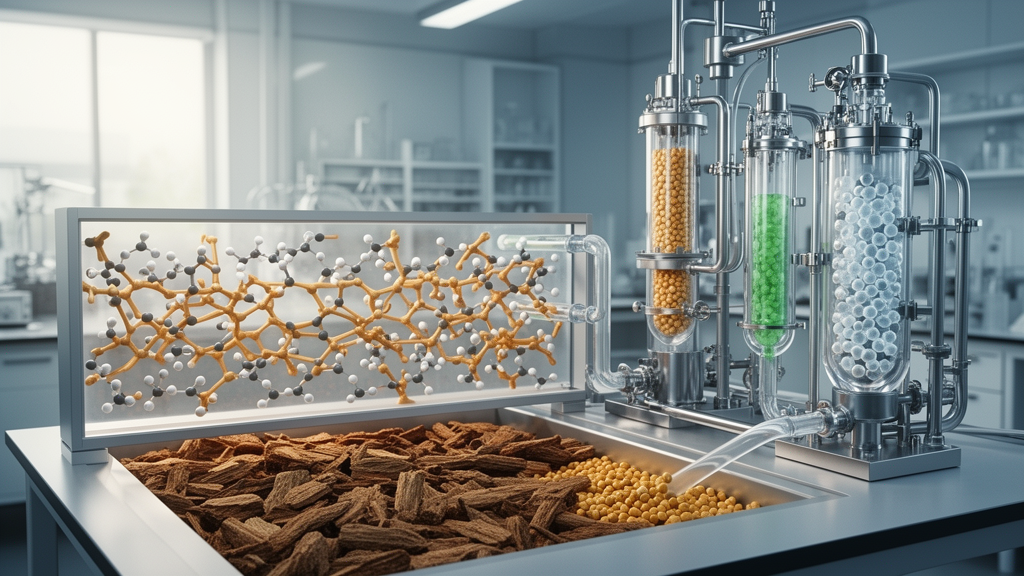
A critical review of renewable-carbon routes for bioplastics finds that the strongest path to lower-impact plastics is not a single material but an integrated system joining waste biomass, captured carbon dioxide, efficient conversion and deliberate control of polymer structure. The analysis links feedstocks with processing choices and molecular design, showing how each stage can alter the carbon footprint, cost and performance of the final product. It also draws a firm boundary around one of the field’s most appealing ideas: a CO₂-derived polymer is not automatically climate-friendly unless capture, activation and processing are supported by renewable energy.
The review covers second-, third- and fourth-generation biomass alongside CO₂ utilization. Agricultural and forestry residues such as straw, bagasse, rice husks and sawdust avoid direct competition with food production but are difficult to break down because cellulose and hemicellulose are embedded in a cross-linked lignin matrix. Algae offer carbohydrates, lipids, proteins and, in some organisms, intracellular polyhydroxyalkanoates, yet harvesting, dewatering and cell disruption can consume substantial energy. Food-processing residues, municipal waste, industrial side streams, engineered biomass and captured CO₂ form a fourth generation that avoids dedicated land use but requires contaminant removal, compositional control or substantial purification. Each feedstock family therefore exchanges one technical advantage for another constraint.
Pretreatment emerges as the decisive early bottleneck. Milling and extrusion increase surface area and may reduce cellulose crystallinity, but electricity demand rises as particles become smaller. Hydrothermal treatment and steam explosion open fibrous structures using hot pressurized water, while dilute acids accelerate hemicellulose hydrolysis at roughly 140–190 °C. Alkaline, organosolv, ionic-liquid and deep-eutectic-solvent methods can disrupt lignin-carbohydrate bonds or cellulose hydrogen bonding, and enzymatic treatments offer mild conditions and high selectivity. Severe treatment can generate furfural, 5-hydroxymethylfurfural, formic acid and levulinic acid that inhibit fermentation. Solvent-based and enzymatic routes also bring their own burdens through recovery, washing, toxicity, long residence times or large reactor volumes, so no pretreatment simultaneously maximizes yield, selectivity, affordability and environmental performance.
After fractionation, glucose and xylose can become lactic acid for polylactic acid, succinic acid for polybutylene succinate, or microbial polyhydroxyalkanoates through fermentation. Furans and polyols open additional catalytic routes, while lignin can yield aromatic monomers, polyols, phenolic resins, epoxy networks and polyurethanes. Integrated biorefineries are designed to capture several products from the same feedstock rather than optimize one in isolation: cellulose may become pulp, nanocellulose or fermentable sugar; hemicellulose may produce xylitol or furans; and lignin may supply higher-value aromatic materials. Such integration can improve carbon use and dilute the cost burden assigned to bioplastics, but it also increases process integration, capital and separation demands, with profitability depending on whether coproduct markets can genuinely absorb the expected volumes.
CO₂ offers a complementary carbon source rather than a complete substitute for biomass. In direct ring-opening copolymerization, catalysts open epoxides and insert CO₂ into metal–alkoxide bonds to form carbonate chains. Certain reported catalyst systems exceed 99% selectivity for CO₂ and monomer conversion above 90% under moderate conditions, producing polycarbonates whose rigidity or elasticity depends on the epoxide and subsequent modification. Indirect routes first convert CO₂ into formate, methanol, carbon monoxide or other intermediates using hydrogenation, electrochemistry or photochemistry. These pathways expand the range of possible polymers but add reaction, separation and purification stages, meaning the amount of CO₂ in a material tells only part of the environmental story.
The review emphasizes that CO₂ activation imposes an energy penalty. The molecule is thermodynamically stable, and direct air capture is particularly demanding at an atmospheric concentration of about 400 parts per million, making concentrated industrial or point-source streams more practical. Life-cycle analyses reviewed by the authors indicate that CO₂ polycarbonates can be carbon-neutral or even net carbon-reducing under favorable renewable-energy conditions, yet may have environmental profiles similar to conventional polymers when fossil electricity dominates capture and polymerization. The same caution applies to biobased polymers: renewable feedstocks do not guarantee a smaller footprint if drying, pretreatment, transport, separation or catalyst production is energy intensive. Comparative assessment therefore requires explicit system boundaries, energy assumptions, functional units and end-of-life scenarios.
Polymer architecture determines how these renewable carbon streams become useful materials. Monomer identity, stereochemistry, molecular weight, dispersity, branching, sequence distribution and crystallinity govern chain packing and movement. Higher molecular weight, stereoregularity or crystallinity can raise strength, heat resistance and barrier performance, but they may also increase viscosity, slow processing, reduce ductility and impede water or enzyme penetration. In PLA, introducing D-lactide disrupts regular packing, lowering crystallinity and stiffness while improving elongation at break. In PHBV, increasing hydroxyvalerate content interrupts chain packing and reduces crystallinity and melting temperature. Copolymer composition thus transmits upstream fermentation and separation decisions into the final material’s mechanics and degradation behavior.
At the material scale, blends, plasticizers, fillers, fibers and cross-links broaden performance while creating new trade-offs. A reported 70/30 PLA/PHA blend can increase toughness by as much as 50% with relatively little change in stiffness or thermal stability, while thermoplastic starch can lower material cost and enhance biodegradability but usually reduces moisture resistance and long-term stability. Natural fibers at 10–30 wt% can raise modulus by 30–100% and tensile strength by 50–200%, provided they adhere strongly to the matrix. Nanocellulose loaded at 5–10 wt% has produced reported PLA modulus gains of 15–35% and tensile-strength changes of 10–25%, although dispersion and interfacial bonding remain difficult. Biobased plasticizers can extend elongation by 50–200%, although they may reduce glass-transition temperature and tensile strength; cross-linking improves dimensional and thermal stability at the expense of remeltability and recyclability.
Commercialization remains the decisive test. Low-density residues incur collection, storage and transport costs, and their moisture, ash, carbohydrate and lignin content can change pretreatment severity, inhibitor formation and catalyst performance. Larger equipment exposes heat- and mass-transfer limits, fiber feeding, plugging, fouling, catalyst poisoning and solvent accumulation that are hidden in batch experiments. The review’s authors argue that long pilot campaigns must demonstrate on-stream operation, product consistency, impurity tolerance and recovery efficiency, while techno-economic analysis includes capacity factor, yield, solvent recovery, catalyst lifetime and financing rather than a single deterministic cost. Scale-up also requires standardized degradation tests, separate collection where bioplastics enter recycling streams, and life-cycle assessment capable of preventing misleading claims based on controlled composting conditions or narrow boundaries.
Emerging tools could accelerate progress, but only within that systems framework. Machine learning may connect composition, catalyst conditions and experimental data with strength, crystallinity, thermal stability and degradation, while high-throughput experimentation can test those relationships through closed-loop optimization. Hybrid biomass–CO₂ systems could react plant-derived epoxides or alcohols with CO₂ and recycle process emissions, provided catalysts tolerate impurities and the units can operate together efficiently. Nanocomposites, green solvents, continuous processing, solvent recovery, chemical recycling and enzymatic depolymerization may reduce bottlenecks or support closed loops. The review ultimately presents bioplastics as components of a broader transition toward circular carbon flows rather than complete replacements for conventional plastics, with credible progress depending on aligned technology, infrastructure, policy and transparent environmental standards.
Subject of Research: Integrated biomass and carbon dioxide routes for sustainable bioplastic production and performance
Article Title: Renewable carbon strategies for sustainable bioplastics integrating biomass valorization with carbon dioxide utilization and structural property relationships
Article References: Regulagadda, S., Gode, T., Vasa, T. R. P., Bathula, N. V. K., Rudhrabatla, V. S. A. P., Yellapragada, R., & Padigapati, S. R. (2026). Renewable carbon strategies for sustainable bioplastics integrating biomass valorization with carbon dioxide utilization and structural property relationships. Discover Green Chemistry, 1(1), Article 39. https://doi.org/10.1007/s44509-026-00041-z
Image Credits: AI Generated
DOI: 10.1007/s44509-026-00041-z
Keywords: bioplastics, biomass valorization, carbon dioxide utilization, biorefineries, polymer engineering, life-cycle assessment, renewable carbon, circular economy, feedstock pretreatment, polymer composites, Renewable, carbon
News Source: Denise Maddox. (October 22, 2026). Renewable carbon strategies for sustainable bioplastics integrating biomass valorization with carbon dioxide utilization and structural property relationships. Scienmag.