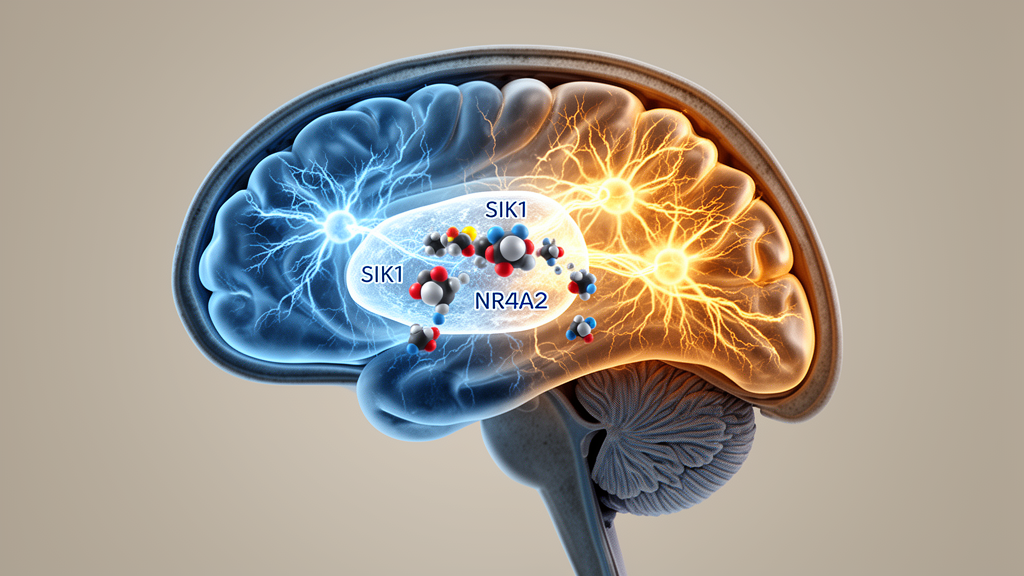
A machine-learning screen combined with experiments in a rat model of status epilepticus identified SIK1 as the highest-ranked candidate among LKB1-pathway genes examined for association with epilepsy risk. Follow-up experiments further showed that SIK1 overexpression worsened seizure severity in rats, while SIK1 knockdown prolonged seizure latency and reduced seizure duration. The analysis also indicated that SIK1 negatively regulates expression of the downstream gene NR4A2. Restoring NR4A2 through co-overexpression reversed the pro-epileptic effect of SIK1 alone, and either SIK1 knockdown or NR4A2 overexpression brought action-potential amplitude in treated hippocampal neurons back toward normal levels. These findings were obtained from public gene-expression data, laboratory animals and cultured primary hippocampal neurons, rather than from a human clinical study.
The investigators screened LKB1-pathway genes using the public GEO dataset GSE143272 and then evaluated the leading candidate in a pentylenetetrazol-induced status epilepticus model in rats. SIK1 expression was significantly upregulated in the hippocampus of the status epilepticus animals, although the study did not establish that this increase represented greater kinase activity. The experimental work used AAV-mediated gene knockdown and overexpression, lentiviral transfection of primary hippocampal neurons, electroencephalography, whole-cell patch-clamp recording and Western blot analysis. This combination allowed the researchers to connect the computational screening with seizure-related measurements, molecular changes and cellular electrophysiology, while remaining within the scope of an induced animal model and laboratory cultures.
Manipulating SIK1 in the rat model produced opposing effects. AAV-mediated SIK1 knockdown prolonged seizure latency and reduced seizure duration, whereas SIK1 overexpression exacerbated seizure severity. The results therefore support a functional role for SIK1 in the experimental phenotype: lowering its expression was associated with less severe seizure outcomes, while raising it was associated with more severe outcomes. The findings do not by themselves establish that SIK1 causes human epilepsy or that targeting it would change seizure outcomes in people. They instead identify a candidate regulatory mechanism that merits further investigation in relevant experimental systems.
Protein-protein-interaction network analysis and mediation analysis identified NR4A2 as a downstream effector of SIK1. The molecular results were inverse: SIK1 knockdown increased NR4A2 expression, while SIK1 overexpression decreased it. Functional rescue experiments strengthened this relationship. Co-overexpression of SIK1 and NR4A2 reversed the pro-epileptic effect produced by SIK1 overexpression alone, showing that increased NR4A2 could counteract the SIK1-associated phenotype under the tested conditions. Together, the data support a model in which SIK1 negatively regulates NR4A2 and in which reduced NR4A2 expression contributes to the increased neuronal excitability associated with SIK1. The study does not show that the entire pathway is a universal driver of epilepsy; rather, it characterizes the axis in the datasets, rat model and neuron cultures examined.
Whole-cell patch-clamp recordings provided a cellular correlate for the seizure and molecular findings. In magnesium-free-treated primary hippocampal neurons, SIK1 knockdown or NR4A2 overexpression restored action-potential amplitude to near-normal levels. The authors interpreted these observations as evidence that the SIK1–NR4A2 axis promotes neuronal hyperexcitability through SIK1-mediated negative regulation of NR4A2. Conversely, the rescue and electrophysiological results indicate that increasing NR4A2 can offset effects attributed to SIK1 in this experimental system. The work suggests that the SIK1–NR4A2 axis may be a target for further epilepsy research, but the evidence presented is preclinical: it comes from a chemically induced rat model and cultured neurons and does not demonstrate a treatment effect in patients.
Subject of Research: SIK1–NR4A2 regulation of seizure severity and neuronal excitability in a rat status-epilepticus model
Article Title: The SIK1-NR4A2 axis: a core driver of epilepsy identified by integrated machine learning and experimental validation
Article References: Liu, X., Zheng, S., Yang, K., Sun, L., Su, L., Zhong, S., Liang, H., & Luo, X. (2026). The SIK1-NR4A2 axis: a core driver of epilepsy identified by integrated machine learning and experimental validation. Frontiers in Cell and Developmental Biology, 14, Article 1887268. https://doi.org/10.3389/fcell.2026.1887268
Image Credits: AI Generated
DOI: 10.3389/fcell.2026.1887268
Keywords: epilepsy, SIK1, NR4A2, LKB1 signaling, status epilepticus, neuronal excitability, machine learning, hippocampus, rat model, primary neurons, SIK1-NR4A2, axis
News Source: Kendall Mcintyre. (October 22, 2026). SIK1–NR4A2 pathway linked to excitability in rat epilepsy model. Scienmag.