EPFL researchers have developed ultra-thin crystalline-silicon metasurfaces that can rapidly tune their interaction with mid-infrared light without changing their physical nanostructure. The peer-reviewed study, published in Nature Communications, demonstrates two tuning methods: integrated electrodes acting as micro-heaters that alter the silicon’s optical properties thousands of times per second and ultrafast laser pulses that induce changes on nanosecond timescales. The researchers report more than an order-of-magnitude improvement in key optical-performance metrics compared with previous mid-infrared platforms based on similar materials.
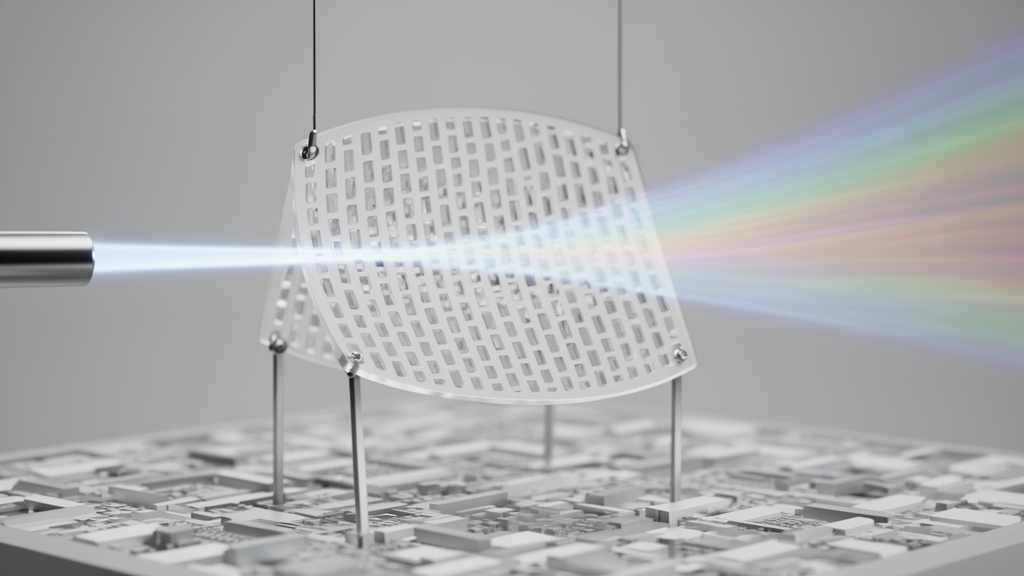
Metasurfaces are ultra-thin structures containing nanoscale patterns that can shape and direct light waves. Most metasurfaces developed thus far are static, meaning their optical properties remain fixed after fabrication and limiting their use in adaptable photonic systems. The EPFL team instead created suspended membranes of crystalline silicon, with the nanostructured layer separated from the surrounding environment by air.
Hatice Altug, who led the work in EPFL’s Bionanophotonic Systems Laboratory within the School of Engineering, said this configuration greatly reduced optical losses that typically limit conventional mid-infrared platforms. Two distinct approaches allowed the researchers to tune the devices without altering their nanostructures. In the electrical approach, integrated electrodes serve as micro-heaters.
Electrical current passing through the electrodes induces changes in the silicon’s optical properties, allowing the metasurface response to be adjusted thousands of times per second. In the optical approach, ultrafast laser pulses induce mobile electrical charges within the silicon, enabling the structures to respond on timescales of billionths of a second, or nanoseconds. The researchers say the combination of high optical performance and rapid tunability could help communication systems transmit information more efficiently and enable sensors that adapt quickly to changing conditions.
Mid-infrared light is relevant to these applications because molecules interact with it in characteristic ways, allowing spectroscopy to identify biological materials, drugs and pollutants. The same light can also carry information in free-space optical communications, where data travel through air rather than through cables or fibers. These potential uses build on the demonstrated tuning performance but remain prospective applications rather than tested clinical or commercial outcomes.
Other proposed directions include compact, low-power devices for free-space optical communications, highly selective and adaptive chemical and biological sensing, and active radiative cooling systems designed to help surfaces release heat in applications such as refrigeration or satellite thermal management. Looking further ahead, the researchers say rapid tunability combined with high optical performance could support advanced photonics applications that require precise control of light, including quantum spectroscopy. The work does not establish performance for any of those individual future systems, but it provides a versatile basis for developing them.
First author Felix Brikh said the platform’s reported optical performance does not come at the expense of scalability because the devices are made using techniques already compatible with large-scale semiconductor production.
Subject of Research: Real-time tuning of suspended crystalline-silicon metasurfaces for mid-infrared photonics
Article Title: A new way to control infrared light in real time
Article References: A new way to control infrared light in real time. Original publication (Bibliographic details unavailable.)
Image Credits: AI Generated
DOI: Not provided
Keywords: mid-infrared light, silicon metasurfaces, real-time modulation, nanosecond tuning, optical communications, infrared spectroscopy, photonic sensing, radiative cooling, quantum photonics, EPFL, control, infrared
News Source: Katie Riggs. (October 22, 2026). Suspended Silicon Metasurfaces Tune Mid-Infrared Light Rapidly. Scienmag.