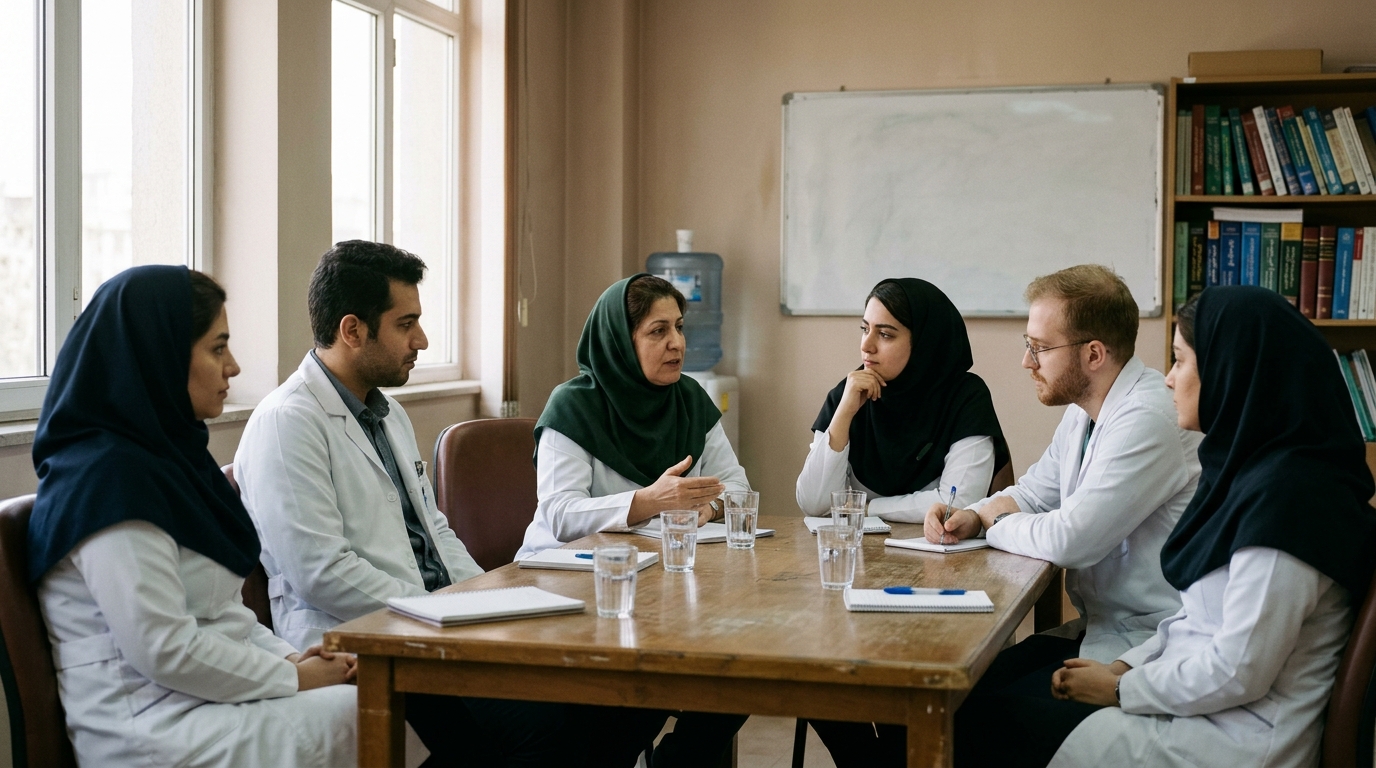
The 2025–2026 military crises in Iran placed unprecedented operational strain on psychiatric medical education, compelling academic medical centers to reorganize clinical training while balancing urgent healthcare delivery against resident instruction. In a correspondence published in Academic Psychiatry, educational leaders and vice chairs for education from a university medical center in Iran detailed how emergency conditions tested institutional resilience. The standard psychiatry residency in Iran is structured as a four-year training program encompassing comprehensive theoretical coursework and clinical rotations across core psychiatric subspecialties. Because the core curriculum relies heavily on bedside teaching within hospital wards, outpatient clinics, and community environments, training is fundamentally intertwined with direct patient care. When national emergencies erupted, institutional priorities shifted immediately toward acute service delivery and personnel safety, rendering formal medical education a secondary operational focus.
The correspondence highlights that human-made emergencies like armed conflict exert systemic pressures distinct from natural disasters, which typically impact restricted geographic zones. Between 2025 and 2026, Iran endured two distinct periods of military confrontation: the twelve-day war in June 2025 and the subsequent Forty-Day War that spanned from February 28 to April 8, 2026. Both conflicts involved widespread aerial bombardment across Tehran, forcing the city’s teaching hospitals to operate under prolonged high-alert conditions. Alongside the physical danger, nationwide restrictions and disruptions to telecommunication networks and internet access directly compromised the administrative and educational functioning of the residency program, preventing conventional academic activities from proceeding uninterrupted.
Under wartime conditions, maintaining the equilibrium between active service provision and structured clinical instruction became severely compromised. While educational activities did not cease entirely, direct clinical supervision was sharply curtailed. In contrast to standard operating procedures, where multiple faculty members supervise different hospital sections concurrently, department staffing shortages occasionally left a single attending physician responsible for managing the entire psychiatric department. This staffing compression significantly reduced opportunities for faculty to provide continuous direct observation and real-time clinical feedback to trainees. Furthermore, the cancellation of elective medical services and a marked decline in inpatient admissions constrained the clinical diversity and volume of cases available for resident learning.
These acute systemic disruptions imposed substantial psychological, personal, and professional strain on psychiatry residents. Trainees contended with heightened financial instability and experienced a growing sense of inequity regarding the allocation of rigorous on-call duties, exacerbated by institutional security requirements that exceeded hospital capacity. While some residents experienced declining motivation under these circumstances, others voluntarily absorbed heavier clinical workloads to sustain hospital operations. The educational performance of both trainees and faculty members deteriorated due to acute sleep disruptions, impaired cognitive concentration, and pervasive fear regarding personal and familial survival. In several instances, families intervened to prevent residents from reporting to the hospital, leading some trainees to actively consider withdrawing from their residency programs.
Attempts to mitigate educational disruptions by shifting entirely to digital platforms exposed significant infrastructural and logistical limitations. Remote learning was repeatedly paralyzed by severe internet outages and connectivity restrictions during the bombardment periods. Additionally, the university center encountered operational bottlenecks because some teaching faculty had limited familiarity with the institution’s existing virtual education platforms. These technological hurdles demonstrated that remote instructional modalities could not serve as an unassisted substitute for in-person training during active warfare, necessitating alternative pedagogical and managerial approaches to sustain the curriculum.
To navigate these intense constraints without exacerbating administrative disruption, educational administrators prioritized measured, patient management strategies over hasty decision-making. Institutional flexibility emerged as the guiding organizational principle, prompting a transition from rigid didactic lectures toward opportunistic bedside instruction during daily clinical encounters and telephone on-call consultations. Whenever telecommunication networks stabilized, academic departments convened essential morning reports, journal clubs, and theoretical lectures online, capturing fleeting windows of connectivity to maintain academic continuity.
Concurrently, the dramatic decline in routine in-person patient visits catalyzed practical innovations in clinical care and resident welfare. Under direct faculty supervision, psychiatry residents expanded telephone and internet-based consultations and psychotherapy sessions, thereby acquiring direct practical experience in the core principles of telepsychiatry. Departments also developed offline instructional packets designed for patients and their families. To support resident mental health, programs introduced structured interventions, including group mentorship meetings, individual counseling sessions with educational supervisors, administrative accommodations to facilitate the return of absent trainees, and volunteer shift coverage to mitigate emotional isolation and preserve training progression.
The authors compared these wartime experiences to earlier educational disruptions encountered during the COVID-19 pandemic, as documented in prior studies by Eissazade and colleagues. While both crises triggered severe disruptions, heightened psychological distress among residents, and exposed an absence of standardized telepsychiatry protocols, their operational environments diverged substantially. COVID-19 constituted a biological threat that fostered the rapid maturation of virtual communication infrastructures. In contrast, military conflict posed acute, direct hazards to physical life and structural safety while dismantling communication networks through repeated internet blackouts. These compounding factors neutralized virtual education and demanded much more rapid psychological crisis interventions than those deployed during the pandemic.
Reflecting on these observations, the authors concluded that the vulnerability of medical education during crises is governed more by an institution’s capacity for rapid operational reconfiguration than by baseline resource limitations. Educational resilience must be conceptualized not merely as a rapid return to pre-crisis routines, but as the deliberate maintenance of training quality throughout an active emergency. To prepare future systems, the authors recommended empirical research on simulation and opportunity-based learning, the establishment of crisis-responsive curricula covering war trauma, resource-scarce triage, and telepsychiatry, maintaining a permanent baseline of 10 to 20 percent virtual instruction during peacetime, and formulating legal and operational frameworks to guarantee resident welfare, equitable workloads, and formal training extensions during prolonged disruptions.
Subject of Research: Psychiatry residency training adaptations during military conflicts in Iran
Article Title: Psychiatry Residency Training in Iran During Periods of Military Crisis: Lessons Learned for the Resilience of Medical Education
Article References: Hajisadeghi Kahdooyeh, S., Asadi, S., Hajebi, A., Keshavarz-Akhlaghi, A.-A., Esmaeeli, S. T., Kashaninasab, F., & Shalbafan, M. (2026). Psychiatry Residency Training in Iran During Periods of Military Crisis: Lessons Learned for the Resilience of Medical Education. Academic Psychiatry. https://doi.org/10.1007/s40596-026-02466-x
Image Credits: AI Generated
DOI: 10.1007/s40596-026-02466-x
Keywords: psychiatry residency, medical education, crisis management, wartime healthcare, telepsychiatry, educational resilience, Iran, clinical training, Psychiatry, Residency, Training, During
News Source: Glenn Wilkins. (November 5, 2026). Psychiatry Residency Programs in Iran Adapt Training During Recent Military Crises. Scienmag.