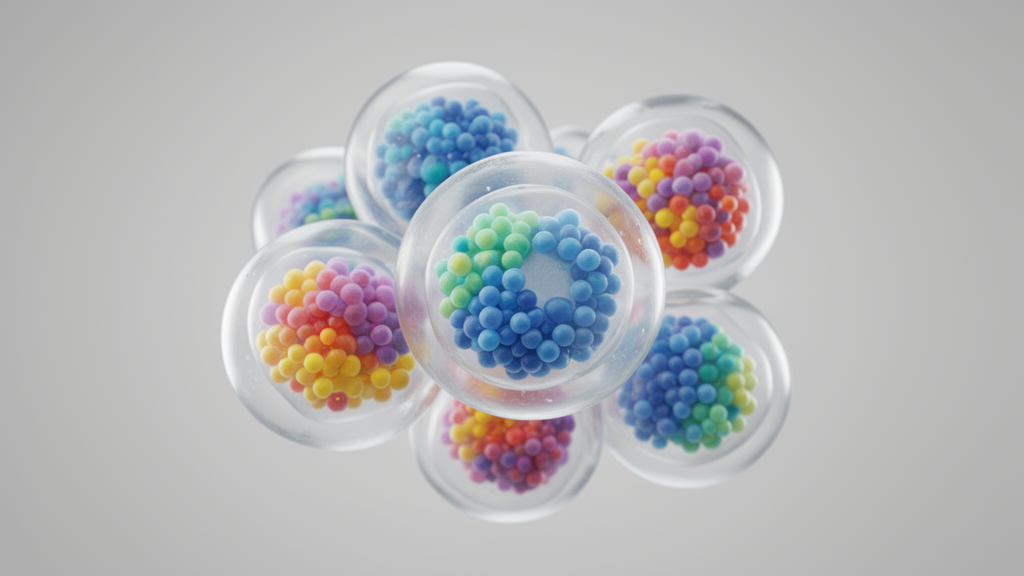
In a major synthesis of synthetic biology and biophysics, researchers have illuminated how liquid-liquid phase separation governs the selective uptake and spatial arrangement of client biomolecules inside synthetic protocells. Natural eukaryotic cells rely on membraneless organelles, including nucleoli, stress granules, and processing bodies, to organize their interior biochemistry without lipid boundaries. Emulating these biological architectures, synthetic coacervate microdroplets formed through phase separation generate crowded interior microenvironments capable of dynamically recruiting enzymes, nucleic acids, and small metabolites. The newly published review systematically examines how diverse molecular forces dictate client molecular partitioning across single-phase coacervate droplets, complex multi-phase systems, and membrane-bound artificial microcompartments. By establishing programmable control over the spatial localization and transport kinetics of guest molecules, these synthetic constructs reproduce essential features of living systems. The findings demonstrate that liquid condensates provide versatile platforms for designing orderly biocatalytic cascades, deciphering prebiotic evolution, and constructing responsive biotechnological materials.
The fundamental mechanism driving client molecule sequestration into coacervate droplets rests upon a delicate equilibrium of multivalent intermolecular interactions. Electrostatic attraction serves as the primary force during complex coacervation, where oppositely charged polyelectrolytes assemble into associative macromolecular networks that enrich client species based on their net charge, overall charge density, and ionizable group arrangement. Positively charged polylysine scaffolds, for example, strongly encapsulate negatively charged ribozymes while excluding neutral or similarly charged molecules. Simultaneously, hydrophobic effects cause nonpolar polymers or amphiphilic macromolecules to aggregate, lowering free energy and selectively drawing hydrophobic client species away from the dilute aqueous phase. Hydrogen bonding introduces further specificity, especially through structured water-bridged networks in polyesteramide coacervates that tune uptake ratios between hydrophilic and hydrophobic species. Furthermore, cation-pi and pi-pi stacking interactions between aromatic side chains, such as phenylalanine, tyrosine, tryptophan, and nucleobases like guanine, provide enhanced structural stability and cargo recruitment.
Within single-phase coacervate droplets, internal physical attributes including density, viscosity, micropolarity, and network mesh porosity dictate molecular solubility and diffusion. Denser polymeric regions preferentially capture heavy macromolecular cargos, whereas lighter regions accommodate smaller solutes, and heightened viscosity effectively restricts diffusion to prevent unwanted solute leakage. Micropolarity functions as a decisive partitioning factor, where lower polarity environments mimic native cellular condensates, concentrating hydrophobic reactants and stabilizing transition intermediates during catalytic reactions. To achieve structural boundary control, researchers engineered metal-organic framework membranes onto poly(diallyldimethylammonium chloride) and poly(acrylic acid) coacervates. This crystalline exterior forms a competitive microcompartment that regulates guest localization based on charge density and molecular weight. Guest molecules with higher molecular weights and elevated charge densities remain tightly sequestered within the coacervate interior. Concurrently, the metal-organic framework shell acts as a selective semi-permeable filter, excluding oversized external species while mediating substrate diffusion to control multi-step enzymatic cascades.
Beyond non-specific physical partitioning, researchers employ high-affinity molecular recognition motifs to engineer programmable recruitment and dynamic release within single-phase droplets. Supramolecular nanoscaffolds assembled from quaternized amylose and carboxymethyl-amylose incorporate DNA recognition domains that selectively sequester complementary single-stranded oligonucleotide signals from external solutions. Introducing fully complementary displacement strands triggers reversible cargo release by competitive replacement. In related systems, oligonucleotide tags appended to neutral proteins permit reversible uptake into amylose coacervates upon hybridization with uptake strands, whereas releaser strands displace the tags and prompt protein ejection. Dynamic toehold-mediated strand displacement similarly establishes concentric compartmentalization in DNA coacervates composed of cyanuric acid and polyadenine, transitioning droplets from uniform structures to layered concentric shells. High-affinity protein recognition pairs, particularly biotin and streptavidin with dissociation constants near 10^-15 M, allow large enzymes and nanoparticles to overcome thermodynamic hurdles, facilitating orthogonal partitioning across distinct condensates.
Multi-phase coacervates introduce internal structural heterogeneity, enabling synthetic protocells to segregate incompatible biochemical reactions into distinct spatial domains. In core-shell multi-phase droplets assembled from arginine-rich, lysine-rich, and aspartic acid-rich oligopeptides, single-stranded and double-stranded RNAs exhibit starkly divergent spatial preferences. Both nucleic acid species display strong baseline affinity for arginine-rich phases due to potent cation-pi and electrostatic interactions. However, inside ternary mixtures, single-stranded RNA concentrates in the inner arginine-rich core, while double-stranded RNA partitions into the outer shell. This segregation occurs because the rigid helical geometry of double-stranded RNA experiences steric hindrance in the dense core, while the outer shell possesses an open dynamic meshwork featuring a 2.6-fold excess of cationic residues. Calculated partition equilibrium constants for 10-mer and 20-mer double-stranded RNAs reach 0.35 and 0.43 in the outer layer, representing 2.5-fold and 3-fold enrichments over the inner phase.
Phase heterogeneity also facilitates spontaneous molecular self-sorting within interconnected protocell networks. In dual-droplet networks comprising liquid crystalline didodecyldimethylammonium bromide coacervates and isotropic poly(diallyldimethylammonium chloride) coacervates, the distinct hydrophobic and electrostatic microenvironments sort guest molecules without external intervention. The hydrophobic droplets display an apparent diffusion coefficient of 1.1 × 10^-13 m^2/s and enrich amphiphilic proteins, lipid dyes, and adenosine triphosphate, whereas the electrostatic droplets exhibit a diffusion coefficient of 3.9 × 10^-13 m^2/s and sequester polyanionic nucleic acids. Exploiting density differentials, macroscopic centrifugation separates the network into distinct upper hydrophobic and lower hydrophilic layers, each retaining its concentrated cargo. In complementary systems combining diethylaminoethyl-dextran and polyaspartic acid coacervates with dextran and polyethylene glycol aqueous two-phase droplets, charged enzymes localize in the coacervate phase while neutral polysaccharides occupy dextran droplets, enabling triggerable cascade activation through selective dissolution with salt or water dilution.
Advanced multi-phase architectures also leverage sequence-designed nucleic acid hybridization and internal vacuole formation to regulate spatial biochemistry. Immiscible condensate droplets composed of synthetic DNA nanostars present sequence-specific single-stranded overhangs that act as molecular anchors, directing complementary tagged enzymes and cargo particles into predetermined phase compartments. Concurrently, membranized coacervate protocells subjected to hypotonic osmotic shock spontaneously reconfigure to form internal aqueous vacuoles. Water influx swells the droplet matrix and transiently increases lipid membrane permeability, shifting initial transport velocities of propidium iodide from 0.24 micromoles per second in unswollen droplets to 0.53 micromoles per second in swollen structures, thereby accelerating enzymatic substrate turnover. In living hybrid bacteriogenic protocells, internal bacterial metabolism and adenosine triphosphate synthesis drive the formation of eukaryotic-like water vacuoles. These functional vacuolar compartments physically isolate hydrophilic molecules from the dense surrounding coacervate matrix, mediating intercompartmental chemical communication and mimicking advanced cellular organization.
Integrating coacervate droplets as artificial sub-compartments within lipid and polymer vesicles recreates the hierarchical organization of eukaryotic cells. Within lipid vesicles, polylysine and adenosine triphosphate form dynamic coacervates that assemble or disassemble in response to pH alterations through protonation shifts, switching encapsulated enzymatic cascades on or off. Thermally responsive artificial organelles utilize polyuridylic acid and spermine, which exhibit upper critical solution temperature behavior with a cloud point around 22 degrees Celsius. When encapsulated within liposomes alongside transcription machinery, in vitro transcription occurs exclusively when components condense into coacervate droplets above this critical temperature. Autocatalytic ligation cascades driven by R3C ribozymes demonstrate dramatic catalytic acceleration upon thermal droplet formation, with measured partition coefficients reaching 286, 104, and 44 for labeled RNA reaction components inside the polyuridylic acid and spermine condensates. Furthermore, tuning electrostatic interactions causes internal droplets to wet vesicle membranes, altering local bilayer curvature.
External physical fields and stimuli provide temporal control over client molecular partitioning within hybrid protocell architectures. Pickering emulsion protocells stabilized by silica nanoparticles integrate polylysine and adenosine triphosphate coacervates, coupling upper critical solution temperature thermal responsiveness with enzymatic pH control. By incorporating urease for ammonia-mediated alkalization and glucose oxidase for enzymatic acidification, droplets cyclically assemble and disassemble to modulate biocatalysis across multiple cycles. Photochemical regulation utilizes azobenzene-functionalized oligonucleotides inside water-in-oil compartments. Exposure to visible light maintains trans-azobenzene conformations that bind complementary single-stranded cargo within designated droplets, whereas ultraviolet illumination triggers isomerization into cis conformations, releasing cargos to fold into alternative hairpins and establishing bidirectional optical transport. In proteinosome microcompartments, azobenzene-glutamic acid and diethylaminoethyl-dextran coacervates respond to light and pH windows between 4.5 and 7.5, implementing Boolean NOR and NAND logic gates, while interfacial wetting mediates oligopeptide-RNA coacervate endocytosis into vesicles.
Despite substantial progress, translating liquid-liquid phase separation models into standardized, predictable synthetic biology platforms requires overcoming critical biophysical hurdles. Long-term droplet stability remains vulnerable to coalescence, aging, and structural degradation during cyclic environmental transitions, particularly within multi-phase droplets and membranized vesicles. Furthermore, nonspecific partitioning governed by micropolarity, viscosity, and charge density lacks quantitative predictability, making precise cargo quantification difficult compared to sequence-specific molecular recognition motifs. Researchers must develop robust mathematical frameworks linking macromolecular charge density, multivalency, network porosity, and environmental conditions to exact partition coefficients. Standardized analytical methodologies and reproducible preparation protocols are equally vital to eliminate inter-laboratory variation. Resolving these mechanistic questions will refine synthetic cell construction and advance biomedical understanding of native biomolecular condensates. Because aberrant phase separation and pathological protein aggregation drive debilitating neurodegenerative disorders and malignancies, elucidating phase separation rules offers therapeutic strategies to dissolve or reprogram disease-associated cellular condensates.
Subject of Research: Biophysical mechanisms of client molecular partitioning within liquid-liquid phase separated protocells
Article Title: Modulating client molecular partition through liquid-liquid phase separation in protocells
Article References: Ji, Y. (2026). Modulating client molecular partition through liquid-liquid phase separation in protocells. Discover Molecules, 3(1), Article 40. https://doi.org/10.1007/s44345-026-00082-8
Image Credits: AI Generated
DOI: 10.1007/s44345-026-00082-8
Keywords: liquid-liquid phase separation, protocells, coacervates, molecular partitioning, synthetic biology, membraneless organelles, multivalent interactions, biomolecular condensates, enzyme cascades, metal-organic frameworks, DNA nanoscaffolds, core-shell microdroplets, biotin-streptavidin, vesicle microcompartments, stimuli-responsive systems, artificial organelles, biocatalysis
News Source: Bethany Barker. (November 23, 2026). Phase Separation Regulates Molecular Sorting Inside Artificial Cells Across Diverse Microenvironments. Scienmag.