Chemical engineers have established a predictive molecular simulation methodology capable of evaluating the capture of hexamethyldisiloxane, a pervasive organic silicon contaminant, within a CMK-3 ordered mesoporous carbon at 298 Kelvin. As biomethane continues to draw global interest as an alternative to fossil fuels, raw biogas produced from anaerobic digestion must undergo rigorous purification to eliminate trace siloxane impurities. These volatile organosilicon species, predominantly hexamethyldisiloxane and octamethylcyclotetrasiloxane originating from widely used commercial hygiene products and cosmetics, decompose into abrasive silicon dioxide deposits when combusted in power generation systems. The resulting solid silica scaling obstructs ductwork and inflicts catastrophic mechanical damage on internal combustion engines and downstream machinery. Regulatory frameworks, including those established by Brazil’s National Petroleum, Natural Gas and Biofuels Agency and European standards, mandate that total siloxane concentrations not exceed 0.3 milligrams per cubic meter for vehicular fuel distribution, while regional pipeline operators such as California’s SoCalGas enforce limits of 1.0 milligram per cubic meter. While physical adsorption within porous matrices offers an economically viable separation pathway, predicting adsorption behavior in ordered mesoporous carbons has historically remained scarce in simulation literature, limiting the ability to computationally scope carbon materials for industrial biogas upgrading.
To address this analytical gap, the research team developed a structured computational framework that pairs molecular-scale Grand Canonical Monte Carlo simulations with pore-network deconvolution to estimate total adsorption isotherms without relying on empirical curve-fitting adjustments. Ordered mesoporous carbons, synthesized through templating techniques such as hard-template replication with silica matrices, possess exceptionally high specific surface areas exceeding 1,000 square meters per gram and broad pore volumes surpassing 1.0 cubic centimeter per gram. By utilizing experimental benchmark datasets from prior physical investigations by Wang and colleagues, the researchers sought to computationally forecast the adsorption equilibrium of hexamethyldisiloxane on CMK-3. Concurrently, they evaluated whether reduced computational representations could replicate macroscopic performance while decreasing numerical overhead, extending the same modeling principles to compare performance directly against conventional porous media, namely granular activated carbon and activated carbon fiber.
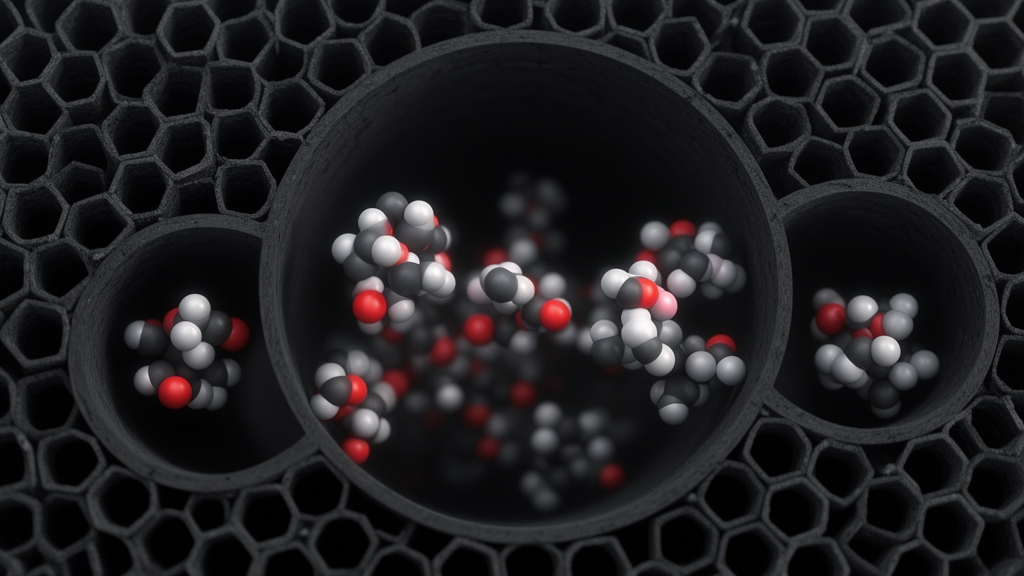
The physical geometry of the CMK-3 ordered mesoporous carbon was represented computationally through a periodic array of cylindrical nanorods. In this framework, each individual carbon nanorod was constructed utilizing eleven concentric cylindrical graphene layers spaced 3.354 angstroms apart. To reflect real physical accessibility while avoiding artificial adsorption inside internal regions where guest molecules cannot penetrate due to steric hindrance, the five outermost cylindrical shells were modeled with active carbon sites, whereas the six interior shells were assigned inert dummy atoms. Because real CMK-3 typically features a hexagonal symmetry that can be partitioned into three identical diamond-like domains, the authors reduced the computational domain to four parallel nanorods assembled in a diamond lattice with internal angles of 60 and 120 degrees. Across this arrangement, the effective nanorod diameter was held constant at 72.8 angstroms, and the pore diameter was geometrically defined as the inscribed cylindrical void between three adjacent rods, with the center-to-center separation distance explicitly defined as a geometric function of rod diameter and pore width.
Characterizing the pore network required simulating nitrogen adsorption isotherms at 77.4 Kelvin across six selected representative pore diameters of 20, 25, 30, 38, 45, and 55 angstroms using Grand Canonical Monte Carlo algorithms within the RASPA3 software platform. Molecular nitrogen was simulated as a single-site Lennard-Jones fluid with Ravikovitch parameters, while the carbon nanorods were treated as a rigid framework using Steele graphitic potentials with Lorentz-Berthelot mixing rules and an interaction cutoff of 14 angstroms. Pressures spanning from 1 to 100,000 pascals were mapped across 38 discrete evaluation points, converting pressure to fugacity via the Peng-Robinson equation of state to establish thermodynamic bulk chemical potentials. Each simulation step executed equal probabilities of translation, insertion, and deletion trial moves over 20,000 equilibration cycles and 40,000 production cycles. The resulting individual nitrogen isotherms revealed that smaller 20 and 25 angstrom pores exhibited rapid monolayer coverage, the 30 angstrom pore displayed distinct multilayer step transitions, and pores extending from 38 to 55 angstroms demonstrated continuous capillary condensation regimes differing primarily by pressure shifts.
To determine the minimum number of discrete pore sizes necessary to reliably reconstruct the experimental nitrogen isotherm of CMK-3, the researchers performed mathematical deconvolution using a non-negative least squares algorithm combined with an L-curve regularization smoothing parameter. When an initial four-pore kernel containing only 20, 25, 30, and 38 angstrom pores was applied, the simulated nitrogen isotherm matched experimental measurements up to roughly 30 kilopascals but severely underestimated uptake at elevated pressures, plateauing at 31 millimoles per gram compared to the measured experimental uptake of 38 millimoles per gram, yielding an R-squared of 0.894. Testing expanded assemblies revealed that while a complete six-pore assembly incorporating both 45 and 55 angstrom pores delivered an R-squared of 0.989, an optimized five-pore kernel terminating at 45 angstroms attained a comparable coefficient of 0.983 and a root mean square deviation of 1.26 millimoles per gram. The derived pore size distribution confirmed that the overwhelming majority of pore volume was concentrated between 35 and 45 angstroms, demonstrating that incorporating larger pores beyond 45 angstroms introduced unnecessary computational expense without meaningfully improving structural fidelity.
The validity of this five-pore representation was further reinforced by comparing its structural outputs against external experimental literature and legacy models. When the authors reconstructed isotherms from independent published OMC characterizations, their 20 to 45 angstrom assembly matched the experimental nitrogen datasets of Gor and coworkers with an R-squared of 0.98 and a root mean square deviation of 1.75 millimoles per gram, and matched the data of Zhou and colleagues with an R-squared of 0.99 and a deviation of 0.81 millimoles per gram. Furthermore, calculating macroscopic structural properties by integrating the discrete pore size distribution yielded an estimated total pore volume and specific surface area that deviated from experimental reference values by only 11 percent and 16 percent, respectively. Evaluating the sensitivity of the pore-kernel truncation indicated that total pore volume varied between minus 12 percent for a 38 angstrom cutoff and plus 10 percent for a 55 angstrom cutoff relative to the five-pore assembly, establishing kernel selection as an identifiable yet bounded factor in downstream property propagation.
Moving to the core siloxane calculations, the researchers investigated local hexamethyldisiloxane adsorption isotherms at 298 Kelvin across the representative pores using Grand Canonical Monte Carlo methods within Materials Studio. Host frameworks remained rigid under three-dimensional periodic boundary conditions, evaluating non-bonded dispersion through a 12-6 Lennard-Jones potential with a 12.5 angstrom cutoff and long-range electrostatics via Ewald summation. Two distinct molecular parameterizations were evaluated: Force Field 1, adapted from parameters originally formulated by Thol and collaborators for cyclic octamethylcyclotetrasiloxane, and Force Field 2, adapted from organosilicate parameters developed by Jorge and coworkers specifically for linear organosilicon molecules including hexamethyldisiloxane. Both approaches treated terminal methyl groups as united-atom interaction sites with partial charges taken from Jorge. Preliminary bulk liquid density simulations at 298 Kelvin yielded 0.735 grams per cubic centimeter for Force Field 1 and 0.673 grams per cubic centimeter for Force Field 2, showing errors of 3.4 percent and 11.5 percent relative to the experimental siloxane density of approximately 0.7606 grams per cubic centimeter, confirming adequate baseline physics.
Subsequent local isotherm simulations spanning 16 pressure stages between 0.01 and 4.5 kilopascals demonstrated that the local adsorption density across individual pores approached an asymptotic plateau of approximately 4.5 millimoles per cubic centimeter, with Force Field 2 exhibiting steeper low-pressure uptake indicative of stronger guest-host interactions. Total macroscopic hexamethyldisiloxane adsorption isotherms were then assembled by calculating the volume-fraction-weighted summation of local pore uptakes. When mapped against physical experimental isotherms, the five-pore model utilizing Force Field 2 achieved a predictive correlation coefficient of R-squared equal to 0.88 and a root mean square deviation of 59.6 milligrams per gram, significantly outperforming Force Field 1, which attained an R-squared of only 0.65 and a root mean square deviation of 102 milligrams per gram. When the 55 angstrom pore was added to form a six-pore kernel, predictive performance deteriorated to an R-squared of 0.79 for Force Field 2 and 0.51 for Force Field 1, confirming that excessive pore volume assignment at large diameters degrades siloxane uptake predictions.
To contextualize performance relative to established commercial materials, identical simulation protocols were applied to slit-pore carbon models representing granular activated carbon and activated carbon fiber across widths of 7, 8.9, 18.5, and 27.9 angstroms. Nitrogen characterization verified that activated carbon fiber behaved predominantly as a microporous matrix dominated by 7 angstrom pores, whereas granular activated carbon exhibited combined micro- and mesoporosity. When simulating hexamethyldisiloxane adsorption at 298 Kelvin, the molecular model accurately replicated the experimental hierarchy of macroscopic uptake capacity: CMK-3 ordered mesoporous carbon demonstrated superior capacity over granular activated carbon, which in turn surpassed activated carbon fiber.
The study authors delineated clear boundaries and assumptions inherent to their predictive framework. The evaluation scope focused strictly on equilibrium adsorption isotherms, explicitly deferring the determination of isosteric heats of adsorption to subsequent investigations. Residual discrepancies between experimental measurements and computational curves were traced to three primary factors: the transferability of force field parameters originally calibrated for liquid-phase systems to gas-phase adsorption regimes, the geometric idealization of perfectly ordered, defect-free nanorods that omit structural irregularities found in real CMK-3 samples, and unquantified measurement uncertainties in published experimental isotherms. Furthermore, the kernel-truncation uncertainty identified during nitrogen deconvolution propagates directly into an approximate plus or minus 10 percent uncertainty band surrounding the predicted total siloxane isotherms. Within these stated limitations, the demonstrated five-pore methodology provides an accurate, non-fitted molecular modeling protocol to screen and optimize ordered mesoporous materials for industrial siloxane separation in biomethane purification systems.
Subject of Research: Molecular simulation of hexamethyldisiloxane adsorption on ordered mesoporous carbon for biogas upgrading
Article Title: Hexamethyldisiloxane adsorption prediction in an Ordered Mesoporous Carbon
Article References: de Pinho Furtado, C. O., Jr., Silvino, P. F. G., Gonçalves, D. V., de Oliveira, J. C. A., & de Lucena, S. M. P. (2026). Hexamethyldisiloxane adsorption prediction in an Ordered Mesoporous Carbon. Brazilian Journal of Chemical Engineering. https://doi.org/10.1007/s43153-026-00736-7
Image Credits: AI Generated
DOI: 10.1007/s43153-026-00736-7
Keywords: hexamethyldisiloxane, ordered mesoporous carbon, CMK-3, biogas upgrading, biomethane purification, molecular simulation, Grand Canonical Monte Carlo, adsorption isotherms, pore size distribution, siloxane removal, granular activated carbon, activated carbon fiber, RASPA3, Materials Studio, Lennard-Jones potential, force field transferability, nanorod model, nitrogen physisorption
News Source: Bethany Barker. (November 23, 2026). Molecular Simulations Predict Siloxane Adsorption on Ordered Mesoporous Carbons for Biogas. Scienmag.