Chemical engineers evaluating sustainable purification techniques for nonpolar industrial solvents have demonstrated that an engineered activated biochar derived from the woody fruit shells of Dipteryx alata, commonly known as baru, rapidly captures the synthetic lipophilic azo dye Sudan IV from liquid n-hexane. In their laboratory trials, the acid-treated biomass material attained an equilibrium adsorption capacity reaching a fitted maximum value of 344.00 milligrams of dye per gram of adsorbent, offering an effective solid-phase mechanism to extract persistent lipophilic colorants directly from a low-polarity aliphatic hydrocarbon. Industrial manufacturing sectors frequently depend on nonpolar organic solvents for critical processing operations, including vegetable-oil recovery, polymer synthesis, and precision chemical cleaning, but the resulting waste streams are notoriously difficult to clean using standard separation strategies. Because conventional physical-chemical treatment approaches have historically focused on aqueous systems, the successful demonstration of a bio-derived porous sorbent operating in a nonaqueous organic medium provides critical empirical benchmarks for designing sustainable circular solvent recycling protocols.
Industrial reliance on aliphatic hydrocarbons like n-hexane presents severe solvent recovery challenges whenever organic streams become contaminated with chemically stable, nonpolar aromatic dyes. Sudan IV, a synthetic diazo compound possessing the molecular formula C24H20N4O, is widely incorporated into hydrocarbon waxes, petroleum products, commercial lubricants, and polymer formulations due to its intense coloration and pronounced solubility in organic media. While water-treatment technologies exploit strong electrostatic attraction, ion-exchange phenomena, and extensive hydrogen-bonding networks to remove dissolved impurities, these conventional mechanisms are severely suppressed or entirely inoperative in nonpolar aprotic liquids. Purifying a nonpolar solvent therefore requires an adsorbent interface capable of overcoming favorable solute-solvent interactions through competitive interfacial binding. A dissolved hydrophobic dye molecule must experience a sufficient free-energy gain upon contacting the carbon surface to displace solvating hexane molecules. Developing robust carbonaceous materials capable of selective interfacial retention within organic solvents addresses an underdeveloped frontier in industrial separations.
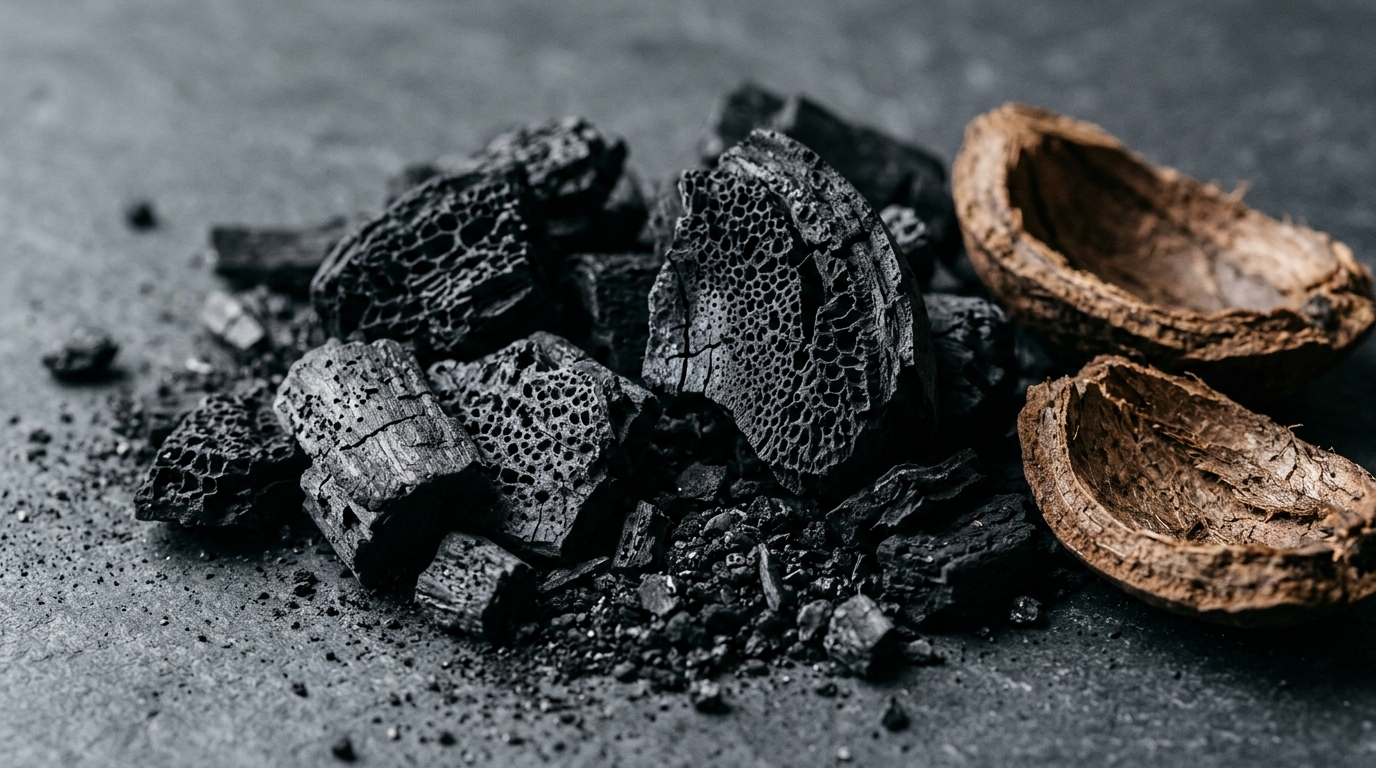
To produce the carbonaceous adsorbent, the investigative team valorized discarded agricultural shells of the baru fruit collected from native Cerrado woodlands located within the state of Mato Grosso, Brazil. Following the manual recovery of the edible almonds, the remaining woody structures—incorporating the dense endocarp, mesocarp, and epicarp layers—were thoroughly washed with distilled water to dislodge adhering debris and dried in an oven maintained at 100 degrees Celsius for 12 hours. The dehydrated woody fractions were subsequently reduced in an analytical mill and classified through an electromagnetic vibrating sieve to isolate uniform precursor particles exhibiting dimensions between 50 and 60 micrometers, designated as Bru. A formal botanical voucher specimen was deposited in the institutional herbarium of Embrapa Pecuaria Sul in Bage, Rio Grande do Sul, under accession number CNPO 5795 to ensure rigorous experimental reproducibility and taxonomic verification across subsequent investigations.
Chemical activation was accomplished by thoroughly blending the classified baru shell particles with concentrated analytical-grade phosphoric acid at an established one-to-two biomass-to-acid mass ratio, followed by controlled thermal decomposition. The acid-impregnated slurry was incubated at 80 degrees Celsius for two hours to induce preliminary biopolymer dehydration and structural rearrangement before entering a conventional laboratory furnace. Pyrolysis proceeded at a target temperature of 550 degrees Celsius for one hour under a restricted-oxygen atmosphere, utilizing a controlled heating ramp of 8.5 degrees Celsius per minute. After passive cooling, the resulting solid residue was collected through filtration, repeatedly washed with distilled water until reaching a neutral filtrate pH, and dried at 105 degrees Celsius for 12 hours to yield the finished activated biochar, designated Bru-BC. The chemical treatment protocol relied on established principles of lignocellulosic activation rather than comparative screening against raw biochar, establishing baseline performance for the finished activated matrix.
Elemental analysis demonstrated that thermal activation and acid treatment substantially restructured the fundamental chemical framework of the precursor material, converting raw lignocellulose into a dense, condensed aromatic matrix. The carbon concentration of the material increased from an initial 57.10 weight percent in the raw biomass to 82.07 weight percent in the final activated product, accompanied by substantial losses in volatile heteroatoms. Hydrogen and oxygen fractions decreased sharply, driving the bulk hydrogen-to-carbon atomic ratio down from 0.71 to 0.38, while the corresponding oxygen-to-carbon atomic ratio dropped from 0.51 to 0.14. This sharp decline in surface oxygen content confirms extensive devolatilization and dehydration during thermal processing, yielding an interface characterized by low polarity and extensive carbon condensation. Researchers treated this low oxygen-to-carbon ratio as a qualitative indication of surface organophilicity rather than a direct quantitative thermodynamic metric, noting that formal solvent wettability and interfacial partition coefficients require separate experimental confirmation.
Nitrogen adsorption-desorption measurements performed at 77 Kelvin revealed that Bru-BC developed a well-developed, hierarchically structured porous network during chemical activation. Brunauer-Emmett-Teller analysis indicated an expansive specific surface area of 1250 square meters per gram alongside a cumulative pore volume of 0.576 cubic centimeters per gram. Barrett-Joyner-Halenda pore-size distribution curves demonstrated an extensive distribution of mesopores extending through the intermediate size domain, complementing narrow microporous cavities that generate sharp low-pressure gas uptake. Scanning electron microscopy operating at 15 kilovolts examined surface topography at magnifications of 500 and 1000 times, disclosing an irregular, rugged morphology punctured by macroscopic cavities, fissures, and structural channels formed during acid etching and gas release. While these micrometer-scale topological cavities visible under electron microscopy visually complement the gas sorption data, researchers emphasized that optical fissures should not be confused with nanoscale adsorption pores.
Spectroscopic evaluations tracked structural changes across the activation process and corroborated the retention of dye molecules on the recovered carbon. Infrared spectra of the raw baru biomass displayed characteristic lignocellulosic vibrations, including a broad hydroxyl stretching band at 3344 reciprocal centimeters, aliphatic carbon-hydrogen vibrations at 2928 and 2869 reciprocal centimeters, and carbonyl ester absorptions at 1728 reciprocal centimeters. Following phosphoric acid activation, Bru-BC exhibited condensed aromatic carbon-carbon skeletal vibrations at 1556 reciprocal centimeters along with diagnostic phosphorus-oxygen functional bands at 1149, 1068, and 978 reciprocal centimeters. After exposure to Sudan IV in hexane, the biochar spectrum displayed prominent azo-aromatic fingerprints, including coupled aromatic and azo modes at 1543, 1497, 1448, and 1403 reciprocal centimeters, confirming persistent dye retention. Raman spectroscopy corroborated this disordered carbon structure, displaying a prominent D band near 1360 reciprocal centimeters alongside a G band near 1590 reciprocal centimeters, confirming sp2 aromatic carbon domains interspersed with structural defects.
Dynamic batch kinetic experiments revealed that the adsorption of Sudan IV from n-hexane onto Bru-BC occurred with remarkable speed at ambient laboratory temperatures. Testing initial dye concentrations of 100 and 200 milligrams per liter demonstrated that more than 90 percent of total equilibrium dye uptake occurred within the initial 20 minutes of contact time. For the lower concentration, uptake increased from 38.64 milligrams per gram at 5 minutes to 49.33 milligrams per gram at 20 minutes, stabilizing near an experimental plateau of 50.33 milligrams per gram, while the higher concentration reached 92.74 milligrams per gram at 20 minutes before leveling at approximately 94.0 milligrams per gram. Mathematical modeling using nonlinear regression demonstrated that the fractal-like pseudo-first-order equation provided the best statistical description of uptake kinetics, achieving adjusted determination coefficients of 0.9986 and 0.9983 alongside lowest Bayesian information criterion values of minus 3.6 and positive 9.2. Researchers underscored that superior empirical fitting reflects time-dependent rate phenomena rather than demonstrating an isolated elementary reaction mechanism or proving covalent chemisorption.
Nonlinear equilibrium modeling over an initial concentration range spanning 20 to 1000 milligrams per liter at 25 degrees Celsius demonstrated that the three-parameter Liu model best captured the heterogeneous adsorption isotherms. The Liu equation yielded an adjusted determination coefficient of 0.9979, a residual standard deviation of 4.32 milligrams per gram, and a Bayesian information criterion of 41.6, outperforming standard Langmuir and Freundlich equations by substantial margins. The fitted maximum saturation capacity reached 344 plus or minus 25 milligrams per gram, with an equilibrium affinity constant of 0.00250 liters per milligram and a dimensionless exponent of 1.312. This capacity compares favorably to previously reported values for modified activated carbons used in oily phases, which recorded maximum uptakes around 200 and 193.6 milligrams per gram. Mechanistically, dye capture relies on convergent physical phenomena, including steric pore filling within hierarchical channels, London dispersion forces, and extensive pi-pi stacking interactions between the conjugated aromatic systems of Sudan IV and the polyaromatic carbon sheets of the biochar.
The operational durability and recyclability of the activated biochar were examined through four consecutive adsorption-desorption sequences using liquid toluene as the desorbing wash solvent. After each adsorption phase, the spent biochar was agitated in toluene for one hour to elute bound dye, recovered through phase separation, oven-dried, and reintroduced into fresh hexane-dye solutions. Bru-BC maintained approximately 60 percent removal efficiency by the fourth cycle, down from approximately 82 percent during the initial cycle, confirming that substantial adsorption capacity remains accessible across repeated cycles. The authors noted that future development must address several experimental limitations, including calculating complete mass balances for solvent consumption and solid adsorbent recovery during regeneration. Furthermore, evaluating multi-solute streams and testing alternative nonpolar solvents remain essential next steps before agricultural waste biochars can be deployed broadly in commercial continuous-flow solvent purification systems.
Subject of Research: Adsorption of Sudan IV from n-hexane using activated Dipteryx alata biochar
Article Title: Reusable activated biochar from Dipteryx alata shells for adsorptive removal of Sudan IV from n-hexane
Article References: Barcellos Junior, J. T. S., Rapachi, D., Gelesky, M. A., Filho, A. C. D., Lima, E. C., & Pavan, F. A. (2026). Reusable activated biochar from Dipteryx alata shells for adsorptive removal of Sudan IV from n-hexane. Discover Chemistry, 3(1), Article 652. https://doi.org/10.1007/s44371-026-01124-3
Image Credits: AI Generated
DOI: 10.1007/s44371-026-01124-3
Keywords: Dipteryx alata, baru shell, activated biochar, Sudan IV, n-hexane, solvent purification, phosphoric acid activation, adsorption kinetics, Liu isotherm, fractal-like pseudo-first-order, hierarchical porosity, toluene desorption, Raman spectroscopy, nonpolar media adsorption, biomass valorization, azo dye removal, specific surface area
News Source: Bethany Barker. (November 28, 2026). Activated Biochar From Baru Fruit Shells Removes Sudan IV From Hexane. Scienmag.