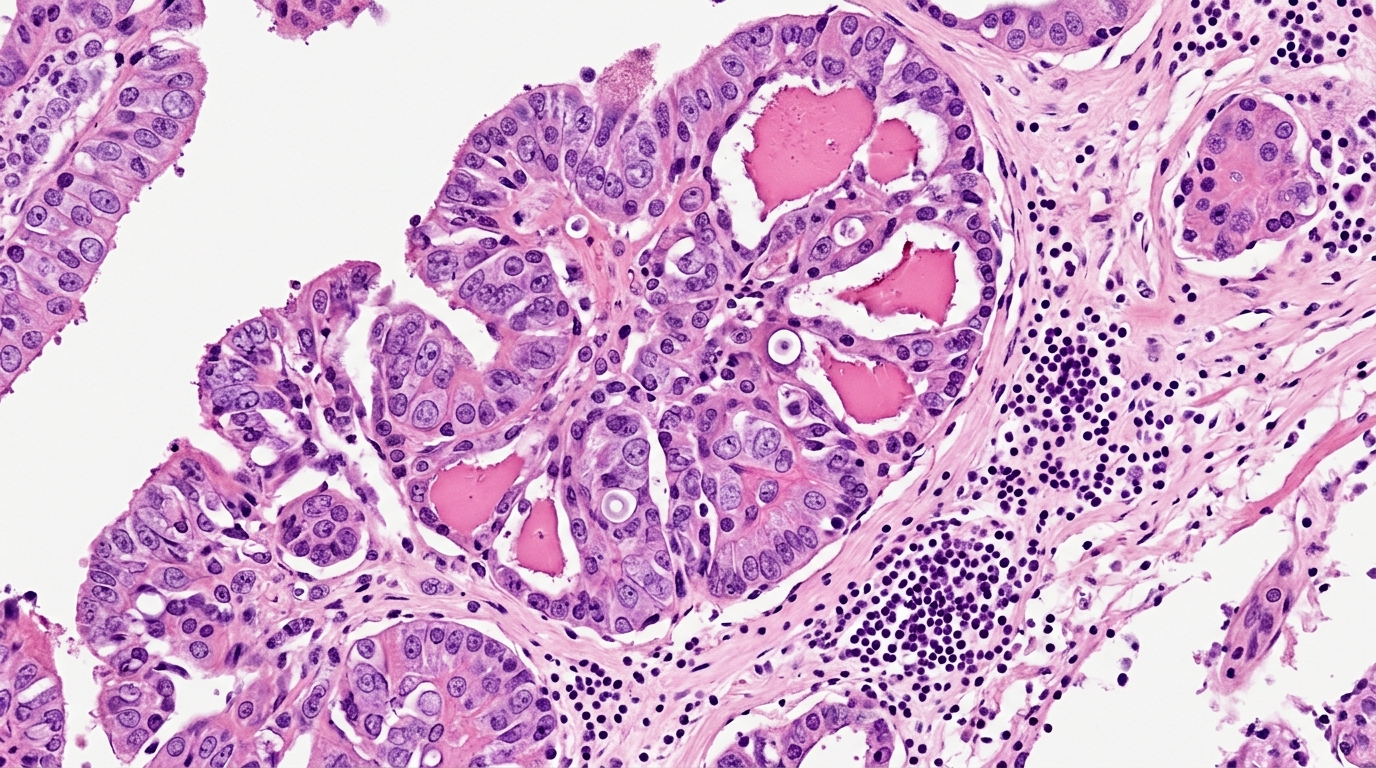
A computational transcriptomic analysis integrating clinical cases and large genomic datasets has identified two functionally distinct molecular subtypes of thyroid cancer defined by gene expression patterns related to thyroid function and autoimmunity. The investigation, published in Frontiers in Endocrinology, evaluated whether molecular signatures linked to hyperthyroidism could classify tumors and uncover biological variations across thyroid carcinomas, including ultrasonographically occult cases.
The researchers initiated their analysis following clinical observations of patients undergoing thyroidectomy for hyperthyroidism who presented with negative preoperative high-resolution ultrasound evaluations but were subsequently found to have unexpected postoperative malignant foci. To investigate the molecular characteristics of these occult carcinomas, the team enrolled nine hyperthyroid patients whose post-surgical clinicopathological evaluations confirmed malignant lesions, including instances exhibiting capsular invasion or extrathyroidal extension.
To explore these transcriptomic mechanisms across broader populations, the study integrated gene expression profiles from TCGA-THCA, GSE9340 combined with GTEx, and GSE33630 cohorts to identify differentially expressed genes associated with hyperthyroidism. Applying unsupervised clustering based on forty hyperthyroidism-associated differentially expressed genes, the authors categorized 505 thyroid carcinoma samples from the TCGA-THCA dataset into two distinct molecular groups, labeled Cluster A and Cluster B.
The classification revealed pronounced differences in biological pathway enrichment between the two groups. Cluster A, comprising 134 cases or 26.5 percent of the analyzed TCGA cohort, demonstrated enrichment in thyroid hormone synthesis and mitochondrial oxidative metabolism pathways, leading investigators to designate it as the hormone-metabolic or differentiated subtype. Conversely, Cluster B encompassed 371 cases, representing 73.5 percent of the cohort, and displayed predominant enrichment in immune activation pathways and extracellular matrix-receptor interactions, designated as the immune-active or inflammatory subtype.
Using weighted gene co-expression network analysis, the researchers identified specific gene modules strongly correlated with these phenotypes. Module ME3 showed a strong positive correlation with Cluster B, with a correlation coefficient of 0.891 and a p-value of less than 0.001, while modules ME9 and ME14 were associated with Cluster A. Protein-protein interaction network construction and machine learning further narrowed the signature down to thirty consensus genes across cohorts, highlighting eight core genes: NGEF, SCD, TIMP1, CTSH, PPARGC1A, PRKACB, ITPR1, and ANXA2.
To evaluate computational reproducibility, the team constructed a core gene-based classifier using the LASSO algorithm, which achieved an area under the curve of 0.9986 for the internal reproduction of the computational cluster labels. Cross-cohort consistency analysis conducted in the GSE33630 validation dataset confirmed a 90 percent expression-direction consistency for the thirty consensus genes. In characterizations of the tumor microenvironment, Cluster B exhibited transcriptomic features characteristic of a hot tumor, marked by elevated immune scores and overexpression of immune checkpoints, whereas Cluster A displayed profiles typical of a cold tumor.
Computational drug sensitivity assessments indicated that Cluster B had predicted lower half-maximal inhibitory concentrations for inhibitors targeting the MAPK pathway, PI3K, AKT, mTOR signaling, and receptor tyrosine kinases. The authors emphasized that these findings stem from an exploratory bioinformatic framework and in silico predictions. They noted that the identified immune microenvironmental phenotypes and therapeutic sensitivities require functional laboratory validation and direct clinical evaluation in prospective hyperthyroid cohorts.
Subject of Research: Transcriptomic subtyping of thyroid cancer associated with thyroid function and autoimmunity
Article Title: Transcriptomic signatures associated with thyroid function and autoimmunity identify immune-active and hormone-metabolic subtypes of thyroid cancer: a clinical case-driven integrative analysis
Article References: Li, X., Qiu, L., Chen, X., Ke, N., Sun, B., Wang, T., Song, Y., Wu, J., Liu, Y., Chen, J., & Xie, W. (2026). Transcriptomic signatures associated with thyroid function and autoimmunity identify immune-active and hormone-metabolic subtypes of thyroid cancer: a clinical case-driven integrative analysis. Frontiers in Endocrinology, 17, Article 2007256. https://doi.org/10.3389/fendo.2026.2007256
Image Credits: AI Generated
DOI: 10.3389/fendo.2026.2007256
Keywords: thyroid cancer, transcriptomics, hyperthyroidism, molecular subtyping, tumor microenvironment, immune checkpoint, TCGA-THCA, GSE33630, WGCNA, LASSO classifier, cold tumor, hot tumor, thyroid hormone synthesis, extracellular matrix, drug sensitivity, endocrinology
News Source: Nathaniel Bowman. (November 28, 2026). Transcriptomic Analysis Identifies Distinct Immune and Metabolic Subtypes in Thyroid Cancer. Scienmag.