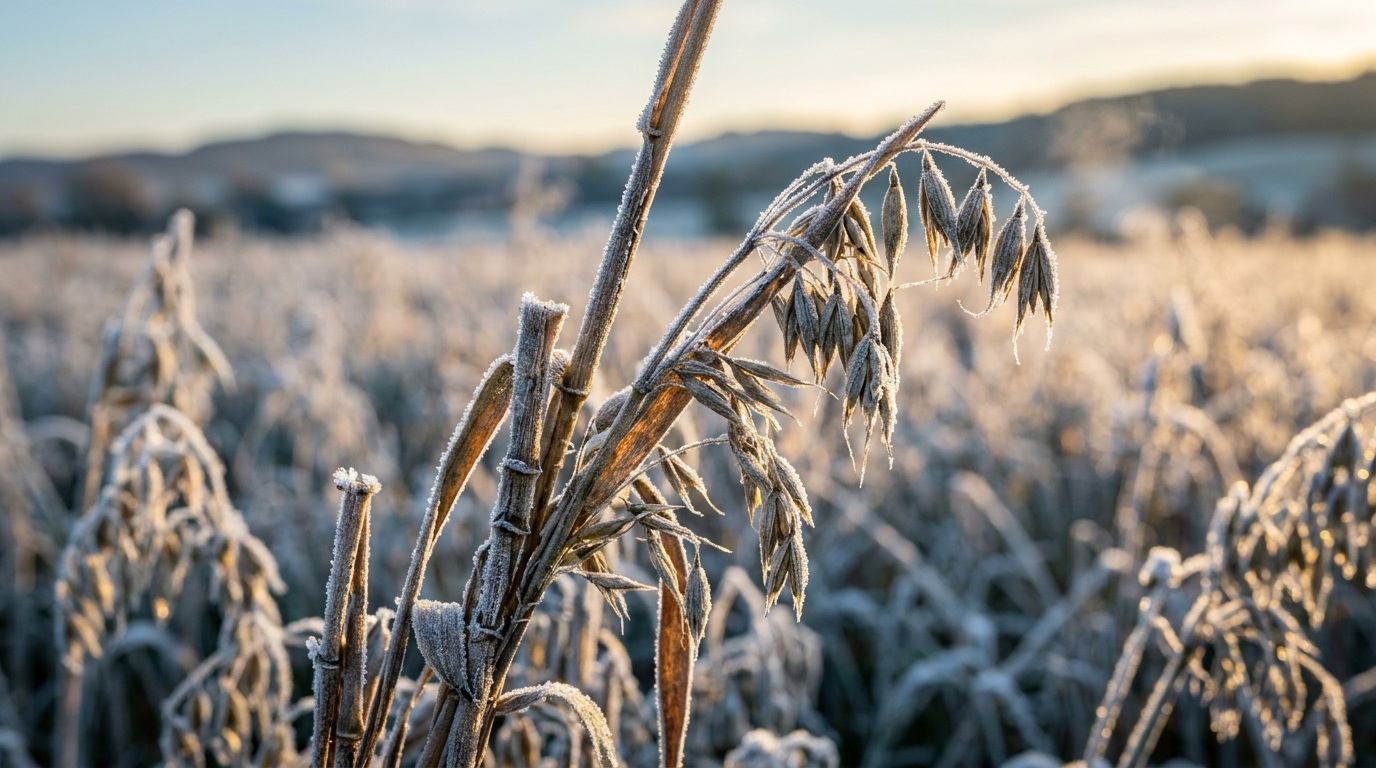
Oat has become one of agriculture’s quiet climate stories. As warming pushes cultivation toward higher latitudes, the crop increasingly runs into late spring frost, sudden cold waves and heavy rainfall, often in quick succession during early vegetative growth. A new review published in Applied Biological Chemistry on 7 September 2026 pulls together what is known about how oat (Avena sativa L.) copes with two of the most punishing of these stresses, low temperature and waterlogging, and the picture that emerges is strikingly lopsided: the crop is comparatively poor at handling freezing but unusually good at surviving flooded soil.
The review, written by Eunchae Bae, Nusrat Jahan Methela and colleagues, argues that the two stresses, although driven by different environmental conditions, produce overlapping physiological consequences. Both disrupt cellular homeostasis, generate oxidative stress through reactive oxygen species, reprogram hormone signaling and force extensive structural remodeling of tissues. That convergence, the authors contend, means oat adaptation should be understood as an integrated stress-response network rather than a set of independent reactions to each stress, and it makes the anatomical side of the story, long neglected in favor of biochemical and breeding studies, essential to grasp.
On the cold side, the news is not encouraging for growers. The review states plainly that oats exhibit relatively poor freezing tolerance compared with cereals such as wheat, owing to limited structural flexibility and less efficient activation of the calcium-dependent and CBF/DREB1-mediated signaling pathways that underpin cold acclimation. In the canonical cold-response pathway, falling temperatures stiffen cell membranes, which act as primary sensors; calcium ions flood into cells as secondary messengers; and the signal travels through protein kinases such as CPKs to switch on the master transcription factors CBF/DREB1, comprising DREB1A/CBF3, DREB1B/CBF1 and DREB1C/CBF2. These trigger a cascade of cold-responsive (COR) genes that produce protective LEA proteins and sugar-metabolizing enzymes, and also regulate cell wall-modifying enzymes such as XTH and expansin, which loosen xyloglucan chains and give walls the flexibility needed to endure the shrinkage caused by freeze-induced dehydration. In wheat, this induction is vigorous. In oats, the review reports, cell wall remodeling is comparatively limited, leaving tissues more susceptible to mechanical damage as ice forms outside cells and water is drawn out of them.
The anatomical evidence reinforces that vulnerability. The crown, the complex tissue at the base of the stem containing the apical meristem, vascular tissues and parenchyma, is the organ from which cereals recover after low-temperature damage to shoots; necrosis there can kill the plant. Initial freezing injury strikes the vascular transition zone between the shoot apical meristem and the nodal plate, and severe damage there disrupts water transport and root regeneration. Freezing can visibly deform crown xylem within 30 minutes, and cell debris and polysaccharides then block the vessels as a secondary injury. Yet the review highlights a distinctive oat strategy: where the wheat apical meristem maintains structural integrity and surviving cells resume division, oat meristem cells can undergo necrosis, and the crop appears to form a lignified structural barrier between living and necrotic tissues, physically containing the spread of freezing injury. Secondary meristems and cells in the central crown region tend to keep their integrity, and anatomical redundancy in the vascular system provides alternative transport pathways around blocked xylem. In effect, oat survives cold not by resisting it the way wheat does, but by quarantining damage and protecting what remains.
Stem architecture adds another layer. A recent three-dimensional imaging study by Heuschele and colleagues, cited in the review, compared nodes and internodes of wheat and oat and found that oat nodes are densely packed, with a thicker nodal diaphragm (1.94 versus 1.58 millimeters, p = 0.031) and a thicker internode stem wall (0.89 versus 0.77 millimeters, p = 0.0426). The authors likened wheat to a light, flexible spring and oat to a thick, rigid one, suggesting that wheat’s air spaces absorb tissue deformation during compression and bending. The size of the central lacuna did not differ significantly between the species, though it varies with genotype and internode position. Because extracellular freezing propagates rapidly along vascular bundles before diffusing into surrounding tissues, as infrared thermography studies have shown, the review argues that these internal spatial differences may shape how freezing injury develops in each crop, although it cautions that direct studies of oat stem cell wall chemistry, mechanical plasticity under freezing and cold-induced wall reorganization remain very limited.
Waterlogging tells the opposite story. Excessive soil moisture sharply restricts gas diffusion, starving roots of oxygen and inhibiting respiration; under severe or prolonged exposure plants can die prematurely. Oat, however, shows relatively high tolerance among cereals, and the review attributes this to anatomical plasticity: aerenchyma formation and adventitious root development that maintain oxygen diffusion and root function under hypoxia. Aerenchyma, continuous internal air channels, forms when waterlogging limits ethylene diffusion from roots, allowing the hormone to accumulate in tissues. Accumulated ethylene upregulates respiratory burst oxidase homologue (RBOH) genes, boosting ROS production, and these signaling molecules promote the programmed death of specific cortical cells. Pectin is modified, the middle lamella dissolves, and cell wall-degrading enzymes finish the job, leaving connected air spaces that ferry oxygen from shoots toward root tips. The review stresses that this is an actively regulated strategy, not passive tissue breakdown.
Adventitious roots complete the flood-survival kit. These roots arise from non-root tissues such as stems and nodes, where dormant primordia form at each node during normal development and emerge during submergence to replace the impaired original root system. Hypoxia rapidly activates ethylene signaling and hypoxia-related genes; abscisic acid levels fall in the adventitious roots, releasing cell division from dormancy; and auxin produced in shoots accumulates in stems, driving division and elongation. The new roots emerge near the soil surface, where oxygen is relatively more available, sustaining absorption while the original roots fail. Measurements cited in the review show oat achieves high root porosity and high aerenchyma ratios in adventitious roots, and comparative work by Setter and Waters found oat develops higher aerenchyma ratios than wheat and barley, a pattern consistent with the relative waterlogging tolerance of these crops. Oat also exhibits substantial recovery after waterlogging ends.
The review’s integrative claim is that these two halves of oat stress biology share machinery. Cell wall remodeling serves double duty, increasing flexibility during freeze-induced dehydration while also enabling cortical cell death and lysigenous aerenchyma during flooding. ROS signaling participates in both cold acclimation and hypoxia responses, and calcium-dependent signaling, hormonal reprogramming involving abscisic acid, ethylene and auxin, and dynamic wall modification are activated under both conditions. Emerging evidence, the authors note, suggests potential cross-talk between low-temperature and waterlogging responses through these overlapping regulatory networks. Avenanthramides, the phenolic-amide compounds unique to oat, add a metabolic dimension: they are inducible secondary metabolites whose accumulation rises under oxidative stress via the phenylpropanoid pathway, while β-glucan and ferulic acid contribute to cell wall integrity and reinforcement, potentially linking functional food chemistry with structural adaptation, though the review flags that relationship as still unclear.
Where does this leave breeders? The authors argue that structural traits, aerenchyma, lignification, crown architecture and growing-point protection, are closely tied to survival but remain understudied in oat relative to other cereals, and the regulatory mechanisms coordinating structural and physiological responses are largely unresolved. They point to advanced imaging platforms, confocal laser scanning microscopy, serial block-face scanning electron microscopy, focused ion beam SEM, X-ray micro-computed tomography and correlative 3D imaging, combined with multi-omics, spatial analyses and AI-based anatomical phenotyping, as the route to identifying structural biomarkers of climate resilience. Strengthening structural flexibility while preserving the adaptive plasticity that makes oat so flood-tolerant, the review concludes, may be the key to cultivars that can withstand both the frost and the rain that a changing climate increasingly delivers together.
Subject of Research: Structural and physiological adaptations of oat to low-temperature and waterlogging stress under climate change
Article Title: Structural and physiological adaptations of oat (Avena sativa L.) adaptation to low temperature and waterlogging stress under climate change
Article References: Bae, E., Methela, N. J., Lee, N., Lee, Y., Yu, G., Lee, J. S., Yook, M.-J., Yoo, H.-S., Hwang, E.-B., Hwang, T.-Y., Lee, G.-H., Mun, B.-G., & Lee, M.-S. (2026). Structural and physiological adaptations of oat (Avena sativa L.) adaptation to low temperature and waterlogging stress under climate change. Applied Biological Chemistry, 69(1), Article 54. https://doi.org/10.1186/s13765-026-01121-1
Image Credits: AI Generated
DOI: 10.1186/s13765-026-01121-1
Keywords: oat, Avena sativa, low-temperature stress, waterlogging, aerenchyma, adventitious roots, CBF/DREB1, cell wall remodeling, climate change, crown anatomy, reactive oxygen species, ethylene signaling
News Source: Drew Townsend. (November 5, 2026). Oat survival playbook revealed: rigid stems, aerenchyma and a cold-weakness problem. Scienmag.