


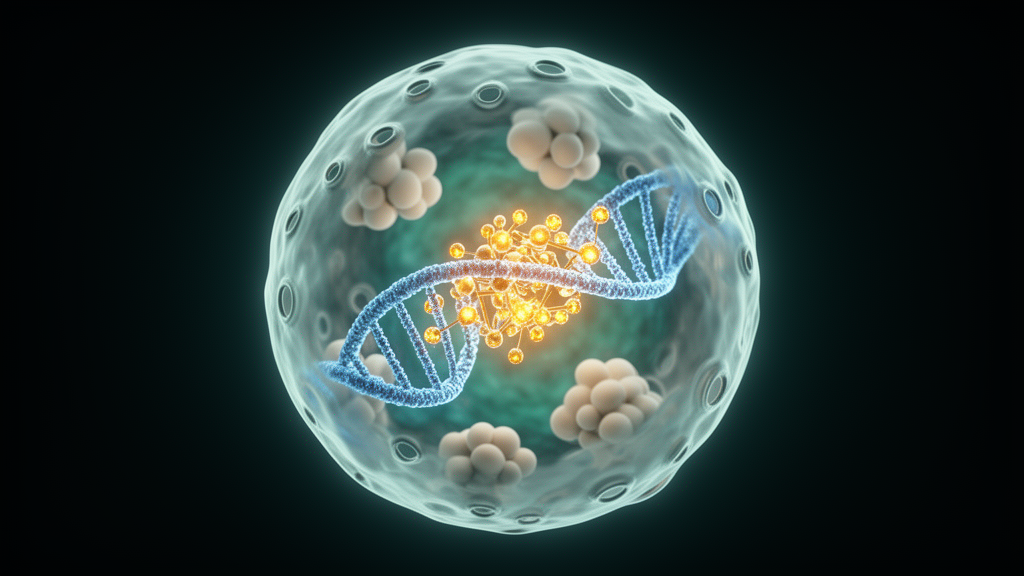
Casein kinase 1 alpha, long known as a brake on the WNT/β-catenin pathway, has now been caught playing a second, opposite role inside the cell nucleus. In a study published in Cell Communication and Signaling, researchers report that specific nuclear isoforms of CK1α act as integral components of the β-catenin/TCF transcriptional complex and are required for WNT-driven transcription in gastrointestinal cancer cells. The finding reframes a protein traditionally viewed as a tumor suppressor within the destruction complex, showing that its location within the cell determines whether it suppresses or amplifies the same signaling pathway.
The story begins with alternative splicing of the CSNK1A1 gene, which generates multiple CK1α isoforms with distinct subcellular localizations and regulatory properties. Cytoplasmic CK1α is a well-established negative regulator of canonical WNT signaling: it phosphorylates β-catenin at Ser45, priming the protein for degradation and keeping WNT target genes silent. What the nuclear pool of the enzyme does, however, has remained poorly understood. The new work identifies L-insert-containing nuclear CK1α isoforms as functional components of the β-catenin/TCF transcriptional machinery in gastrointestinal cancer cells, filling a conspicuous gap in the map of the WNT pathway.
Using isoform-specific assays, the team demonstrated that CK1α isoforms carrying the L-insert accumulate in the nucleus to a greater extent than isoforms lacking this insertion, and that these nuclear isoforms support WNT-driven transcription. When the researchers knocked down the L-insert-containing isoforms in esophageal adenocarcinoma and colorectal cancer models, the consequences were direct and measurable: β-catenin recruitment to TCF-bound chromatin was reduced, and the expression of WNT target genes was attenuated. In other words, without these nuclear isoforms, the transcriptional complex loses its grip on the DNA targets it needs to activate.
A second set of experiments probed the role of the kinase’s catalytic activity. The researchers introduced kinase-inactive CK1α mutants and found that these mutants retained their association with the β-catenin/TCF complex but showed reduced WNT reporter activity. This dissociation between binding and output indicates that CK1α catalytic activity is dispensable for the physical association with the transcriptional complex but is required for full transcriptional activation. In other words, CK1α must be catalytically active to deliver the full WNT transcriptional signal, even though its presence in the complex alone does not require that activity.
The study then turned the logic around and exploited the canonical negative regulatory function of CK1α. Pharmacological activation of the kinase with SSTC3 increased β-catenin Ser45 phosphorylation, reduced the abundance of active β-catenin, and limited its nuclear availability and binding to TCF sites. The downstream effect was an attenuation of WNT transcriptional activity and a reduction in tumor-initiating cell (TIC)-enriched populations in gastrointestinal tumors.
These molecular effects translated into behavior in living systems. In vivo, SSTC3-mediated CK1α activation reduced tumorigenic potential and delayed tumor regrowth. The authors argue that together, the findings identify L-insert-containing nuclear CK1α isoforms as positive regulators of WNT transcription, in contrast to the negative regulatory function of cytoplasmic CK1α within the β-catenin destruction complex, and provide a rationale for pharmacological CK1α activation as a strategy to target WNT-driven tumor-initiating cells.
The conceptual payoff is a location-dependent switch. The same gene product, CSNK1A1, produces isoforms that either dismantle β-catenin in the cytoplasm or help assemble the transcriptional apparatus in the nucleus, depending on whether their sequence carries the L-insert and where they localize. Activation, by contrast, strengthens the destruction-side function while the nuclear isoforms’ positive role is starved of active β-catenin substrate.
The kinase-inactive mutant data add a mechanistic layer: complex assembly and transcriptional output are separable functions, with catalytic activity needed only for the latter. That separation gives medicinal chemists two distinct intervention points on the same protein, and the SSTC3 experiments show that biasing the kinase toward its destructive mode is pharmacologically achievable.
Limitations are worth keeping in view. The mechanistic evidence comes from gastrointestinal cancer cell models, specifically esophageal adenocarcinoma and colorectal cancer, and the in vivo findings concern tumor growth and regrowth dynamics in those systems. The study was shared early as a peer-reviewed, accepted version of record pending final edits. Whether L-insert-containing nuclear CK1α isoforms behave identically in other WNT-driven tumor types, and whether SSTC3-like compounds can be developed into clinically usable agents, remain questions for future work. Still, the core message stands: in WNT-driven tumor-initiating cells, the nuclear arm of CK1α is not an accessory but a required component of the transcriptional engine, and turning up the kinase’s activity elsewhere in the cell may be the more effective way to shut that engine down.
Subject of Research: Nuclear CK1α isoforms as components of the WNT/β-catenin transcriptional complex in gastrointestinal tumor-initiating cells
Article Title: Nuclear CK1α as an integral component of the WNT/β-catenin transcriptional complex is required in WNT-driven tumor-initiating cells
Article References: Alvarez-Trotta, A., Shersher, E., Beckedorff, F., Martinez, C., Lahiry, M., Lavezzo, G. M., Umland, O., Cilingir, E. K., Astudillo, L., Diluvio, G., Rostami, N., Melendez, R. A., Kaneku, H., Fei, D., Nimer, S. D., & Capobianco, A. J. (2026). Nuclear CK1α as an integral component of the WNT/β-catenin transcriptional complex is required in WNT-driven tumor-initiating cells. Cell Communication and Signaling. https://doi.org/10.1186/s12964-026-03298-w
Image Credits: AI Generated
DOI: 10.1186/s12964-026-03298-w
Keywords: CK1α, CSNK1A1, WNT signaling, β-catenin, TCF, tumor-initiating cells, colorectal cancer, esophageal adenocarcinoma, alternative splicing, SSTC3, gastrointestinal cancer, transcriptional regulation
News Source: Nathaniel Bowman. (October 28, 2026). Nuclear CK1α joins the WNT transcription machine to drive tumor-initiating cells. Scienmag.



