• HOME
  • NEWS
  • EXPLORE
    • CAREER
      • Companies
      • Jobs
    • EVENTS
    • iGEM
      • News
      • Team
    • PHOTOS
    • VIDEO
    • WIKI
  • BLOG
  • COMMUNITY
    • FACEBOOK
    • INSTAGRAM
    • TWITTER
Sunday, October 4, 2026
BIOENGINEER.ORG
No Result
View All Result
  • Login
  • HOME
  • NEWS
  • EXPLORE
    • CAREER
      • Companies
      • Jobs
        • Lecturer
        • PhD Studentship
        • Postdoc
        • Research Assistant
    • EVENTS
    • iGEM
      • News
      • Team
    • PHOTOS
    • VIDEO
    • WIKI
  • BLOG
  • COMMUNITY
    • FACEBOOK
    • INSTAGRAM
    • TWITTER
  • HOME
  • NEWS
  • EXPLORE
    • CAREER
      • Companies
      • Jobs
        • Lecturer
        • PhD Studentship
        • Postdoc
        • Research Assistant
    • EVENTS
    • iGEM
      • News
      • Team
    • PHOTOS
    • VIDEO
    • WIKI
  • BLOG
  • COMMUNITY
    • FACEBOOK
    • INSTAGRAM
    • TWITTER
No Result
View All Result
Bioengineer.org
No Result
View All Result
Home NEWS Science News Chemistry

New skills of Graphene: Tunable lattice vibrations

Bioengineer by Bioengineer
March 1, 2021
in Chemistry
Reading Time: 2 mins read
0
IMAGE
Share on FacebookShare on TwitterShare on LinkedinShare on RedditShare on Telegram

IMAGE

Credit: K. Höflich/HZB

Without electronics and photonics, there would be no computers, smartphones, sensors, or information and communication technologies. In the coming years, the new field of phononics may further expand these options. That field is concerned with understanding and controlling lattice vibrations (phonons) in solids. In order to realize phononic devices, however, lattice vibrations have to be controlled as precisely as commonly realized in the case of electrons or photons.

Phononic cyrstals

The key building block for such a device is a phononic crystal, an artificially fabricated structure in which properties such as stiffness, mass or mechanical stress vary periodically. Phononic devices are used as acoustic waveguides, phonon lenses, and vibration shields and may realize mechanical Qubits in the future. However, until now, these systems operated at fixed vibrational frequencies. It was not possible to change their vibrational modes in a controlled manner.

Periodic hole pattern in graphene

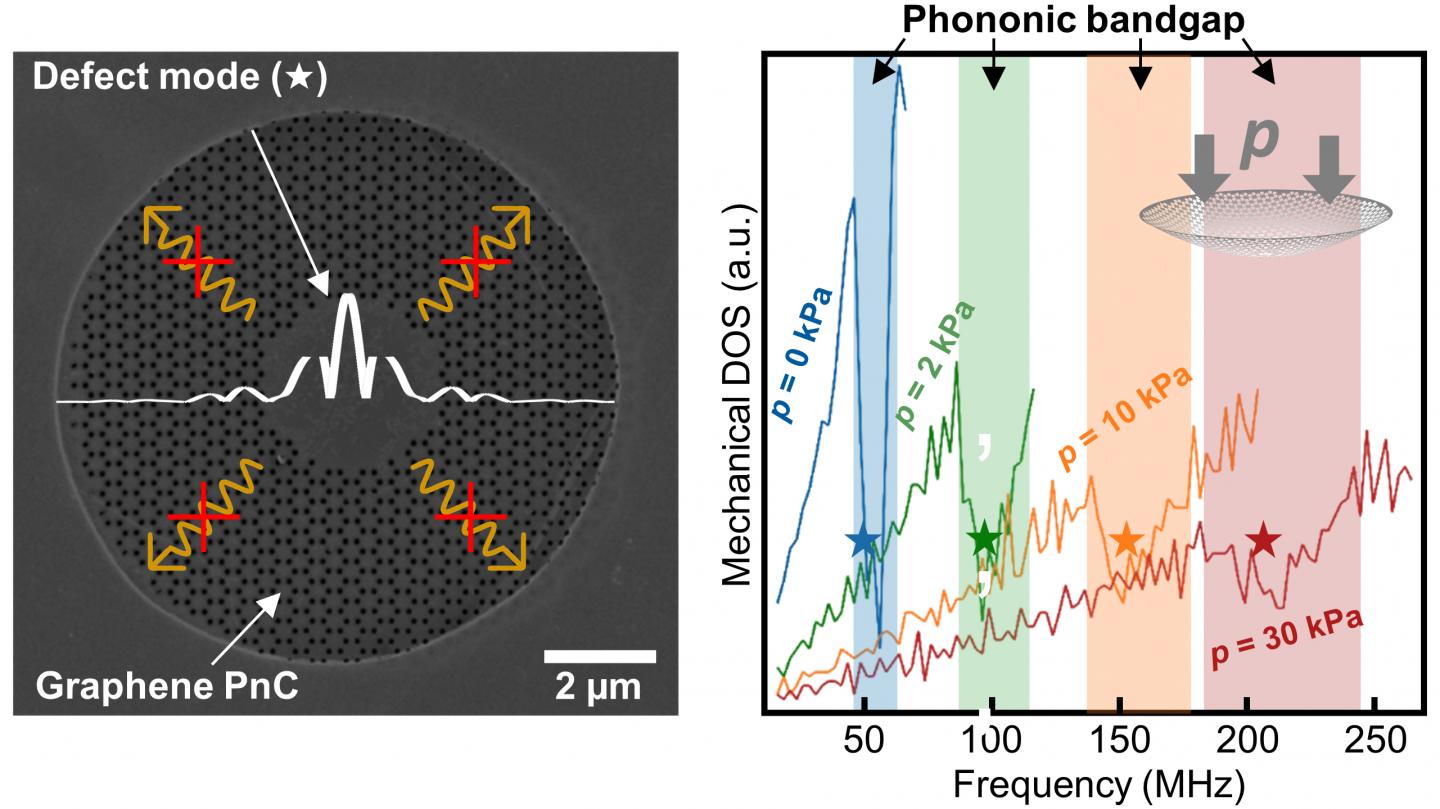
Now, for the first time, a team at Freie Universität Berlin and HZB has demonstrated this control. They used graphene, a form of carbon in which the carbon atoms interconnect two-dimensionally to form a flat honeycomb structure. Using a focused beam of helium ions, the team was able to cut a periodic pattern of holes in the graphene. This method is available at CoreLab CCMS (Correlative Microscopy and Spectroscopy). “We had to optimize the process a lot to cut a regular pattern of holes in the graphene surface without touching neighbouring holes,” Dr. Katja Höflich, group leader at Ferdinand-Braun-Institut Berlin and guest scientist at HZB, explains.

Bandgap and tunability

Jan N. Kirchhof, first author of the study now published in Nano Letters, calculated the vibrational properties of this phononic crystal. His simulations show that in a certain frequency range no vibrational modes are allowed. Analogues to the electronic band structure in solids, this region is a mechanical band gap. This band gap can be used to localize individual modes to shield them from the environment. What’s special here: “The simulation shows that we can tune the phononic system quickly and selectively, from 50 megahertz to 217 megahertz, via applied mechanical pressure, induced by a gate voltage.” says Jan Kirchhof.

Future applications

“We hope that our results will push the field of phononics further. We expect to discover some fundamental physics and develop technologies that could lead to application in e.g. ultrasensitive photosensors or even quantum technologies” explains Prof. Kirill Bolotin, head of the FU working group. The first experiments on the new phononic crystals from HZB are already underway in his group.

###

Media Contact
Antonia Roetger
[email protected]

Original Source

https://www.helmholtz-berlin.de/pubbin/news_seite?nid=22540;sprache=en;seitenid=1

Related Journal Article

http://dx.doi.org/10.1021/acs.nanolett.0c04986

Tags: AcousticsAtomic/Molecular/Particle PhysicsChemistry/Physics/Materials SciencesIndustrial Engineering/ChemistryMaterialsNanotechnology/Micromachines
Share12Tweet8Share2ShareShareShare2

Related Posts

AI Digital Twins Could Transform Intensive Care in Landmark $38 Million Federal Project

AI Digital Twins Could Transform Intensive Care in Landmark $38 Million Federal Project

October 4, 2026
Ancient Chinese Medicine Compounds Turned Into Next-Generation Antibiotic Candidates by AI

Ancient Chinese Medicine Compounds Turned Into Next-Generation Antibiotic Candidates by AI

October 4, 2026

How Bacteria Wire Themselves to Electrodes: The Electron Transfer Secrets Powering Microbial Fuel Cells

October 4, 2026

Scientists unlock rice protein’s hidden power as a plant-based emulsifier

October 4, 2026
Please login to join discussion

POPULAR NEWS

  • Alloys That Shrink Their Own Grains: New PIX Mechanism Refines Metals With Heat Alone

    Alloys That Shrink Their Own Grains: New PIX Mechanism Refines Metals With Heat Alone

    29 shares
    Share 12 Tweet 7
  • Endurance Exercise Reshapes the Liver in Males and Females Through Distinct Molecular Routes

    29 shares
    Share 12 Tweet 7
  • Single Transcription Factor PU.1 Rapidly Converts Fibroblasts into Macrophage-Lineage Cells

    29 shares
    Share 12 Tweet 7
  • New Scale Measures How Ready Nurse Educators Really Are for the AI Era

    29 shares
    Share 12 Tweet 7

About

We bring you the latest biotechnology news from best research centers and universities around the world. Check our website.

Follow us

Recent News

Alloys That Shrink Their Own Grains: New PIX Mechanism Refines Metals With Heat Alone

Endurance Exercise Reshapes the Liver in Males and Females Through Distinct Molecular Routes

Single Transcription Factor PU.1 Rapidly Converts Fibroblasts into Macrophage-Lineage Cells

Subscribe to Blog via Email

Success! An email was just sent to confirm your subscription. Please find the email now and click 'Confirm' to start subscribing.

Join 85 other subscribers
  • Contact Us

Bioengineer.org © Copyright 2023 All Rights Reserved.

Welcome Back!

Login to your account below

Forgotten Password?

Retrieve your password

Please enter your username or email address to reset your password.

Log In
No Result
View All Result
  • Homepages
    • Home Page 1
    • Home Page 2
  • News
  • National
  • Business
  • Health
  • Lifestyle
  • Science

Bioengineer.org © Copyright 2023 All Rights Reserved.