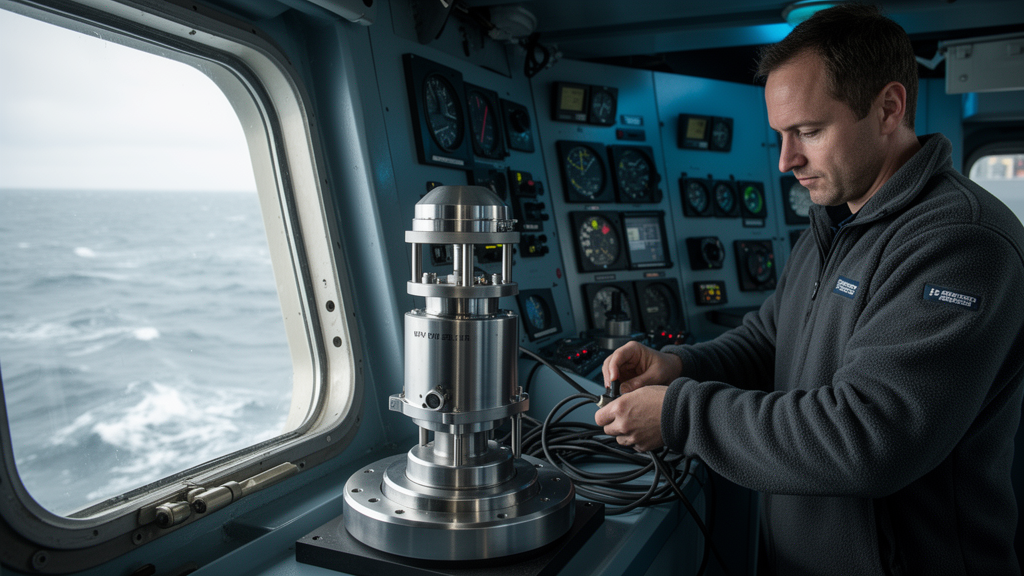
Researchers have developed a high-precision shipborne strapdown gravimetry method that remains robust when global navigation satellite system (GNSS) signals are interrupted or degraded, according to a peer-reviewed study published in Communications Engineering. The work addresses a persistent weakness in marine gravity measurement, where the accuracy of shipborne systems depends heavily on continuous, reliable satellite positioning. The team reports that under conditions combining GNSS signal outages and interference scenarios, the overall accuracy of the method reaches 0.771 milligal, a level of precision relevant to mapping subtle variations in Earth’s gravitational field at sea.
Strapdown gravimetry relies on coupling a strapdown inertial navigation system (SINS) with GNSS measurements. The inertial sensors track a vessel’s motion continuously, while satellite signals anchor that motion to absolute position and velocity, allowing the underlying gravity signal to be separated from the ship’s own accelerations. When GNSS signals drop out or suffer interference, this anchoring is lost, and errors in the inertial solution can grow rapidly, contaminating the derived gravity information. The new method is designed to keep producing reliable gravity data in real time and at low operating cost even under these anomalous conditions.
The approach adaptively switches between two measurement modes, each paired with a filtering strategy suited to the situation. During GNSS signal outages, the system uses an integration of the strapdown inertial navigation system with a pseudo log (SINS/PL), governed by a covariance matching adaptive Kalman filter. This configuration allows the system to continue outputting gravity information reliably while satellite positioning is unavailable. During periods of interference, or when signals are normal, the method reverts to SINS/GNSS integration based on a linear Huber-M estimation robust Kalman filter, which is designed to limit the influence of anomalous measurements on the navigation solution.
The adaptive design is central to the reported performance. By adjusting the measurement modes and applying the advanced filters according to the prevailing signal conditions, the method can effectively handle GNSS signal anomalies rather than degrading when they occur. The marine shipborne experiments described in the study tested the method under both signal outage and interference scenarios, and the reported 0.771 milligal figure reflects the overall accuracy achieved across those conditions.
According to the authors, compared to existing methods the approach has superior comprehensive performance, including higher computational efficiency and robustness. The combination of real-time output and low operating cost is presented as a practical advantage for marine gravity surveys, where maintaining reliable gravity information despite satellite signal problems has been a key factor limiting system performance. The study, published as an open-access article on 05 September 2026, positions the adaptive dual-mode filtering framework as a step toward more dependable high-precision gravity measurement at sea, even when the satellite signals that shipborne gravimetry normally depends on become unreliable.
Subject of Research: Adaptive robust filtering for shipborne strapdown gravimetry under GNSS signal anomalies
Article Title: A high-precision shipborne strapdown gravimetry method adaptively robust to global navigation satellite system signal anomalies
Article References: Qin, F., Qian, L., Li, K., Yan, J., Li, Y., Chen, H., Ding, Z., Zhang, G., Gong, W., Li, A., Zhu, T., Han, Y., Yang, H., Hu, L., & Niu, Y. (2026). A high-precision shipborne strapdown gravimetry method adaptively robust to global navigation satellite system signal anomalies. Communications Engineering. https://doi.org/10.1038/s44172-026-00768-4
Image Credits: AI Generated
DOI: 10.1038/s44172-026-00768-4
Keywords: shipborne gravimetry, GNSS anomalies, strapdown inertial navigation, Kalman filtering, marine geophysics, high-precision, shipborne, strapdown, gravimetry, method, adaptively, robust
News Source: Denise Maddox. (October 24, 2026). New Shipborne Gravimetry Method Stays Accurate When GNSS Signals Fail. Scienmag.