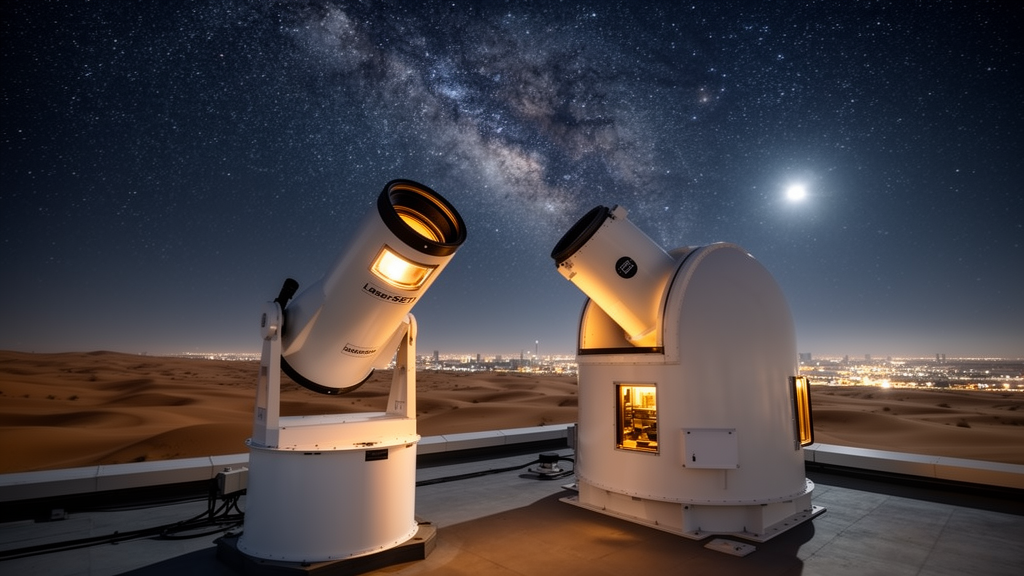
The night sky over AlUla in northwest Saudi Arabia is now under continuous automated watch by instruments designed to catch very brief flashes of light. The SETI Institute and the Royal Commission for AlUla (RCU) have installed and commissioned two LaserSETI stations at AlUla Manara, a milestone that makes AlUla the network’s first and only observing site in Asia and its fifth site worldwide. The new stations join existing installations in California, Hawai’i, Arizona and Puerto Rico, extending a distributed optical observatory that watches large portions of the sky continuously rather than focusing on single targets. According to the announcement, the instruments are fully operational and actively collecting astronomical data, marking the transition from a two-year-old plan to working hardware on the ground.
LaserSETI was conceived by the SETI Institute to keep a constant watch on large parts of the sky, searching for very brief flashes of light. The project treats these fleeting optical events as potential signatures of three distinct possibilities: short-lived cosmic events, unusual astronomical phenomena that conventional surveys may never catch in the act, or, potentially, laser technology originating beyond Earth. The logic behind the search is rooted in timing. Events too brief to be captured by scheduled observations of a conventional telescope can easily go unrecorded. An instrument that never stops watching, and that sees a wide field at once, is built precisely to close that gap.
Most telescopes, whether ground-based observatories or survey instruments, concentrate on one object or a small patch of sky at a time. LaserSETI works differently. Its wide-field cameras and diffraction gratings monitor large areas of the sky continuously, recording optical events that conventional observing strategies might miss entirely. This combination of breadth and persistence defines the project’s observing philosophy, and it is why the network’s designers describe it as a global observatory rather than a collection of individual telescopes. Rather than pointing at a chosen target and waiting, the system keeps its cameras open to broad expanses of sky at all hours, building a continuous record of whatever optical activity occurs within its field of view.
Location is a deliberate part of that philosophy. By spreading instruments around the world, the network can watch more of the sky for longer periods and compare unusual events seen from different places. AlUla brings both geographic and environmental value to this arrangement. Its protected dark skies provide favorable conditions for detecting faint optical phenomena, while its position in Asia extends LaserSETI’s observational coverage into an entirely new region, reducing the gaps in global coverage that a network confined to the Americas would inevitably leave. With sites now distributed across North America and Asia, the network’s designers gain the ability to examine unusual events from multiple geographic vantage points.
“Two years ago, we announced our intention to bring LaserSETI to AlUla. Today, the instruments are installed, commissioned and observing the sky,” said Dr. Franck Marchis, Senior Planetary Astronomer and Director of Citizen Science at the SETI Institute. “AlUla gives LaserSETI an important new geographic vantage point and connects this remarkable astronomical site to a growing global network. This is exactly what LaserSETI needs: instruments distributed around the world, observing continuously and together.” His remarks underline the project’s core premise, that the search for brief optical transients depends on instruments working in concert across time zones rather than any single site acting alone.
The two stations were installed on August 19, 2026, at the AlUla Manara ASM Site and are now fully operational and actively collecting astronomical data. “LaserSETI was designed from the beginning as a global observatory rather than a single telescope,” said Eliot Gillum, Director of LaserSETI at the SETI Institute. “Adding AlUla extends the network into an entirely new geographic region. Every new location improves our ability to monitor the sky continuously and to compare observations of unusual events from different parts of the world.” In a network built around continuous wide-field monitoring, each added site contributes both additional observing time and an independent vantage point from which unusual events can be examined.
The commissioning also carries weight for the host region. “The commissioning of LaserSETI at AlUla Manara marks an important milestone in our collaboration with SETI Institute, translating our shared ambition into scientific capability on the ground,” said Naif Al Malik, AlUla Manara Executive Program Head. “By connecting AlUla’s exceptional dark skies to a global observation network, we are creating new opportunities for scientific research, international collaboration and knowledge exchange, while strengthening AlUla’s growing role in astronomy and scientific discovery.” The statement frames the instruments not only as scientific hardware but as an anchor for AlUla’s broader ambitions in astronomy, linking site preservation to active research capability.
The new stations are part of a partnership between RCU and the SETI Institute announced in August 2024 to support astronomy research, technology, education and public involvement in AlUla. The agreement includes support for developing the AlUla Manara Observatory and installing LaserSETI instruments. Under the current arrangement, the SETI Institute will run and maintain the AlUla stations for three years together with RCU. Observations from AlUla will contribute to the global LaserSETI network, allowing scientists to analyze and compare data collected from different geographic locations. AlUla Manara is also working with LaserSETI to customize data outputs for analysis, future research and scientific communications, an effort intended to make the station’s observations useful across multiple research applications.
The partnership extends beyond operations into publication and public engagement. It includes scientific research and publication, along with opportunities to use results from the instruments for education and public outreach. The next phase will focus on analyzing data collected by the system and developing further opportunities for research and international scientific partnerships. The work will also help demonstrate the quality of AlUla’s dark skies and strengthen AlUla Manara’s broader astronomy program, connecting dark-sky protection with science, technology, education and public engagement. In practice, this means the same instruments that feed the global search for brief optical flashes will also serve as a showcase for what preserved dark skies make possible, from research-grade observations to programs that bring the public into contact with working science.
LaserSETI is a project creating a global network of optical instruments to watch the night sky for brief flashes of light and other short events. By observing large parts of the sky continuously from different locations, LaserSETI makes it possible to spot short-lived astronomical events and expand the search for possible signs of technology beyond Earth. The SETI Institute, founded in 1984, is a nonprofit, multidisciplinary research and education organization whose mission is to lead humanity’s quest to understand the origins and prevalence of life and intelligence in the universe and to share that knowledge with the world, with research encompassing the physical and biological sciences and expertise in data analytics, machine learning and advanced signal detection technologies. The Royal Commission for AlUla was established by royal decree in July 2017 to preserve and develop AlUla, a region of outstanding natural and cultural significance in northwest Saudi Arabia, with initiatives spanning archaeology, tourism, culture, education, science and the arts in support of the Kingdom’s Vision 2030 objectives. With the AlUla stations now observing, the network’s coverage has grown to span five sites and, for the first time, an entire new continent.
Subject of Research: Installation of two LaserSETI optical transient survey stations at AlUla Manara, Saudi Arabia, establishing the network's first Asian observing site
Article Title: SETI Institute and Royal Commission for AlUla bring two LaserSETI stations to Saudi Arabia
Article References: SETI Institute and Royal Commission for AlUla bring two LaserSETI stations to Saudi Arabia. Original publication (Bibliographic details unavailable.)
Image Credits: AI Generated
DOI: Not provided
Keywords: LaserSETI, SETI Institute, Royal Commission for AlUla, Saudi Arabia, optical transients, technosignatures, wide-field astronomy, dark skies, AlUla Manara, global observatory network, SETI, Institute
News Source: Denise Maddox. (October 24, 2026). Saudi Arabia Hosts LaserSETI’s First Asian Stations in Global Sky Watch. Scienmag.