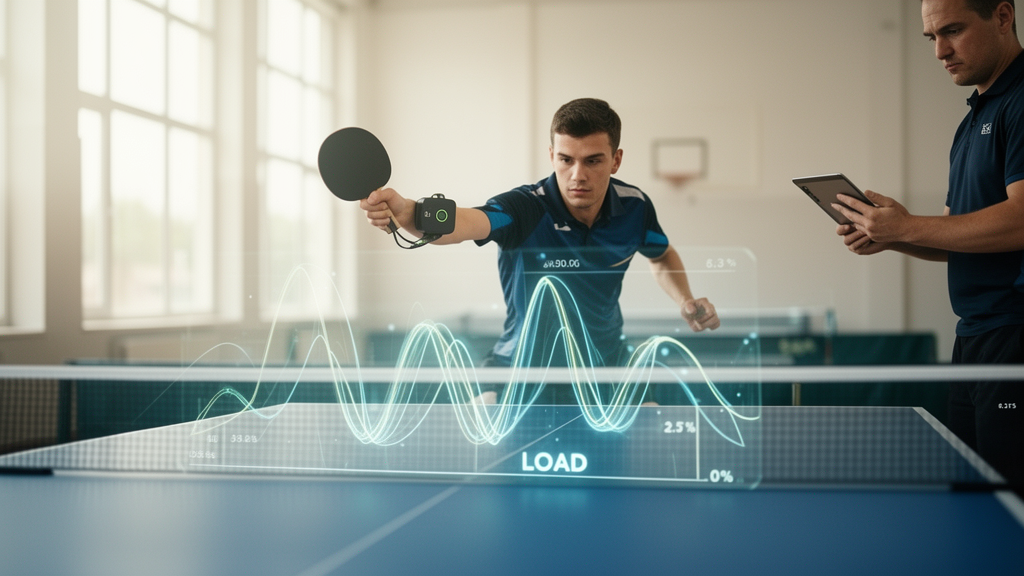
A deep learning framework that reads the temporal fingerprints of table tennis training has achieved 96.65 percent accuracy in a classification-based evaluation of skill levels, with an area under the ROC curve of 0.97, according to new research published in Discover Artificial Intelligence. The study, led by Guokun Wang, combines a gated recurrent unit (GRU) neural network with a nature-inspired optimization algorithm called the meerkat optimization algorithm (MOA) to model the complex, nonlinear relationship between how hard a player trains and how quickly their skills develop. For evaluation, the framework’s predicted continuous skill scores were grouped into Low, Medium and High categories using dataset-derived thresholds, while the original continuous scores were retained for regression and correlation analyses. The work arrives as smart IoT technologies reshape how coaches understand athletic performance, offering a data-driven alternative to traditional assessment methods that the study says fail to capture temporal dependencies and dynamic performance variations in racquet sports instruction.
Table tennis is among the fastest racquet sports, demanding rapid reflexes, precise stroke mechanics, agile footwork and split-second tactical judgement. The research describes effective coaching as combining technical teaching with adaptation of training methods to individual performance levels, covering strokes such as the forehand drive, backhand push, topspin and smash, alongside spin control, tactical judgement and mental strength. Traditional coaching, the study notes, pays limited attention to the dynamic trend of player performance, which can lead to inadequate training interventions. Trainers cannot clearly determine the impact of intensity, duration and repetitions on skill development without scientific monitoring. The new research addresses this gap by building an IoT-integrated framework where sensors continuously measure multivariate training data, which is then fed into a temporal deep learning model designed to forecast skill progression.
The framework draws its evidence from a publicly available Kaggle dataset called the Table Tennis IoT Training Performance Dataset, which contains 1,000 training-session records and 22 attributes describing training load, physiological responses, technical performance, error measurements and skill-related indicators obtained through IoT-assisted monitoring. Key features include practice duration, training intensity, stroke frequency, heart rate, fatigue level, stroke accuracy, stroke consistency, stroke speed and footwork efficiency. Because the researchers did not have access to the raw sensor data stream, temporal sequences were generated by ordering each player’s sessions chronologically using Player ID and Session ID variables. Fixed-length overlapping windows of 20 consecutive sessions were created with a stride of one session, meaning each successive sequence shared 19 sessions with the preceding one, preserving temporal continuity across the training samples. The dataset was divided into 70 percent training data and 30 percent validation data.
Pre-processing the IoT data involved three critical operations. Data cleaning removed noise, sensor errors and duplicates to ensure reliability. Missing values, which the study reports occur in heart rate, accelerometer and stroke count records, were handled under a Missing at Random (MAR) assumption and reconstructed using temporal interpolation that estimates a value at time t from the previous and next observed readings. Finally, min-max normalization scaled all sensor features to a fixed range between 0 and 1, eliminating unit differences between heart rate measured in beats per minute, stroke counts measured in discrete events and intensity measured on continuous scales. This balanced input structure, the researcher argues, is essential for the GRU model to learn meaningful patterns across heterogeneous sensor channels and to conduct accurate skill prediction and correlation analysis.
Time-domain feature extraction (TDFE) then transformed the pre-processed session data into meaningful performance indicators. The method computes statistical moments from sequential session data: the zeroth moment measures total stroke energy and overall movement strength, the second moment captures stroke speed and wrist-arm movement variations, and the fourth moment detects abrupt changes that signal inconsistent stroke patterns. Derived measures including sparseness, the impulsiveness ratio factor and the waveform length ratio assess fatigue effects by tracking how signal characteristics change across a training session. These temporally organized features, covering stroke- and fatigue-related characteristics, were then provided to the MOA-GRU framework to model changes in skill performance across consecutive training sessions.
The GRU architecture itself is a streamlined variant of the recurrent neural network designed for time-series data. Unlike the long short-term memory (LSTM) network, which uses three gates, the GRU employs only two: an update gate that balances the influence of past training load and skill progression, and a reset gate that helps the model ignore irrelevant stroke history when a new movement pattern appears. A candidate hidden state encodes current stroke characteristics such as acceleration, angular velocity and stroke timing, while the final hidden state maintains memory of previous sessions while integrating new information. The study selected 64 hidden units based on empirical tuning and literature-supported configurations, seeking an optimal balance between model complexity, convergence stability and prediction accuracy. This structure allows the model to capture both short-term fluctuations in physiological stress and long-term adaptation trends observed in the training data.
The meerkat optimization algorithm, inspired by the social foraging behavior of wild meerkat colonies, optimizes both IoT feature selection and GRU hyperparameters. The algorithm initializes a population of candidate solutions, each representing a potential combination of selected features, GRU hidden units, sequence length, learning rate and batch size. A fitness function combining accuracy, precision, recall and error rate evaluates each candidate, and the population is divided into foraging and caring groups that explore new feature combinations and improve weak solutions respectively. Through iterative neighbor generation, swapping of best and worst solutions, and random replacement for diversity, the algorithm converges on optimal configurations while avoiding local minima. The researchers report that MOA demonstrates more stable and faster convergence compared to particle swarm optimization, genetic algorithms and ant colony optimization.
Statistical validation using Pearson correlation analysis revealed strong positive associations between training variables and skill gains. Training duration correlated at r = 0.86, training intensity at r = 0.88, stroke frequency at r = 0.85 and heart rate at r = 0.83 with actual skill scores. The MOA-GRU model’s predicted correlations ranged from 0.90 to 0.95, exceeding the actual correlations of 0.83 to 0.89, which the study attributes to the model’s ability to capture temporal and nonlinear patterns that linear statistical methods miss. The framework achieved an R² value of 0.935 with a mean normalized error of 0.070, training accuracy of 0.968 and validation accuracy of 0.972 on unseen data. In comparative testing on the same dataset against existing models including AGTO-SELM, FAST R-CNN, CNN, XGBoost, SVM and ANN, the MOA-GRU framework consistently outperformed all alternatives, which achieved accuracy averages between 0.847 and 0.932. Five-fold cross-validation supported the model’s stability and generalization, and ablation testing confirmed that removing pre-processing, TDFE, MOA or GRU components reduced performance significantly.
Explainable AI analysis using SHapley Additive Explanations (SHAP) quantified the contribution of individual sensor features to the model’s predictions, examining six error factors: arm error, wrist error, racket angle error, hitting position error, timing error and footwork lag error. The SHAP analysis, the study reports, identifies key error factors influencing predictions and improves the interpretability, transparency and reliability of the MOA-GRU model. The analysis confirmed that each error component contributes unique information to the skill prediction, and the study notes that the largely independent error features enhance the model’s ability to isolate technical weaknesses. The researcher also cites recent research indicating that explainable deep learning models can increase the transparency and trustworthiness of sensor-driven prediction systems, positioning SHAP as a way to interpret how table tennis skill predictions are generated.
The practical implications extend to real-time coaching dashboards that display player performance trends, training load effects and skill development trajectories. Coaches can use the framework to adjust training intensity, modify stroke drills and redesign footwork exercises during sessions, preventing skill deterioration from fatigue and providing personalized feedback grounded in quantitative evidence. The study acknowledges significant limitations, including reliance on a public IoT dataset of modest size, potential differences among sensor systems, and the absence of metadata such as player demographics, sensor specifications, sampling rates and recording environments. Future work, the researcher notes, should validate the framework using larger real-world datasets and more comprehensive wearable and biomechanical sensing data before the system can be deployed across diverse sports training settings with confidence.
Subject of Research: Application of a meerkat-optimized gated recurrent unit model to correlate IoT training load data with table tennis skill improvement.
Article Title: The application of GRU (gated recurrent unit) model in the correlation analysis of training load and skill improvement in table tennis teaching under the internet of things environment
Article References: Wang, G. (2026). The application of GRU (gated recurrent unit) model in the correlation analysis of training load and skill improvement in table tennis teaching under the internet of things environment. Discover Artificial Intelligence, 6(1), Article 1624. https://doi.org/10.1007/s44163-026-02571-8
Image Credits: AI Generated
DOI: 10.1007/s44163-026-02571-8
Keywords: table tennis, gated recurrent unit, internet of things, training load, skill prediction, deep learning, meerkat optimization algorithm, time-domain feature extraction, SHAP, sports analytics, wearable sensors, Pearson correlation
News Source: Blake Davidson. (October 24, 2026). AI Model Predicts Table Tennis Skill Gains From IoT Training Load Data. Scienmag.