Credit: Yen Strandqvist/Chalmers University of Technology
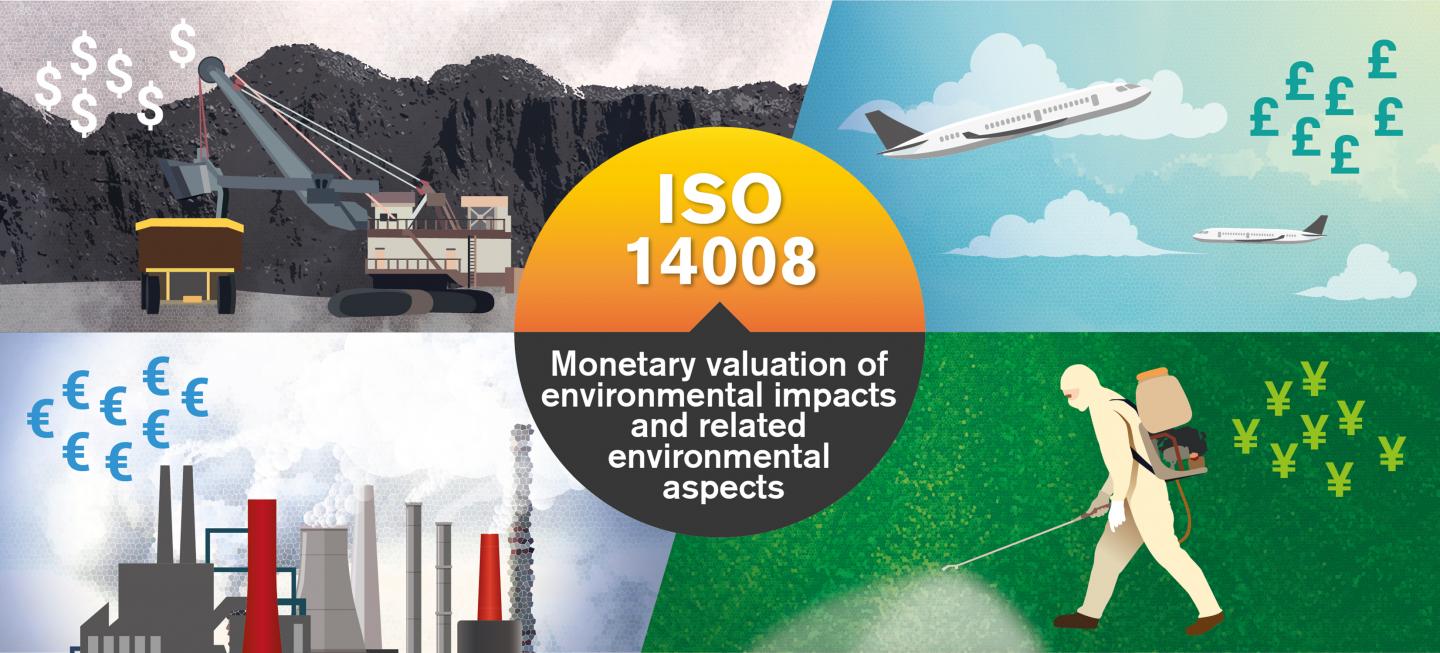
Environmental damage costs society enormous amounts of money – and often leaves future generations to foot the bill. Now, a new ISO standard will help companies valuate and manage the impact of their environmental damage, by providing a clear figure for the cost of their goods and services to the environment.
We know what goods and services cost us, but what does the environment pay? For many years now, this question has been the focus of several global companies and researchers at the Swedish Life Cycle Center, a competence centre hosted by Chalmers University of Technology, Sweden. For as long as 30 years, they have been using the so-called ‘EPS tool ‘ to place a monetary value on environmental damage.
Over the past three years, Bengt Steen, Professor Emeritus at Chalmers, has led the development of a new ISO standard for monetary valuation. The work has been in collaboration with AB Volvo, Essity, Nouryon (formerly Akzo Nobel Specialty Chemicals) and the IVL Swedish Environmental Institute. The initiative was taken by Swedish Life Cycle Center.
“One reason why sustainable development does not move fast enough is that it is not linked to the economy,” says Bengt Steen. “Experts speak one language, and business leaders another. The negative environmental effects often remain just figures on paper. But by translating environmental issues into a monetary value, it becomes much easier to present the whole picture to an organisation and influence their strategic decisions.”
Unlike many other tools, EPS weighs different types of environmental impacts, not just the effect on climate. For example, a given course of action may be beneficial for the climate but damaging for biodiversity or public health. With this approach, an overall picture is reached of what impact a product or service has on the environment, throughout its entire life cycle. A large variety of aspects are covered. Until now, this has been complex work, requiring a lot of manual input and expert knowledge.
“With this standard, we can remove several of the obstacles to increased usage of monetary valuation. In a few years, when users can routinely assess the total environmental damage cost for a given investment, supplier, product design and so on, environmental issues can occupy a more central place in the boardroom. Costs to the environment can be presented side by side with profits for the company,” says Bengt Steen.
Emma Ringström, Sustainability Manager at Nouryon, says that monetary valuation has given the company much valuable insight.
“We have made monetary valuation of a number of our value chains and included the results of this in our annual report. The analyses include financial, social, human and environmental capital, where environmental capital is partly calculated with life cycle assessment and with EPS as a valuation method. The tool has also been used to see which activities in the value chain have a large total environmental damage cost compared to profit, and therefore need to be prioritised to become more sustainable.”
Although tools such as EPS have existed for 30 years, and many companies like Nouryon use them to calculate their costs to the environment, Bengt Steen believes their development moves too slowly. There is no standardised framework, and few databases exist that enable their use in a uniform manner.
Therefore, in 2015, the idea of a new ISO standard was born within Swedish Life Cycle Center. Together with SIS – the Swedish Standards Institute – a proposal was written that now after just over three years of work, together with many internationally recognised experts, is launched.
“Few things yield such an impact as these type of heavyweight, international standards,” explains Bengt Steen. “When companies in the future can see where there are clear environmental benefits, investments are stimulated for a sustainable business.”
The ISO standard contains a guide for how monetary valuation should be made, defines terms and sets requirements for documentation. By extension, the standard is expected to lead to increased collaboration between experts of various kinds, as well as helping to create credible databases and software.
How to calculate a monetary valuation of environmental impacts:
With monetary valuation of environmental impacts, many different aspects are taken into consideration. These can include energy consumption, climate impact, material use and emissions into water, air and soil. During a product’s lifetime, the amount of emissions generated, and amount of resources expended can also be measured. These lead to many demonstrable environmental effects, such as reduced crop yields, lower fish stocks and shortened human life spans, due to floods and heat waves.
Finally, using generally accepted sources, such as the OECD’s estimate of people’s productivity value, and market prices for cereals, fish and meat, the cost of the impact can be ascertained. The end result is a concrete figure, calculated in Euros.
In some cases, the figure represents a real incurred cost for the company, in the form of taxation or fees. In other cases, the figure signals possible future economic liabilities, or is simply a sign that the product results in environmental damage that the company wants to avoid.
A simple example of environmental impact valuation:
Imagine a wooden chair, which is worn out and needs to be disposed of. The chair weighs 12 kg. There are two options:
- Throw the chair into a nearby rubbish bin, after which it ends up in landfill.
- Drive the chair to a heating plant 10 km away, where it will be burned, and used for local heating instead of fossil fuels.
In the first case, the cost of transport and the landfill is low – 0.40 Euros, and the emissions from the transport are largely negligible. But, the degradation of the wood in the landfill takes place under oxygen-poor conditions, resulting in 4 kg of methane being formed. This leaks into the atmosphere and contributes to the greenhouse effect. The environmental cost of methane emissions has been calculated at EUR 3.80/kg using the EPS methodology. In total, therefore, there is a conventional cost of 0.40 Euros, and an environmental damage cost of 4 X 3.80 = 15.20 Euros.
In the second case, the transport costs 5 Euros. The transport gives an emission of 3.8 kg carbon dioxide, but the thermal energy derived from the chair means that 6 kg of coal does not have to be burned for the heating plant to produce the heat needed. This results in a saving of about 20 kg of carbon dioxide emissions, and 6 kg of the finite natural resource, coal. With EPS, the environmental damage cost for carbon dioxide has been calculated at EUR 0.135/kg and the natural resource value of coal at EUR 0.161/kg. Therefore, this method of disposal results in a total conventional cost of 5 Euro, but a saving of environmental damage costs, an actual environmental gain, of 0.135 X (20 – 3.80) + 0.161 X 6 = 3.153 Euros.
###
Link to the standard:
https:/
Link to the EPS tool:
https:/
Media Contact
Johanna Wilde
[email protected]
Original Source
https:/