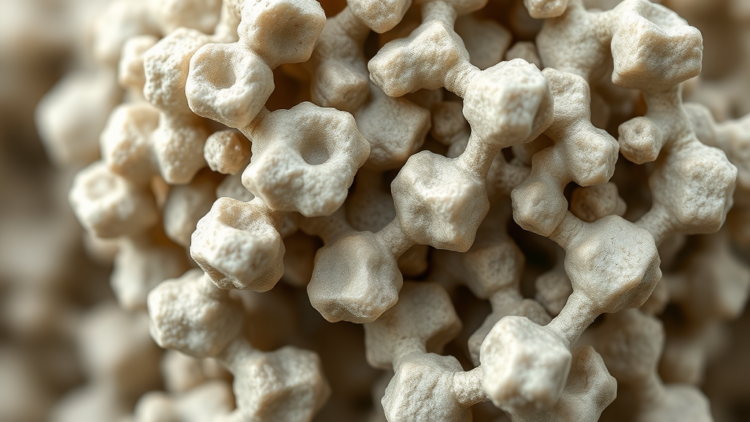
Zeolites are among the most industrially important materials in modern chemistry. These crystalline aluminosilicates, with their vast internal surface areas and strong solid acidity, sit at the heart of processes that refine crude oil into gasoline and diesel, and they also serve in adsorption, ion exchange, and countless other catalytic applications. Yet for all their power, conventional zeolites carry a fundamental limitation: their pores are tiny. The micropores of a workhorse catalyst such as ZSM-5 measure only about 0.5 to 0.55 nanometers across, which means that large, bulky hydrocarbon molecules in heavy oil feedstocks simply cannot squeeze inside to reach the acid sites where cracking reactions occur. A new study from researchers at Konkuk University in Seoul, published in the journal Advances in Industrial and Engineering Chemistry, reports a synthesis strategy that overcomes this bottleneck by building ordered mesopores directly onto zeolite crystals while protecting the delicate framework from destruction in the process.
The research, led by Deok Woo Kim, Dong Seop Choi, and Ji Bong Joo of Konkuk University’s Department of Chemical Engineering, tackles a long-standing dilemma in catalyst design. The standard method for opening up zeolites, known as desilication, involves treating the crystals with an alkaline solution such as sodium hydroxide. The alkali selectively dissolves silicon species from the framework, carving out larger pores that improve access. But the process is destructive and difficult to control. As silica dissolves, it can reprecipitate randomly as amorphous deposits on the crystal surface, blocking the very openings the treatment was meant to create. Worse, prolonged alkali exposure can collapse the zeolite framework entirely, destroying the microporosity and acid sites that give the material its catalytic power in the first place.
The Korean team’s solution was to introduce a surfactant, cetyltrimethylammonium bromide or CTAB, into the synthesis. Their procedure began by stirring ZSM-5 zeolite with a sodium hydroxide solution at room temperature, then adding a CTAB solution and transferring the mixture to a Teflon-lined autoclave for hydrothermal treatment at 130 degrees Celsius. After adjusting the pH to approximately 8 and continuing treatment for another 24 hours, the product was filtered, dried, and calcined at 550 degrees Celsius to burn away the organic template. The resulting material, designated HF_ZSM-5, was compared against a conventional alkali-treated sample, AT_ZSM-5, prepared by simply stirring ZSM-5 in a 0.5 molar sodium hydroxide solution at 80 degrees Celsius for five hours.
The characterization results reveal why the surfactant approach is so effective. X-ray diffraction confirmed that all samples retained the characteristic ZSM-5 framework, but the alkali-treated material showed markedly reduced crystallinity, evidence of structural damage from the harsh alkaline conditions. The hierarchical material, by contrast, preserved much higher crystallinity despite facing even harsher synthesis conditions. The researchers attribute this protection to CTAB micelles that electrostatically bind to the negatively charged zeolite surface, acting as a shield against excessive silica dissolution. Strikingly, the hierarchical sample also displayed new low-angle diffraction peaks near 2.3, 4.2, and 4.8 degrees, the signature of long-range ordered hexagonal mesoporous aluminosilicate resembling the well-known material MCM-41. In other words, the treatment did not merely etch holes in the crystal; it grew an entirely new ordered mesoporous phase on its surface.
Nitrogen adsorption measurements told a complementary story. Pristine ZSM-5 showed the classic type I isotherm of a purely microporous material. The alkali-treated sample shifted toward a type IV isotherm, indicating mesoporosity, and adsorbed far more nitrogen overall, yet paradoxically exhibited the lowest specific surface area of all the samples. This apparent contradiction points to severe framework damage: excessive alkali treatment had collapsed the micropore structure, destroying the internal surface area even as it created larger voids. The hierarchical zeolite, meanwhile, maintained a surface area comparable to the pristine material while simultaneously developing a clear distribution of mesopores in the 1 to 10 nanometer range. Transmission electron microscopy provided direct visual confirmation, revealing cylindrical pores arranged in hexagonal arrays on the surface of the hierarchical crystals, while the alkali-treated sample showed only cracks and disordered dissolution.
Acidity measurements using ammonia temperature-programmed desorption added another layer of insight. All treated samples lost some acid sites compared with pristine ZSM-5, an expected consequence of partial framework decomposition. Strong Brønsted acid sites, associated with the higher-temperature desorption peak near 400 degrees Celsius, declined more steeply than weak sites, suggesting that desilication converts strong sites into weaker ones, possibly as silica-free alumina surfaces that function as external acid sites. Crucially, the hierarchical material preserved its strong acid sites better than the simply alkali-treated sample, again because the CTAB micelles blocked deep penetration of alkaline species into the framework. The newly formed mesoporous aluminosilicate layer also contributed additional acid sites of its own, similar to those found in aluminum-containing MCM-41.
The catalytic payoff came in cracking tests conducted in a fixed-bed reactor at 500 degrees Celsius. The team chose 1,3,5-triisopropylbenzene, or TIPB, as a probe molecule for bulky feedstocks. At 0.95 nanometers, TIPB is far too large to enter the micropores of ZSM-5, so pristine zeolite could only crack it slowly on its limited external surface, achieving a conversion of just 40.1 percent. The alkali-treated sample performed better by opening access to exposed acid sites. But the hierarchical zeolite was the clear winner, reaching 80.8 percent conversion, exactly 2.01 times higher than the pristine material. Product selectivity reinforced the conclusion: the hierarchical catalyst showed the greatest selectivity toward benzene, the deep-cracking product, indicating that molecules were diffusing through the mesopores and undergoing extensive catalytic cracking rather than simple thermal pyrolysis.
A second test with n-dodecane, a linear hydrocarbon small enough to diffuse into ZSM-5 micropores, revealed a different but equally important advantage. Here the pristine zeolite achieved the highest conversion thanks to its abundant internal acid sites, while the alkali-treated sample fared worst because its collapsed framework had lost so much acidity. The hierarchical material landed in between, retaining enough acid sites for respectable conversion. The decisive metric, however, was coke formation. Coke, the polyaromatic carbonaceous residue that builds up when cracked hydrocarbon fragments linger and carbonize inside pores, is the chief cause of catalyst deactivation in industrial cracking. Pristine ZSM-5, despite its high conversion, produced the most coke because its strong acid sites trap intermediates within narrow micropores. The hierarchical zeolite produced the least coke of all, because its mesopore network allowed fragments to diffuse out before they could accumulate and transform into pore-blocking polyaromatics.
The implications for the petroleum industry are considerable. Fluid catalytic cracking remains the dominant route to transportation fuels worldwide, and its efficiency hinges on how well catalysts can convert the heaviest, bulkiest fractions of crude oil. The Konkuk team’s findings demonstrate that surfactant-templated recrystallization can deliver the best of both worlds: a preserved crystalline zeolite framework with its strong acid sites intact, plus an ordered network of mesopores that welcomes large molecules and sweeps coke precursors away. Compared with conventional desilication, which trades structural integrity for porosity, the hierarchical approach achieved higher conversion of bulky molecules, retained substantial activity toward smaller ones, and minimized deactivating coke deposits. As refineries face pressure to process heavier feedstocks and squeeze more value from every barrel, catalysts engineered with this kind of hierarchical pore architecture could prove transformative, turning molecular traffic jams into open highways for chemistry.
Subject of Research: Synthesis of hierarchical mesoporous zeolites for enhanced catalytic cracking of bulky hydrocarbon molecules
Article Title: Synthesis of hierarchical zeolites for enhanced catalytic cracking performance toward larger hydrocarbon molecules
Article References: Kim, D. W., Choi, D. S., & Joo, J. B. (2025). Synthesis of hierarchical zeolites for enhanced catalytic cracking performance toward larger hydrocarbon molecules. Advances in Industrial and Engineering Chemistry, 1(1), Article 30. https://doi.org/10.1007/s44405-025-00031-y
Image Credits: AI Generated
DOI: 10.1007/s44405-025-00031-y
Keywords: zeolites, hierarchical zeolites, catalytic cracking, ZSM-5, mesoporous materials, fluid catalytic cracking, desilication, CTAB surfactant, MCM-41, coke formation, acid sites, petroleum refining
Cite Scienmag News
APA
MLA
Chicago
Bethany Barker. (September 25, 2026). Surfactant-Shielded Zeolites Double Cracking Power for Bulky Oil Molecules. Scienmag. https://scienmag.com/surfactant-shielded-zeolites-double-cracking-power-for-bulky-oil-molecules/
Bethany Barker. “Surfactant-Shielded Zeolites Double Cracking Power for Bulky Oil Molecules.” Scienmag, 25 September 2026, https://scienmag.com/surfactant-shielded-zeolites-double-cracking-power-for-bulky-oil-molecules/. Accessed 25 September 2026.
Bethany Barker. “Surfactant-Shielded Zeolites Double Cracking Power for Bulky Oil Molecules.” Scienmag. September 25, 2026. https://scienmag.com/surfactant-shielded-zeolites-double-cracking-power-for-bulky-oil-molecules/
Copy citation
Download RIS
Tags: acid sitesadvanced catalyst design for crude oil processingcatalytic crackingcoke formationCTAB surfactantdesilicationfluid catalytic crackingheavy oil refining catalystshierarchical pore structure in catalystshierarchical zeolitesimproving catalytic cracking efficiencyindustrial applications of modified zeolitesinnovative synthesis of mesoporous zeoliteslarge molecule diffusion in zeolitesMCM-41mesoporous materialsmesoporous zeolites for bulky hydrocarbon crackingovercoming micropore size limitations in zeolitespetroleum refiningprotecting zeolite frameworks during pore expansionsurfactant-assisted zeolite synthesisZeolite catalyst enhancementzeolitesZSM-5