• HOME
  • NEWS
  • EXPLORE
    • CAREER
      • Companies
      • Jobs
    • EVENTS
    • iGEM
      • News
      • Team
    • PHOTOS
    • VIDEO
    • WIKI
  • BLOG
  • COMMUNITY
    • FACEBOOK
    • INSTAGRAM
    • TWITTER
Wednesday, May 13, 2026
BIOENGINEER.ORG
No Result
View All Result
  • Login
  • HOME
  • NEWS
  • EXPLORE
    • CAREER
      • Companies
      • Jobs
        • Lecturer
        • PhD Studentship
        • Postdoc
        • Research Assistant
    • EVENTS
    • iGEM
      • News
      • Team
    • PHOTOS
    • VIDEO
    • WIKI
  • BLOG
  • COMMUNITY
    • FACEBOOK
    • INSTAGRAM
    • TWITTER
  • HOME
  • NEWS
  • EXPLORE
    • CAREER
      • Companies
      • Jobs
        • Lecturer
        • PhD Studentship
        • Postdoc
        • Research Assistant
    • EVENTS
    • iGEM
      • News
      • Team
    • PHOTOS
    • VIDEO
    • WIKI
  • BLOG
  • COMMUNITY
    • FACEBOOK
    • INSTAGRAM
    • TWITTER
No Result
View All Result
Bioengineer.org
No Result
View All Result
Home NEWS Science News Biology

New catalysts remove NOx pollutants at lower temperatures

Bioengineer by Bioengineer
November 16, 2019
in Biology
Reading Time: 3 mins read
0
IMAGE
Share on FacebookShare on TwitterShare on LinkedinShare on RedditShare on Telegram

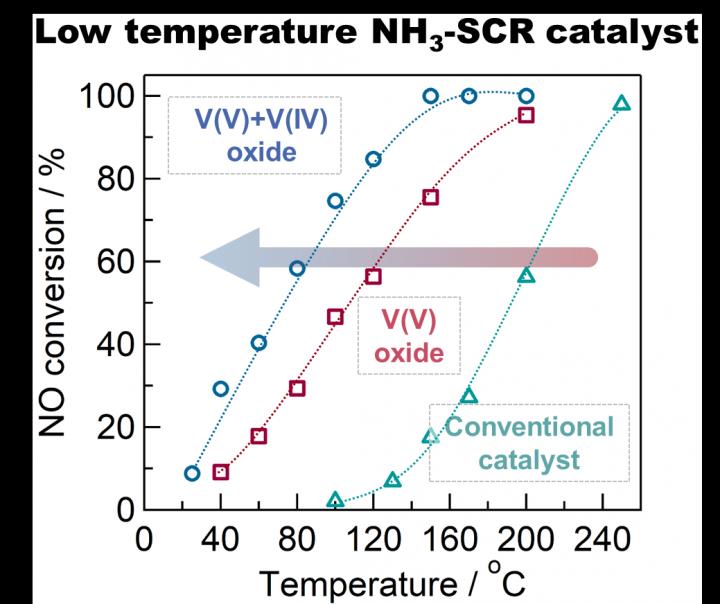
Bulk ‘defective’ vanadium oxide for NOx removal from industrial exhaust at temperatures lower than 150 degrees Celsius
IMAGE

Credit: Tokyo Metropolitan University


Tokyo, Japan – Scientists from Tokyo Metropolitan University have developed a low-temperature catalyst for removing NOx gas from industrial exhaust using ammonia. Composed of bulk “defective” vanadium oxide instead of vanadium oxides supported on titanium oxide like in commercial catalysts, the catalyst works at lower temperatures (

Nitrogen monoxide (NO) and nitrogen dioxide (NO2), or nitrogen oxides (NOx), are common atmospheric pollutants created by burning fossil fuels, coal and natural gas. They are a major cause of photochemical smog and acid rain, which makes their removal from vehicle and factory emissions extremely important. A key technology for removing nitrogen oxides is their reaction with ammonia via selective catalytic reduction (SCR), where NOx is rendered harmless via reduction to nitrogen and water. In particular, vanadium oxides supported on titania are known to have excellent selectivity for conversion to nitrogen, and have been successfully applied to stationary boilers.

However, a significant bottleneck for supported catalysts is the high temperature required for catalytic activity, often 200 to 400 degrees Celsius. This often results in units being placed close to e.g. the boiler in power plants, where they can be easily damaged not only physically by ash but by the accumulation of ammonium sulfates. These deactivating factors can be avoided if the unit is placed downstream after an electrostatic precipitator for removing dust and a desulfation system to remove sulfate deposits. However, this approach requires high catalytic activity at lower temperatures, since the temperature of the exhaust gas has generally dropped to around 100 degrees Celsius by this point. A catalyst is needed that works at lower temperatures.

Now, a team led by Yusuke Inomata and Toru Murayama from Tokyo Metropolitan University have developed a catalyst based on bulk vanadium oxides. Vanadium (V) oxide (V2O5) is a common state of vanadium oxide; the team however successfully synthesized a mixture of vanadium (V) and vanadium (IV) oxides, or “defective” vanadium oxide, by heating a precursor to 270 degrees Celsius. They found that this “defective” catalyst had excellent catalytic activity at temperatures down to 100 degrees Celsius; at this temperature, the speed at which NOx is converted to harmless nitrogen was 10 times faster than conventional titania supported vanadium oxide catalysts, showing exceptional performance where convertional catalysts fall short. The improvement was attributed to the presence of V(IV) which creates “Lewis acid” (electron-accepting) sites, promoting the reaction of nitrogen oxide with ammonia to become nitrogen.

Beyond practical application to industrial catalysis, the team hope that the mechanisms they have uncovered serve as a model system for further scientific studies.

###

This work was collabolated with the Chugoku Electric Power Company, Incorporated, and was partially supported by the Cooperative Research Program of the Institute for Catalysis, Hokkaido University (Grant #19B1016).

Media Contact
Go Totsukawa
[email protected]
81-426-772-728

Original Source

https://doi.org/10.1021/acscatal.9b02695

Related Journal Article

http://dx.doi.org/10.1021/acscatal.9b02695

Tags: Biomedical/Environmental/Chemical EngineeringChemistry/Physics/Materials SciencesIndustrial Engineering/ChemistryMaterialsPharmaceutical/Combinatorial ChemistryPublic Health
Share13Tweet8Share2ShareShareShare2

Related Posts

Cutting-Edge Genomic Techniques Reveal Unexpected Cellular Changes in the Aging Brain — Biology

Cutting-Edge Genomic Techniques Reveal Unexpected Cellular Changes in the Aging Brain

May 12, 2026
USC Researchers Initiate Study on the Most Advanced Lab-Grown Kidney Structures — Biology

USC Researchers Initiate Study on the Most Advanced Lab-Grown Kidney Structures

May 12, 2026

Childbirth in Humans Is Not Uniquely Challenging Among Mammals, New Research Shows

May 12, 2026

From Complexity to Clarity: Unraveling the “Topological Laws” Governing Cell Death

May 11, 2026
Please login to join discussion

POPULAR NEWS

  • Research Indicates Potential Connection Between Prenatal Medication Exposure and Elevated Autism Risk

    842 shares
    Share 337 Tweet 211
  • New Study Reveals Plants Can Detect the Sound of Rain

    728 shares
    Share 290 Tweet 182
  • Salmonella Haem Blocks Macrophages, Boosts Infection

    62 shares
    Share 25 Tweet 16
  • Breastmilk Balances E. coli and Beneficial Bacteria in Infant Gut Microbiomes

    57 shares
    Share 23 Tweet 14

About

We bring you the latest biotechnology news from best research centers and universities around the world. Check our website.

Follow us

Recent News

Erin Roby Shares ECI Science Journey Insights

Immunogenetics Advances Personalised Psoriasis Diagnosis, Treatment

New Study Uncovers Rigorous Selection Patterns in Social Relationships

Subscribe to Blog via Email

Enter your email address to subscribe to this blog and receive notifications of new posts by email.

Join 82 other subscribers
  • Contact Us

Bioengineer.org © Copyright 2023 All Rights Reserved.

Welcome Back!

Login to your account below

Forgotten Password?

Retrieve your password

Please enter your username or email address to reset your password.

Log In
No Result
View All Result
  • Homepages
    • Home Page 1
    • Home Page 2
  • News
  • National
  • Business
  • Health
  • Lifestyle
  • Science

Bioengineer.org © Copyright 2023 All Rights Reserved.