


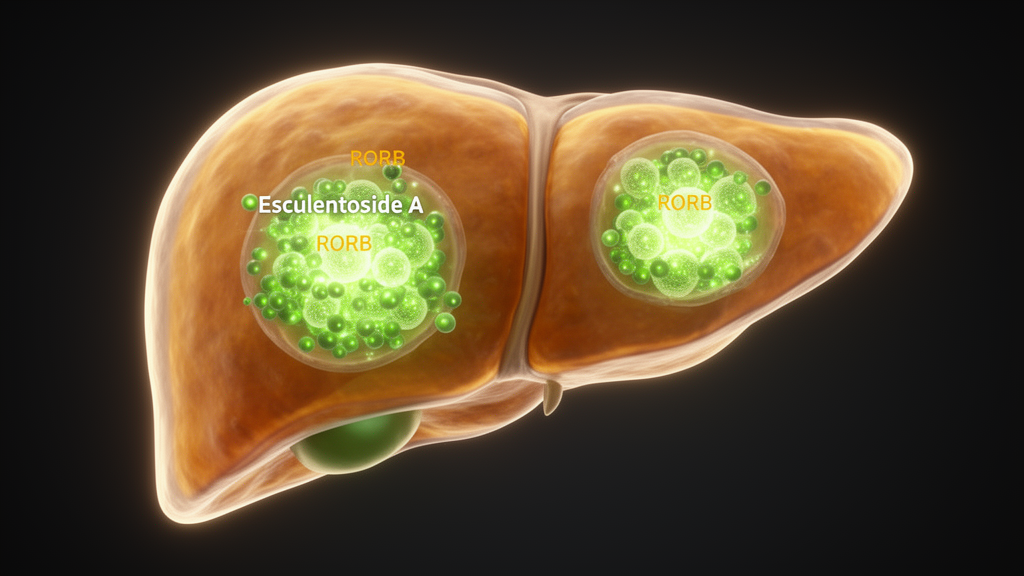
A natural triterpenoid saponin extracted from the roots of the plant Phytolacca esculenta has emerged as a surprising suppressor of liver cancer’s most stubborn behaviors. In a new laboratory study published in the journal Cell Division, researchers report that esculentoside A, known as EsA, slowed the proliferation, migration, invasion and stem-like properties of hepatocellular carcinoma cells in culture, and shrank tumors in mouse models of the disease. The compound appears to work through an unexpected route: it raises the amount of a poorly studied nuclear receptor called RORB, which in turn dampens Wnt signaling, a pathway long implicated in tumor growth and self-renewal.
Hepatocellular carcinoma, the most common form of primary liver cancer, ranks among the world’s leading causes of cancer-related mortality, sitting third in that grim tally according to the study’s introduction. One reason the disease is so difficult to treat is the intrinsic stemness of many tumor cells, a capacity for self-renewal that fuels tumor initiation, progression and resistance to therapy. Wnt/beta-catenin signaling, along with NF-kappaB, MAPK and PI3K/AKT pathways, integrates inflammatory cues with these stemness programs, making the pathway a tempting but historically challenging drug target. The Chinese research team, led by Qing Ye, Dousheng Bai, Aoqing Wang, Xi Zhang and Ruiqi Chai, set out to test whether EsA, a molecule with documented anti-inflammatory, antioxidant and hepatoprotective properties, could attack this axis.
The in vitro evidence was built on three hepatocellular carcinoma cell lines, HCCLM3, MHCC97L and Huh-7, alongside a normal human hepatocyte line called HHL-5. When the cells were exposed to escalating concentrations of EsA ranging from 100 to 300 micrograms per milliliter, a Cell Counting Kit-8 assay showed a dose-dependent drop in viability, and the team selected the 300 microgram per milliliter dose for subsequent experiments. At that concentration, a battery of functional assays told a consistent story. Sphere formation and clonogenic assays revealed impaired self-renewal, Western blots showed reduced levels of the stemness transcription factors Nanog and Oct4, flow cytometry recorded a smaller fraction of CD133-positive cells, a widely used marker of liver cancer stem-like cells, and TUNEL staining documented increased apoptosis. EdU, wound healing and Transwell assays each confirmed reduced proliferation, migration and invasion.
The animal work extended these findings into living systems. In subcutaneous xenografts established by injecting HCCLM3 cells into nude mice, EsA treatment significantly inhibited tumor growth and markedly reduced tumor weights compared with saline controls. Immunohistochemistry of the excised tumors showed lower Ki67, a proliferation marker, and lower CD133, while TUNEL staining again revealed more apoptotic cells. In an orthotopic model, in which tumor cells were injected directly into the left hepatic lobe of the mice, EsA reduced liver weight and the maximum tumor diameter on the liver surface, and hematoxylin-eosin staining of lung tissue showed fewer metastatic nodules, suggesting the compound also impeded metastatic spread. Notably, in tumor-free mice given the same 40 milligram per kilogram intraperitoneal regimen every three days for four weeks, body weight, serum ALT, AST and creatinine levels, and the histology of liver, kidney, lung and heart tissue all appeared unremarkable, an early biosafety signal that the authors emphasize will require much deeper pharmacological scrutiny.
The mechanistic hunt began with bioinformatics rather than a hypothesis. Using the chemical structure and SMILES notation of EsA retrieved from the PubChem database, the team predicted candidate protein targets through the Super-PRED database, then intersected that list with differentially expressed genes from the GSE184733 RNA sequencing dataset, which compared fresh-frozen hepatocellular carcinoma samples with paired adjacent normal liver tissue from patients who had undergone liver resection or transplantation, using a threshold of adjusted p-value below 0.01 and a log2 fold change greater than 2. A protein-protein interaction analysis in the STRING database highlighted a connection between RXFP1 and RORB, and because RORB showed a stronger expression deficit in tumors, with a log2 fold change of minus 2.653 compared with minus 2.183 for RXFP1, the researchers chose RORB for follow-up. Reverse transcription quantitative PCR and Western blotting confirmed that RORB was expressed at lower levels in the hepatocellular carcinoma cell lines than in the normal hepatocyte line.
What happened when EsA entered the picture was mechanistically revealing. RORB protein levels in the cancer cells rose progressively with increasing EsA concentrations, peaking at 300 micrograms per milliliter, yet quantitative PCR showed that RORB messenger RNA levels were essentially unchanged. That dissociation pointed away from gene transcription and toward protein stability. A cycloheximide chase experiment, which blocks new protein synthesis and tracks the decay of existing protein, showed that RORB remained more stable in EsA-treated cells, and a co-immunoprecipitation assay demonstrated that EsA reduced the ubiquitination tagging that normally flags RORB for proteasomal destruction. In parallel, molecular docking with Autodock Vina suggested a plausible binding interface between the saponin and the receptor, with a best Vina score of minus 8.771 kilocalories per mole, though the authors are careful to note that docking alone provides only preliminary structural support rather than proof of a direct biochemical interaction.
To test whether RORB was genuinely required for the compound’s effects, the team knocked it down in the cancer cells using lentiviral short hairpin RNAs, selecting two constructs with the best efficiency. The consequences were striking. With RORB silenced, sphere formation and colony formation increased, Nanog and Oct4 climbed, the CD133-positive fraction expanded, and the pro-apoptotic effect of EsA was blunted. Conversely, Western blots showed that EsA treatment lowered total beta-catenin protein and reduced Wnt pathway activity as measured by TOP/FOP flash luciferase reporter assays, and RORB knockdown reversed both effects. As a specificity control, the researchers treated RORB-silenced cells with XAV-939, a tankyrase inhibitor that suppresses canonical Wnt signaling, and found that the drug restored the suppression of stemness markers, sphere formation, colony formation, CD133 positivity and apoptosis, indicating that the phenotype was not merely a byproduct of general growth inhibition.
The clinical correlate, though modest in scale, aligned with the laboratory story. In 21 hepatocellular carcinoma tissue samples collected from patients at Subei People’s Hospital between February 2024 and January 2025, together with matched adjacent non-cancerous tissue, both RT-qPCR and immunohistochemistry confirmed lower RORB expression in the tumors. When patients were split at the median RORB positive rate, beta-catenin staining was stronger in the low-RORB group, and Pearson correlation analysis showed a significant negative relationship between the two proteins across the samples. Higher RORB expression was also negatively correlated with tumor TNM staging, with no association to age or sex, and a Kaplan-Meier Plotter analysis of liver cancer datasets linked high RORB expression to favorable overall survival. These are associations in a small cohort, not proof of causation, but they are consistent with the direction of the experimental findings.
The authors are candid about the limits of the work. The 300 microgram per milliliter dose was chosen from preliminary experiments, and its pharmacological relevance in a living organism remains untested. The bioinformatic screen surfaced several candidate interactors, and RORB is one node in a wider signaling landscape that includes NF-kappaB, PI3K/AKT and G protein pathways, not a lone driver of tumor behavior. Most importantly, no co-immunoprecipitation or chromatin immunoprecipitation experiments were performed to establish a direct molecular interaction between EsA and RORB or between RORB and the Wnt machinery, so indirect regulation cannot be excluded. What the study does establish, within the confines of cell culture and mouse models, is a coherent chain of evidence: a plant-derived saponin stabilizes a nuclear receptor, the receptor restrains Wnt signaling, and liver cancer cells lose key malignant and stem-like traits as a result. Whether that chain holds in patients, and whether EsA or a derivative can be developed into a usable therapy, will depend on the pharmacokinetic, dosing and mechanistic studies the authors say must come next.
Subject of Research: Preclinical research on esculentoside A suppressing hepatocellular carcinoma through RORB-mediated inhibition of Wnt signaling
Article Title: Esculentoside A suppresses the malignant progression of hepatocellular carcinoma by promoting RORB
Article References: Ye, Q., Bai, D., Wang, A., Zhang, X., & Chai, R. (2026). Esculentoside A suppresses the malignant progression of hepatocellular carcinoma by promoting RORB. Cell Division, 21(1), Article 17. https://doi.org/10.1186/s13008-026-00189-x
Image Credits: AI Generated
DOI: 10.1186/s13008-026-00189-x
Keywords: hepatocellular carcinoma, esculentoside A, RORB, Wnt signaling, cancer stemness, natural products, molecular docking, xenograft models, beta-catenin, Phytolacca esculenta, preclinical study, nuclear receptor
News Source: Nathaniel Bowman. (October 29, 2026). Natural Saponin Esculentoside A Curbs Liver Cancer Growth by Stabilizing RORB Protein. Scienmag.



