• HOME
  • NEWS
  • EXPLORE
    • CAREER
      • Companies
      • Jobs
    • EVENTS
    • iGEM
      • News
      • Team
    • PHOTOS
    • VIDEO
    • WIKI
  • BLOG
  • COMMUNITY
    • FACEBOOK
    • INSTAGRAM
    • TWITTER
Monday, July 6, 2026
BIOENGINEER.ORG
No Result
View All Result
  • Login
  • HOME
  • NEWS
  • EXPLORE
    • CAREER
      • Companies
      • Jobs
        • Lecturer
        • PhD Studentship
        • Postdoc
        • Research Assistant
    • EVENTS
    • iGEM
      • News
      • Team
    • PHOTOS
    • VIDEO
    • WIKI
  • BLOG
  • COMMUNITY
    • FACEBOOK
    • INSTAGRAM
    • TWITTER
  • HOME
  • NEWS
  • EXPLORE
    • CAREER
      • Companies
      • Jobs
        • Lecturer
        • PhD Studentship
        • Postdoc
        • Research Assistant
    • EVENTS
    • iGEM
      • News
      • Team
    • PHOTOS
    • VIDEO
    • WIKI
  • BLOG
  • COMMUNITY
    • FACEBOOK
    • INSTAGRAM
    • TWITTER
No Result
View All Result
Bioengineer.org
No Result
View All Result
Home NEWS Science News Health

Myocarditis: Overshooting the mark

Bioengineer by Bioengineer
January 28, 2019
in Health
Reading Time: 2 mins read
0
Share on FacebookShare on TwitterShare on LinkedinShare on RedditShare on Telegram

Researchers from Ludwig-Maximilians-Universitaet (LMU) in Munich have shown that a protein called midkine, a member of the class of signaling molecules known as cytokines, is a key driver of inflammation in the heart muscle that can lead to heart failure in patients with myocarditis.

Myocarditis denotes an inflammatory response against the heart muscle, which can strike at any age. Although it often clears up spontaneously without any after-effects, in some patients the inflammation can become chronic and may ultimately lead to heart failure. A new study conducted by LMU researchers has now elucidated the role of the signaling molecule (‘cytokine’) named midkine for the development and progression of myocarditis. The results of the work, which was carried out by a team led by Professor Barbara Walzog and Dr. Ludwig Weckbach (both members of Collaborative Research Center 914 on “Trafficking of Immune Cells in Inflammation, Development and Disease”) are reported in the Journal of Experimental Medicine.

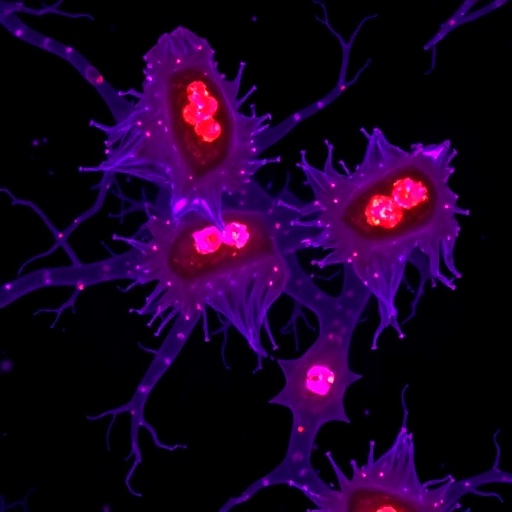
The authors analyzed tissue samples obtained from patients with myocarditis, and were able for the first time to demonstrate the presence of ‘neutrophil extracellular traps’ (NETs) in human cardiac tissue. The formation of NETs is a characteristic component of the innate immune response to pathogenic microorganisms. NETs are networks made up of DNA extruded by a class of white blood cells known as neutrophils and serve to immobilize bacteria. This facilitates their engulfment and destruction by phagocytosis, which is the primary function of neutrophils. However, if the immune response overshoots, the build-up of NETs, and the concomitant release of pro-inflammatory signaling molecules, can damage the heart tissue. The authors showed that midkine was able to mediate the formation of NETs as well as the accumulation of neutrophils in inflamed heart tissue. In order to test whether midkine has a deleterious effect on the inflamed heart muscle, Weckbach and colleagues turned to an animal model of autoimmune myocarditis. “We demonstrated that antibody-mediated inhibition of midkine indeed reduced neutrophil infiltration into the heart tissue and led to a significant improvement in heart function. In particular, this intervention protected the tissue from undergoing fibrotic remodeling, a process which is a major contributor to heart failure,” says Barbara Walzog. The study thus identifies a possible point of attack for efforts to halt progression of the condition: “These findings identify the cytokine midkine as a new target structure for the effective treatment of inflammatory heart conditions,” says Ludwig Weckbach.

###

Media Contact
Dr. Kathrin Bilgeri
[email protected]
0049-892-180-3423

Related Journal Article

https://www.en.uni-muenchen.de/news/newsarchiv/2019/walzog_myocarditis.html
http://dx.doi.org/10.1084/jem.20181102

Tags: Medicine/Health
Share12Tweet8Share2ShareShareShare2

Related Posts

Enzymes reveal homoharringtonine’s full plant pathway.

July 6, 2026

Macrophage UPP1-mtROS-cGAS-NLRP3 Axis Drives Lung Cancer Metastasis

July 6, 2026

Unseen Chaos Beneath Our Feet: Human Activity Breaks the Vital Connection Between Coastal Soil Carbon and Density

July 6, 2026

From Anxiety to Overwhelm: Tracing the Hidden Stress Escalation in Dementia Caregiving

July 6, 2026
Please login to join discussion

POPULAR NEWS

  • Detection of EDCs in Breast Milk and Infant Urine Up to Six Months Highlights Early Exposure Risks

    77 shares
    Share 31 Tweet 19
  • New Drug Candidate Developed at McMaster Shows Potential for Treating Brain Cancer

    58 shares
    Share 23 Tweet 15
  • Saying Goodbye to PGY-6: Pediatric Fellowship Realities

    103 shares
    Share 41 Tweet 26
  • KTU Researchers Explore Ultrasound’s Role in Enhancing Blood Flow Beyond Diagnostics

    53 shares
    Share 21 Tweet 13

About

We bring you the latest biotechnology news from best research centers and universities around the world. Check our website.

Follow us

Recent News

Enzymes reveal homoharringtonine’s full plant pathway.

Tissue-resident Granzyme K+ CD8 T cells fuel Crohn’s

Macrophage UPP1-mtROS-cGAS-NLRP3 Axis Drives Lung Cancer Metastasis

Subscribe to Blog via Email

Success! An email was just sent to confirm your subscription. Please find the email now and click 'Confirm' to start subscribing.

Join 83 other subscribers
  • Contact Us

Bioengineer.org © Copyright 2023 All Rights Reserved.

Welcome Back!

Login to your account below

Forgotten Password?

Retrieve your password

Please enter your username or email address to reset your password.

Log In
No Result
View All Result
  • Homepages
    • Home Page 1
    • Home Page 2
  • News
  • National
  • Business
  • Health
  • Lifestyle
  • Science

Bioengineer.org © Copyright 2023 All Rights Reserved.