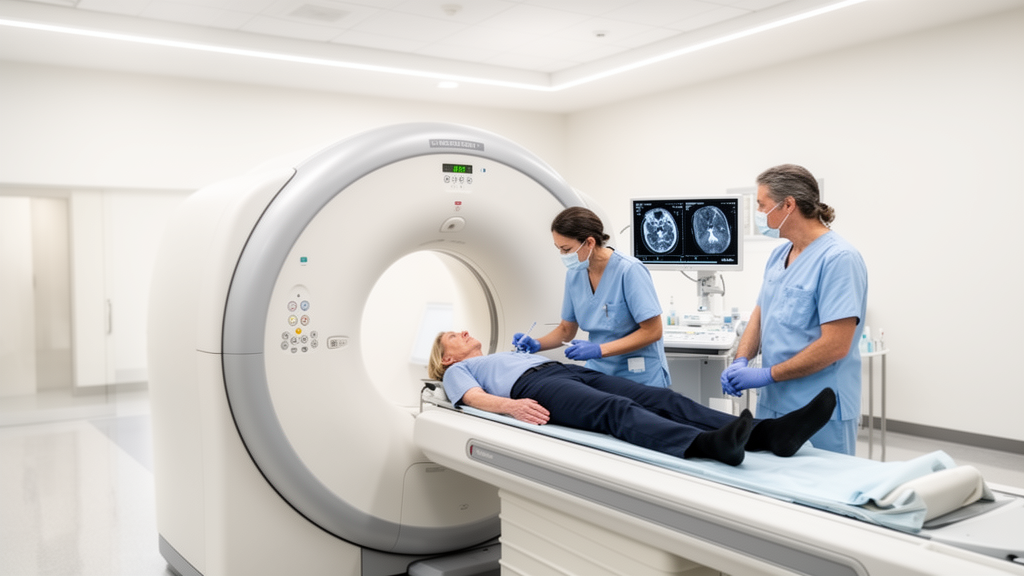
A multicenter prospective clinical trial will evaluate whether the radiotracer [¹⁸F]F-FAPI, used with positron emission tomography–computed tomography, can locate the primary tumor in adults with cancer of unknown primary after conventional investigations have been inconclusive. The investigator-initiated protocol plans to recruit 50 patients across six medical centers in the Netherlands. It is designed to assess the scan’s diagnostic performance, its clinical impact and its added value following standard work-up that includes [¹⁸F]fluoro-2-deoxy-d-glucose PET-CT. The study is a protocol: it describes planned methods and hypotheses but does not yet report patient outcomes.
Cancer of unknown primary, or CUP, is defined in the protocol as metastatic disease for which no primary tumor has been identified despite comprehensive diagnostic evaluation. This unresolved origin creates diagnostic uncertainty and can prevent clinicians from selecting evidence-based, site-specific treatment. The investigators propose [¹⁸F]F-FAPI as a potential alternative imaging approach for patients whose previous examinations, including [¹⁸F]FDG PET-CT, have not established the tumor’s site of origin. Their stated hypothesis is that FAPI PET-CT will identify the primary tumor in at least 15% of cases; that percentage is a study threshold to be tested, not an observed result.
FAPI tracers target fibroblast activation protein in cancer-associated fibroblasts, components of the tumor microenvironment. According to the protocol, their selective uptake in tumor-associated stroma and relatively low physiological uptake in normal tissues may provide greater tumor-to-background contrast than [¹⁸F]FDG. The researchers hypothesize that this favorable biodistribution could help reveal primary tumors that conventional imaging has missed. Whether [¹⁸F]F-FAPI PET-CT actually performs better in the intended CUP population remains to be determined by the trial.
Participants must be at least 18 years old and have CUP diagnosed after a standard diagnostic work-up that includes [¹⁸F]FDG PET-CT. Each participant will receive a single [¹⁸F]F-FAPI PET-CT examination. The images will be interpreted centrally by two independent nuclear medicine physicians or nuclear radiologists. Their interpretations will be combined into a consensus report, with recommendations supplied to the patient’s treating physician. The trial will also examine information from pathology, additional imaging and whole genome sequencing, alongside other clinical data collected during follow-up.
To assess the added diagnostic value and clinical effect of the new imaging strategy, a central Truth Panel of multidisciplinary experts will review pseudonymized participant data. This panel will use the available clinical evidence through six months after each [¹⁸F]F-FAPI PET-CT to evaluate how the scan affects diagnosis. Planned analyses include diagnostic performance measures and the scan’s potential to identify the tumor’s origin, but the protocol does not provide results for sensitivity, specificity, positive predictive value, negative predictive value or patient benefit. Patient recruitment began in July 2024, and the study is expected to conclude after the last enrolled participant completes six months of follow-up. The trial is registered as NCT06644716.
Subject of Research: Evaluation of [¹⁸F]F-FAPI PET-CT for detecting primary tumors in adults with cancer of unknown primary
Article Title: Study protocol of a multicenter prospective [¹⁸F]F-FAPI PET-CT imaging study in patients with cancer of unknown primary
Article References: Droogers, E., Hendriks, M. P., Minnaard, W., Kool, W., Schouten, L. J., Loef, C., Verburg, F. A., Robbrecht, D. G. J., & van Zanten, S. E. M. V. (2026). Study protocol of a multicenter prospective [¹⁸F]F-FAPI PET-CT imaging study in patients with cancer of unknown primary. BMC Cancer. https://doi.org/10.1186/s12885-026-16855-w
Image Credits: AI Generated
DOI: 10.1186/s12885-026-16855-w
Keywords: cancer of unknown primary, FAPI PET-CT, cancer imaging, fibroblast activation protein, cancer-associated fibroblasts, radiotracers, PET-CT, molecular imaging, multicenter trial, Netherlands, protocol, multicenter
News Source: Nathaniel Bowman. (October 25, 2026). Multicenter trial will test FAPI PET-CT for cancer of unknown primary. Scienmag.