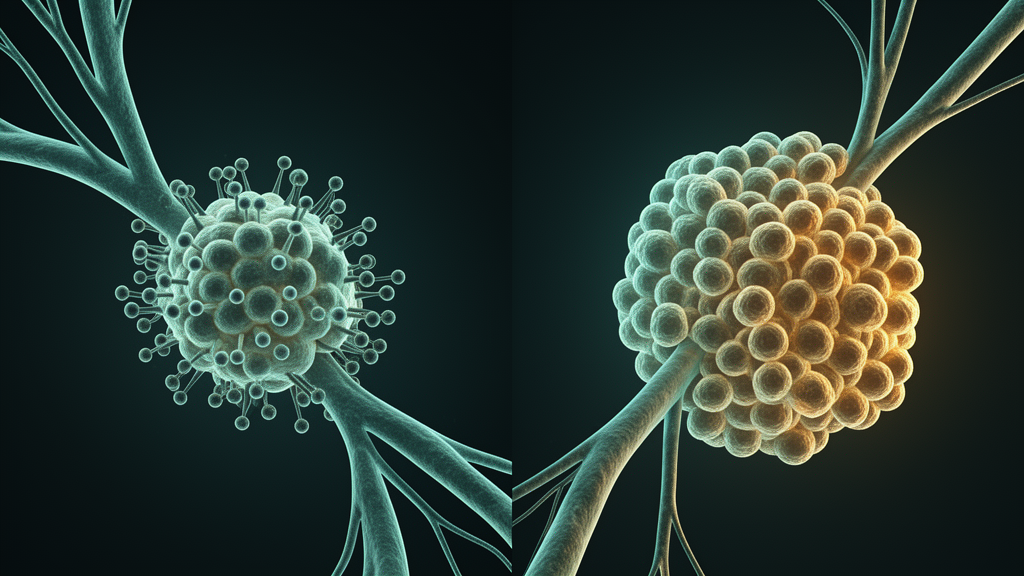
CD19-directed chimeric antigen receptor T-cell therapy has transformed the treatment of relapsed or refractory large B-cell lymphoma, but a retrospective single-center study published in Cancer Immunology, Immunotherapy on 25 October 2026 reports that where the disease sits in the body may matter as much as how much of it there is. In 109 consecutive patients treated with CD19-directed CAR T-cell therapy between January 2019 and May 2025, tumors shrank to a strikingly similar degree whether they occupied lymph nodes or organs beyond them, yet median progression-free survival was 306.5 days in patients with nodal disease compared with only 90 days in those with extranodal disease. The disconnect between tumor reduction and survival is the study’s central result, and it suggests that conventional response assessment, which measures how much lymphoma shrinks overall, may miss prognostic information encoded in the anatomical distribution of the disease.
The researchers analyzed baseline and follow-up CT or PET/CT scans using structured lesion tracking, assessing up to six target lesions per patient according to Lugano criteria and calculating the sum of the products of diameters, or SPD, as a measure of tumor burden. Depth of response was defined as the percentage change in SPD from baseline. The cohort had a median age of 65 years, with an interquartile range of 57 to 71 years, and 65 of the 109 patients, or 59.6 percent, had extranodal disease at baseline, meaning lymphoma had spread beyond the lymph nodes. Baseline tumor burden was markedly higher in these patients: the median SPD was 3,573 square millimeters in extranodal disease, with an interquartile range of 1,314 to 9,708 square millimeters, compared with 1,998 square millimeters in nodal disease, with an interquartile range of 1,347 to 2,921 square millimeters.
When the researchers compared how much tumors shrank after CAR T-cell therapy, nodal and extranodal lesions responded to a remarkably similar degree. At the first follow-up, tumor reduction was 62.1 percent in nodal disease versus 65.6 percent in extranodal disease, and at the second follow-up the figures were 77.9 percent versus 78.1 percent. The therapy’s cytoreductive effect, its ability to shrink measurable lesions, therefore appeared essentially equivalent regardless of anatomical site. The authors add an important caveat, however: the apparent comparability of response depth at the second follow-up may partly reflect differential attrition, as patients with extranodal disease were more likely to be lost to follow-up before that timepoint. This underscores the practical challenges of tracking outcomes in a population with aggressive, widely distributed disease, and it means the second timepoint comparison should be interpreted with corresponding care.
Using Kaplan-Meier analysis and Cox regression, the team found that baseline tumor burden was independently associated with both progression-free and overall survival: each doubling of SPD was associated with a 17 percent higher hazard of progression or death and a 21 percent higher hazard of death. Yet tumor burden alone did not explain the survival gap between nodal and extranodal disease, which persisted despite similar depth of response. When the analysis turned to individual organs, pleural, hepatobiliary, and adrenal involvement showed the strongest associations with adverse outcomes in this exploratory, hypothesis-generating organ-level analysis. Pleural involvement remained independently associated with both progression-free survival and overall survival, even though organ-specific subgroups were small, ranging from seven to nineteen patients, and the estimates should be interpreted with caution.
The authors frame these organ-level findings as candidate signals rather than established risk categories, and their conclusion explicitly calls for confirmation in larger, multicenter cohorts before pleural and hepatobiliary involvement can be treated as high-risk imaging phenotypes. Even so, the study’s broader implication is concrete: anatomical disease distribution may carry prognostic information beyond global tumor burden, and organ-specific response assessment may eventually provide information that standard global measurements do not capture. For patients whose lymphoma shrinks dramatically after CAR T-cell therapy but who carry disease in sites flagged by this analysis, the findings offer a hypothesis for why remissions may be shorter, and they identify a direction for future research into which patients with relapsed or refractory large B-cell lymphoma are most likely to maintain long remissions after this therapy.
Subject of Research: Organ-specific imaging response and survival after CD19-directed CAR T-cell therapy in relapsed or refractory large B-cell lymphoma
Article Title: Organ-specific depth of response to CD19-directed CAR T-cell therapy in B-cell lymphomas
Article References: Kassube, M., Achhammer, P., Linden, P., Bücklein, V. L., Tix, T., Kruk, L., Holzgreve, A., Werner, R. A., Ricke, J., von Bergwelt-Baildon, M., Rejeski, K., Subklewe, M., Kunz, W. G., & Winkelmann, M. (2026). Organ-specific depth of response to CD19-directed CAR T-cell therapy in B-cell lymphomas. Cancer Immunology, Immunotherapy. https://doi.org/10.1007/s00262-026-04605-7
Image Credits: AI Generated
DOI: 10.1007/s00262-026-04605-7
Keywords: CAR T-cell therapy, CD19, large B-cell lymphoma, extranodal disease, tumor burden, progression-free survival, PET/CT imaging, depth of response, Lugano criteria, immotherapy, pleural involvement, hepatobiliary disease
News Source: Nathaniel Bowman. (October 25, 2026). CAR T cells shrink lymphoma everywhere, but survival depends on location. Scienmag.