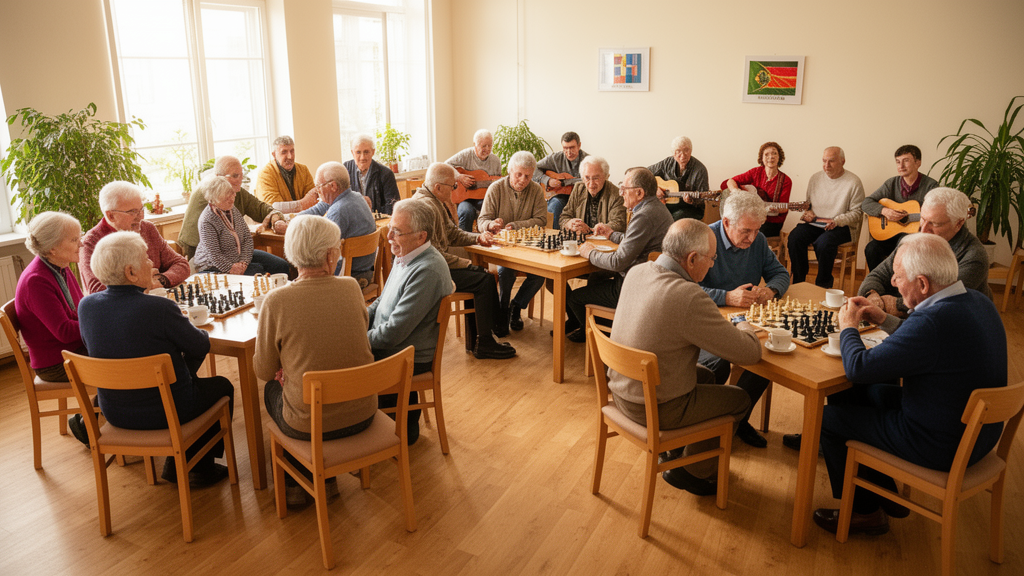
People who regularly participated in three or more social activities showed higher cognitive performance and lower risks of decline in memory and executive function in a large observational study spanning 24 countries. The analysis pooled longitudinal data from five nationally representative surveys, including 57,793 participants whose average age ranged from 57 to 73 and who were followed for an average of six years. Participants who engaged in social activities consistently had higher global cognitive scores than those who did not, with scores tending to rise as the number of activities increased.
The findings, published online on 20 October 2026 in the Journal of Epidemiology & Community Health, drew on the US Health and Retirement Study, the English Longitudinal Study of Ageing, the China Health and Retirement Longitudinal Study, the Mexican Health and Ageing Study and the Survey of Health, Ageing and Retirement in Europe. Survey waves ranged from 2008 to 2021, depending on the cohort. At each wave, participants reported the types and number of social activities they engaged in, and researchers assessed memory and executive function. Test results were combined into a global cognitive-function z score, for which higher values indicated better cognitive performance.
Participants reporting at least three activities had the greatest apparent protection against impairments in memory and executive function, with higher year-by-year cognitive scores during follow-up than those reporting no activities. Volunteering and sports-club membership were associated with a lower risk of cognitive decline across all five survey groups. Attending training courses and caring for children were significantly associated with higher cognitive scores from one year to the next. Active involvement in political, community, church and religious groups, however, was not consistently associated with cognitive enhancement, indicating that the observed relationships differed among types of social participation.
Additional analysis suggested that associations between social activities and cognitive function were stronger among women, participants aged 60 or older, people with higher education, those without depression, people living alone, those of normal weight, rural residents, and people who smoked or drank alcohol. The investigators offered several possible explanations but did not directly test them. Under the “use it or lose it” hypothesis, sustained engagement in cognitively stimulating activities may enhance neural plasticity and strengthen synaptic connections. Higher education may support neural efficiency and compensatory capacity, potentially increasing resilience to age-related neuropathological changes. Meaningful participation may also promote psychological wellbeing, modulate neuroendocrine function and lessen the effects of chronic stress on the hippocampus.
The research was observational and therefore cannot establish that participation in social activities caused better cognitive outcomes. The authors also identified limitations including the lack of standardisation across the five surveys, only partial adjustment for potentially influential factors, and the focus on the quantity of activities rather than their quality, motivation or experience. The results support an association between diverse, sustained social engagement and better cognitive trajectories among older adults, but they do not demonstrate that a particular activity prevents dementia. The investigators described social activities as a possible multidimensional protective factor and said the findings underscore the importance of targeted approaches to promoting diverse and sustained social engagement among older adults.
Subject of Research: Associations between social participation and cognitive trajectories in older adults
Article Title: Diverse and sustained social activities may boost cognition in older age
Article References: Diverse and sustained social activities may boost cognition in older age. Original publication (Bibliographic details unavailable.)
Image Credits: AI Generated
DOI: Not provided
Keywords: social activity, cognitive performance, older adults, cognitive decline, longitudinal cohorts, volunteering, sports clubs, memory, executive function, dementia, Diverse, sustained
News Source: Glenn Wilkins. (October 25, 2026). Social activities linked to better cognition across 24 countries. Scienmag.