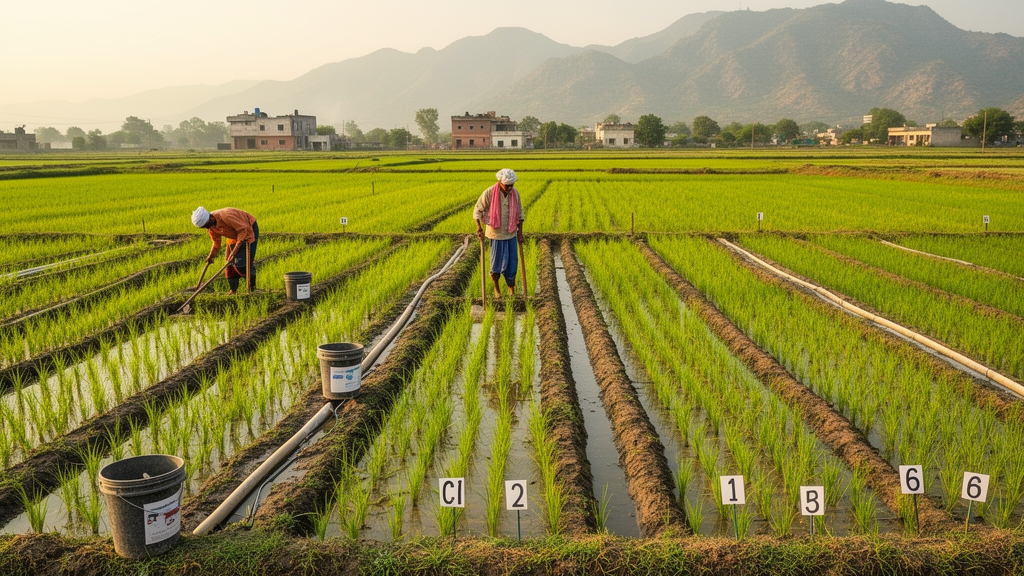
A field experiment under dry direct-seeded conditions found that the rice genotype Shalimar Rice-3, a nitrogen rate of 120 kilograms per hectare, and splitting the nitrogen into five applications were each associated with favorable grain yield and agronomic efficiency under temperate conditions in northern India. These were measured treatment outcomes rather than a controlled demonstration that the three factors act independently. Across the tested treatments, the maximum observed grain yield was 7.3 tonnes per hectare, recorded with 120 kilograms of nitrogen per hectare applied in five splits. The results therefore point to a productive combination involving genotype, fertilizer rate and application schedule, but the conclusions remain confined to the cultivars, rates, schedules and growing environment evaluated.
The researchers evaluated three temperate rice genotypes—Shalimar Rice-3, Shalimar Rice-4 and SKAU-484—under dry direct-seeded field conditions. Each genotype was tested with three nitrogen rates of 0, 120 and 150 kilograms per hectare and three split-application schedules delivering the fertilizer in three, four or five applications. Measurements included crop phenology, grain yield, protein yield, heat-unit requirements, thermal and hydrothermal efficiency indices, and agronomic nitrogen-use efficiency. Dry direct-seeded rice was investigated as an alternative to conventional transplanting, which the study describes as becoming increasingly difficult because of limited water resources and labor shortages. The experiment focused on genotype and nitrogen management within a dry direct-seeded system rather than surveying the full range of rice-production practices.
Nitrogen application was associated with increases in both grain and protein yield, while the treatment receiving no nitrogen showed markedly reduced efficiency indices. At 120 kilograms of nitrogen per hectare, grain yields ranged from 6.7 to 7.4 tonnes per hectare, compared with 6.9 to 7.6 tonnes per hectare at 150 kilograms per hectare. The additional 30 kilograms per hectare did not produce a consistent yield advantage across the study: grain yield was significantly higher under the 150-kilogram treatment in 2025, but the 120-kilogram treatment produced the highest single observed yield when its five-split schedule was considered. That treatment yielded 7.3 tonnes per hectare, slightly more than the 7.1 tonnes per hectare obtained from 150 kilograms per hectare applied in three splits. The comparison indicates that application schedule can distinguish outcomes at the two rates, without establishing that more splits caused the higher yield in every season or treatment combination.
The efficiency measurements favored the lower of the two tested nitrogen rates. Agronomic nitrogen-use efficiency under 120 kilograms per hectare ranged from 16.7 to 17.2 kilograms of grain per kilogram of nitrogen, approximately 15% higher than under 150 kilograms per hectare. Shalimar Rice-3 also required fewer heat units to reach maturity and recorded higher heat-use efficiency, hydrothermal-unit efficiency and agronomic nitrogen-use efficiency than the two comparison genotypes. Separately, the reported genotype comparison showed that Shalimar Rice-3 yielded 6.4 tonnes per hectare, 14% more than Shalimar Rice-4 and 5% more than SKAU-484. That 6.4-tonne figure was the genotype result and should not be confused with the 7.3-tonne maximum recorded across the broader set of nitrogen-rate and split-application treatments.
Taken together, the field measurements associate SR-3 with comparatively strong performance, 120 kilograms of nitrogen per hectare with high yield and efficiency, and five-way splitting with the highest observed grain yield. The experiment was conducted under temperate dry direct-seeded conditions in northern India, and the supplied findings do not establish whether the same ranking would hold in other climates, soil conditions, seasons or production regions. Nor do they quantify performance against transplanted rice. Within the tested scope, however, the results indicate that genotype selection and nitrogen scheduling warrant joint attention: the moderate rate was associated with better agronomic nitrogen-use efficiency, while greater splitting coincided with the maximum yield. The authors therefore described SR-3 cultivated with an appropriate nitrogen rate and split strategy as a promising option for improving productivity and sustainability in dry direct-seeded rice under temperate northern Indian conditions.
Subject of Research: Effects of genotype, nitrogen rate and split application on yield and efficiency in temperate dry direct-seeded rice
Article Title: Optimizing genotype and nitrogen management for improved yield and agronomic efficiency in dry direct seeded rice under temperate ecology
Article References: Mubarak, T., Jehangir, I. A., Lone, A. H., Gruda, N. S., Salem, A., Dewidar, A. Z., & Mattar, M. A. (2026). Optimizing genotype and nitrogen management for improved yield and agronomic efficiency in dry direct seeded rice under temperate ecology. BMC Plant Biology. https://doi.org/10.1186/s12870-026-09840-9
Image Credits: AI Generated
DOI: 10.1186/s12870-026-09840-9
Keywords: dry direct-seeded rice, rice genotypes, nitrogen rate, split application, grain yield, protein yield, nitrogen-use efficiency, thermal efficiency, temperate agriculture, northern India, Optimizing, genotype
News Source: Alan Morgan. (October 25, 2026). Northern India dry-seeded rice trial links genotype and nitrogen splitting to yield. Scienmag.