The combination of both plants delivered the strongest antioxidant performance, reaching a free radical scavenging capacity of 97.03 percent in the ABTS assay by the end of 21 days at 4 degrees Celsius, while a yogurt enriched only with moringa kept lactic acid bacteria counts rising through day 14.
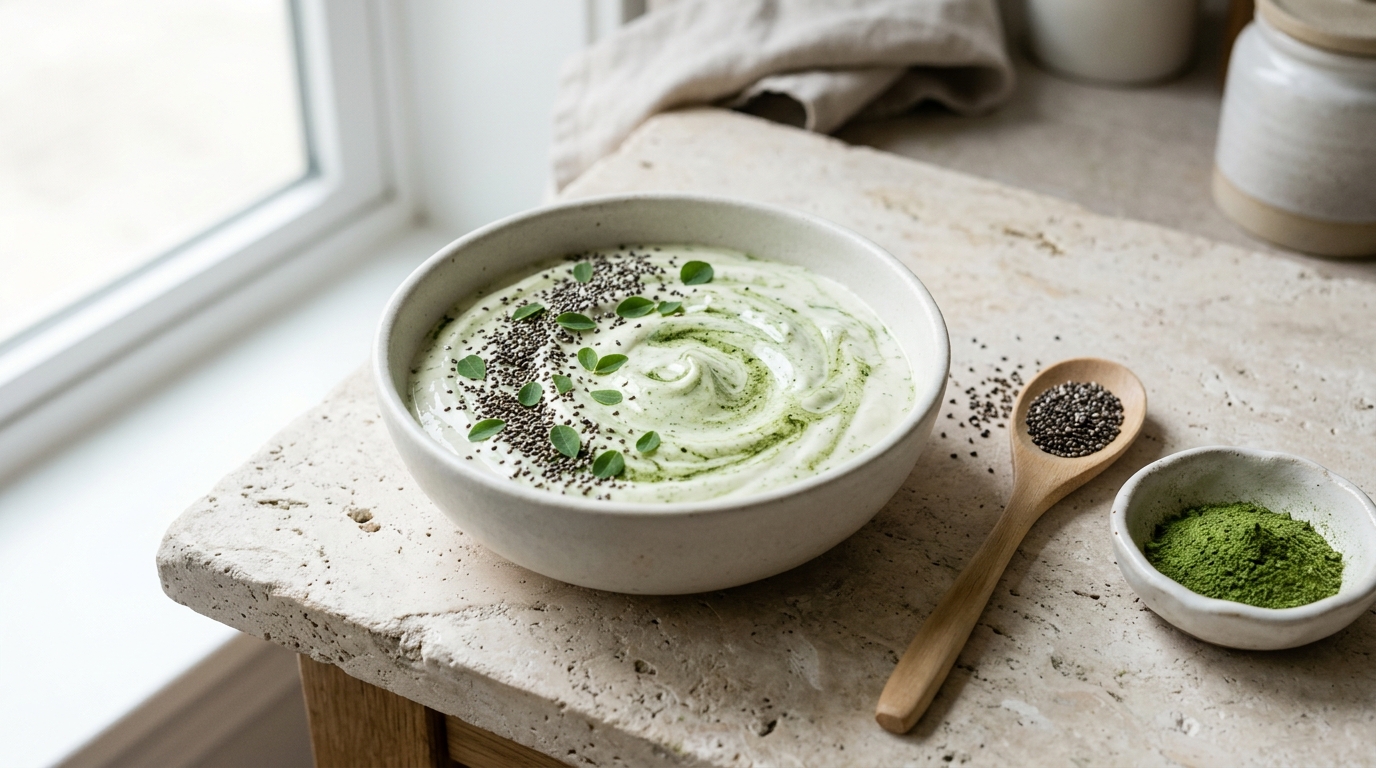
Researchers prepared four yogurt treatments following Mexican official standards for the product: a plain control, one with 0.1 percent dry extract of Moringa oleifera leaves, one with 0.5 percent flour ground from Salvia hispanica seeds, and a mix containing both additions. Each batch was inoculated with a lyophilized starter culture of Lactobacillus bulgaricus and Streptococcus thermophilus, incubated for five hours, stabilized at 4 degrees Celsius for 12 hours, and then sampled on days 0, 7, 14, and 21. The team measured pH, titratable acidity, total phenolic compounds, antioxidant activity by two chemical assays, peptide concentration, and viable lactic acid bacteria counts across the storage period.
The chia-enriched yogurt recorded the highest titratable acidity at 1.84 percent lactic acid, a statistically significant difference from the other treatments. The control yogurt drifted from a pH of 4.63 on day zero to 4.14 by day 21, while the moringa and chia yogurts ended slightly lower at 4.07 and 4.10 respectively.
From day zero, the mix yogurt already led with 196.25 milligrams of gallic acid equivalents per 100 grams, compared with 102.92 in the control. Most treatments gained phenolic content over time, though with different patterns. The control and moringa yogurts peaked at day 14 before dipping slightly, while the chia and mix yogurts climbed steadily throughout. By day 21, the mix treatment reached 313.80 milligrams of gallic acid equivalents per 100 grams, the highest value recorded in the study. The authors attribute this accumulation to bioactive compounds naturally present in the ingredients, including flavonoids such as quercetin and kaempferol and hydroxycinnamic acids like gallic, caffeic, and chlorogenic acid.
Antioxidant activity measured by the ABTS assay rose significantly across all treatments during storage. The mix yogurt hit 97.03 percent inhibition by day 21, followed by chia at 93.35 percent, moringa at 90.40 percent, and the control at 66.03 percent. The DPPH assay painted a more nuanced picture. Moringa yogurt led on day 14 with 23.15 percent radical scavenging, while the mix peaked earlier at 20.50 percent on day 7. By day 21, DPPH inhibition had declined in the moringa, chia, and control treatments. The researchers note that high-molecular-weight compounds in the yogurt matrix may react poorly with the DPPH radical, whereas smaller molecules interact more freely, which helps explain why the two assays diverged.
Peptide concentration, measured as leucine equivalents, revealed proteolytic activity during storage. On day zero, the mix yogurt started highest at 27.09 milligrams of leucine per 100 grams, followed by moringa at 25.67, chia at 23.95, and control at 19.42. By day 21, the mix had climbed to 34.71 and chia to 27.94, while the control and moringa yogurts fell to 22.31 and 19.03 respectively.
The control showed no significant change across the full storage period.
The study has clear limitations. The authors themselves call for in vivo trials to validate the antioxidant effects and for optimization of the production process.
Still, the work adds to evidence that adding Moringa oleifera leaf extract and Salvia hispanica seed flour to yogurt altered its measured phenolic content, antioxidant activity, peptide concentration, and lactic acid bacteria viability during 21 days of refrigerated storage. Moringa oleifera brings a dense nutritional portfolio of proteins, vitamins A, C, and E, and minerals including calcium, potassium, and iron, along with flavonoids and phenolic acids. Salvia hispanica contributes omega-3 fatty acids, fiber, and its own polyphenolic antioxidants.
Subject of Research: Effects of Moringa oleifera leaf extract and Salvia hispanica seed flour on antioxidant activity, phenolic content, peptide concentration, and lactic acid bacteria viability in yogurt during 21 days of refrigerated storage
Article Title: Evaluation of the addition of Moringa oleifera L. and Salvia hispanica L. on the antioxidant activity and viability of lactic acid bacteria in yogurt during refrigerated storage
Article References: Getsemani, L.-G., Manuel, T.-L. V., Rubi, S.-C. M., Manuel, M. H.-V., de Lourdes, V.-V. M., & Jesús, M.-S. T. (2025). Evaluation of the addition of Moringa oleifera L. and Salvia hispanica L. on the antioxidant activity and viability of lactic acid bacteria in yogurt during refrigerated storage. Dairy Science and Management, 2(1), Article 4. https://doi.org/10.1186/s44363-025-00005-x
Image Credits: AI Generated
DOI: 10.1186/s44363-025-00005-x
Keywords: yogurt, Moringa oleifera, Salvia hispanica, antioxidant activity, lactic acid bacteria, phenolic compounds, refrigerated storage, functional foods, post-acidification, peptide concentration, DPPH assay, ABTS assay
News Source: Alan Morgan. (November 5, 2026). Moringa and Chia Enriched Yogurt Showed Stronger Antioxidant Activity Over 21 Days. Scienmag.