• HOME
  • NEWS
  • EXPLORE
    • CAREER
      • Companies
      • Jobs
    • EVENTS
    • iGEM
      • News
      • Team
    • PHOTOS
    • VIDEO
    • WIKI
  • BLOG
  • COMMUNITY
    • FACEBOOK
    • INSTAGRAM
    • TWITTER
Tuesday, May 12, 2026
BIOENGINEER.ORG
No Result
View All Result
  • Login
  • HOME
  • NEWS
  • EXPLORE
    • CAREER
      • Companies
      • Jobs
        • Lecturer
        • PhD Studentship
        • Postdoc
        • Research Assistant
    • EVENTS
    • iGEM
      • News
      • Team
    • PHOTOS
    • VIDEO
    • WIKI
  • BLOG
  • COMMUNITY
    • FACEBOOK
    • INSTAGRAM
    • TWITTER
  • HOME
  • NEWS
  • EXPLORE
    • CAREER
      • Companies
      • Jobs
        • Lecturer
        • PhD Studentship
        • Postdoc
        • Research Assistant
    • EVENTS
    • iGEM
      • News
      • Team
    • PHOTOS
    • VIDEO
    • WIKI
  • BLOG
  • COMMUNITY
    • FACEBOOK
    • INSTAGRAM
    • TWITTER
No Result
View All Result
Bioengineer.org
No Result
View All Result
Home NEWS Science News Chemistry

Metallic state of Ag nanoclusters in oxidative dispersion identified in situ

Bioengineer by Bioengineer
March 4, 2021
in Chemistry
Reading Time: 2 mins read
0
IMAGE
Share on FacebookShare on TwitterShare on LinkedinShare on RedditShare on Telegram

IMAGE

Credit: DICP

Oxidative dispersion has been widely used in the regeneration of sintered metal catalysts as well as the fabrication of single-atom catalysts.

The consensus on the oxidative dispersion process includes the formation of mobile metal oxide species from large metal particles and the capture of these species on a support surface. Nevertheless, the mechanism of oxidation-induced dispersion has yet to be confirmed via in situ electron microscopic and/or spectroscopic characterizations.

Recently, a research team led by Prof. FU Qiang and Prof. BAO Xinhe from the Dalian Institute of Chemical Physics (DICP) of the Chinese Academy of Sciences (CAS), in collaboration with Prof. YANG Bing from DICP and Prof. GAO Yi from the Shanghai Institute of Applied Physics of CAS, reported the oxygen adsorption-induced dispersion of metallic Ag nanoclusters in a typical oxidative atmosphere.

The results were published in Nature Communications on March 3.

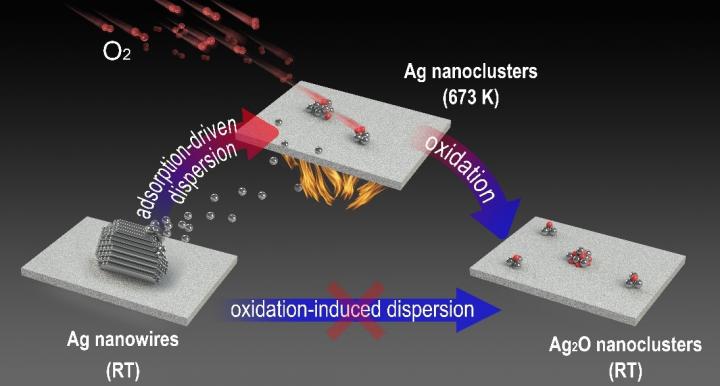
By utilizing in situ imaging methods such as environmental scanning electron microscopy (ESEM), and newly developed near-ambient pressure photoemission electron microscopy (NAP-PEEM), researchers found that micron-scale Ag nanowires could be dispersed into subnanometer clusters under an oxygen atmosphere.

Ex situ experiments indicated that Ag nanowires were converted into AgOx nanoclusters. Conversely, in situ near-ambient pressure photoelectron spectroscopy (NAP-XPS) directly demonstrated the presence of a transitional state of metallic Ag nanoclusters during dispersion at high temperatures, while the formation of the oxide occurred during the cooling process. The dynamic dispersion of Ag nanowires during CO oxidation was also demonstrated.

Based on experimental and theoretical calculations, chemisorption of oxygen from the O2 atmosphere was shown to be the essential driving force for the dispersion of metallic Ag nanoclusters.

This work provides a new understanding of the role of the O2 atmosphere in oxidative dispersion, which is particularly important for the prediction and control of the dynamic dispersion/redispersion of supported metal catalysts under similar reaction conditions.

###

This work was supported by the National Natural Science Foundation of China, the Strategic Priority Research Program (B) of the Chinese Academy of Sciences, the Ministry of Science and Technology of China, and the DNL Cooperation Fund.

Media Contact
Jean Wang
[email protected]

Original Source

https://www.nature.com/articles/s41467-021-21552-2

Related Journal Article

http://dx.doi.org/10.1038/s41467-021-21552-2

Tags: Atomic PhysicsAtomic/Molecular/Particle PhysicsChemistry/Physics/Materials SciencesNanotechnology/Micromachines
Share12Tweet8Share2ShareShareShare2

Related Posts

Innovative Method Unveiled to Detect Signs of Dark Matter — Chemistry

Innovative Method Unveiled to Detect Signs of Dark Matter

May 12, 2026
Illuminating the Science Behind Historical Featherwork Art — Chemistry

Illuminating the Science Behind Historical Featherwork Art

May 12, 2026

Humans and Zebra Finches Share Similar Speech Learning Techniques #ASA190

May 11, 2026

Unveiling Dark Matter Through Molecular Insights

May 11, 2026
Please login to join discussion

POPULAR NEWS

  • Research Indicates Potential Connection Between Prenatal Medication Exposure and Elevated Autism Risk

    842 shares
    Share 337 Tweet 211
  • New Study Reveals Plants Can Detect the Sound of Rain

    728 shares
    Share 290 Tweet 182
  • Salmonella Haem Blocks Macrophages, Boosts Infection

    62 shares
    Share 25 Tweet 16
  • Breastmilk Balances E. coli and Beneficial Bacteria in Infant Gut Microbiomes

    57 shares
    Share 23 Tweet 14

About

We bring you the latest biotechnology news from best research centers and universities around the world. Check our website.

Follow us

Recent News

USC Researchers Initiate Study on the Most Advanced Lab-Grown Kidney Structures

Chaotic VCSELs Power Dynamic Physical Unclonable Functions

Breakthrough in CAR T Cell Therapy: Insights from Successfully Treated AML Patients

Subscribe to Blog via Email

Enter your email address to subscribe to this blog and receive notifications of new posts by email.

Join 82 other subscribers
  • Contact Us

Bioengineer.org © Copyright 2023 All Rights Reserved.

Welcome Back!

Login to your account below

Forgotten Password?

Retrieve your password

Please enter your username or email address to reset your password.

Log In
No Result
View All Result
  • Homepages
    • Home Page 1
    • Home Page 2
  • News
  • National
  • Business
  • Health
  • Lifestyle
  • Science

Bioengineer.org © Copyright 2023 All Rights Reserved.