A plant long used by traditional healers across Ethiopia and the wider Afro-montane region has been put under the systematic microscope, and the verdict is a familiar one in medicinal plant research: intriguing preclinical signals, but no human evidence. A systematic review published in Clinical Phytoscience on 9 July 2026 has pulled together every study the authors could find on Verbascum sinaiticum Benth, a biennial herb in the figwort family better known as a relative of common mullein, and concluded that while the plant is rich in bioactive chemistry, its therapeutic promise rests almost entirely on laboratory and animal data.
The review, conducted by Beyene Dereje Degefa, Alemayehu Megersa and Delelegn Getachew, followed the PRISMA 2020 reporting guidelines and searched PubMed, Embase, Web of Science, Google Scholar and Global Index Medicus from database inception to 30 May 2025. From 1,729 records initially identified, 46 studies met the inclusion criteria: 25 ethnobotanical surveys, 8 phytochemical investigations and 13 pharmacological studies, of which 7 were purely in vitro, 4 were in vivo animal experiments and 2 combined both approaches. Study quality was appraised with the Critical Appraisal Skills Programme checklist, and the authors note that the protocol was not prospectively registered in PROSPERO, a limitation they acknowledge openly.
What emerges first from the ethnobotanical record is striking in its geographic concentration. All 25 ethnobotanical surveys included in the review were conducted in Ethiopia, where the plant is used for gastrointestinal complaints such as stomachache, diarrhea and indigestion, wound healing, diabetes, hemorrhage, cancer, syphilis, amoebiasis, scabies, liver disease, epilepsy, cough, hypertension, anthrax and trypanosomiasis, among other conditions. Fresh crushed leaves mixed with water are applied topically for skin diseases, and leaves and roots are the most commonly used plant parts, administered both orally and on the skin. Outside Ethiopia, the review identified only one additional ethnobotanical record: a report from Eritrea of the plant being used against tapeworm infection. Despite the species growing across Sudan, Somalia and Yemen, no ethnobotanical studies from those countries have been published.
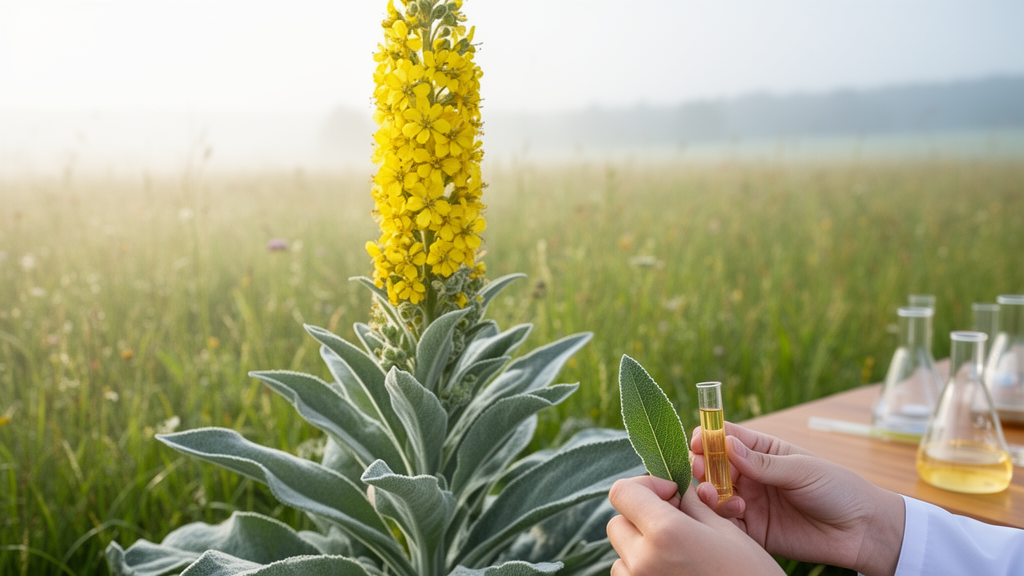
Verbascum sinaiticum itself is a conspicuous plant. It is a biennial herb reaching 60 to 200 centimeters in height, with an erect, thick, grayish-tomentose stem, dense white hairs on leaves and stems, and yellow flowers 20 to 28 millimeters across borne in clusters of two to seven. It is native to the Afro-montane region, with a distribution stretching from northeast Africa through Egypt’s Sinai Mountains and the eastern Mediterranean, eastward through Iran to Afghanistan, and south to Yemen, Israel and Eritrea. It is frequently found along roadsides, where its woolly foliage makes it hard to miss.
The phytochemical picture is where the review becomes genuinely detailed. Analyses of the plant’s roots, leaves, flowers and aerial parts have yielded a suite of compounds: the flavones luteolin and chrysoeriol, chrysoeriol-7-glucoside, the iridoid glycosides ajugol and aucubin, the flavonolignans hydrocarpin and sinaiticin, the phenylethanoid glycoside acteoside, and four isoflavone glycosides including orobol and orobol 7-O-β-D-glucoside. Screening has also shown that the chemical profile depends on the solvent: aqueous leaf extracts contain saponins and alkaloids, while methanol extracts additionally contain steroids, flavonoids, glycosides, phenols and tannins. Thin-layer chromatography of flower extracts confirmed flavonoids and terpenoids there as well.
On the pharmacological side, the preclinical evidence spans an unusually wide range of activities. In vitro, a methanol leaf extract inhibited the enzyme alpha-glucosidase by 89 percent at 25 parts per million, with a half-maximal inhibitory concentration of 4.66 micrograms per milliliter, a potency the authors note compares favorably with standard inhibitors under similar assay conditions. In mice, an 80 percent methanol crude extract and its ethyl acetate fraction significantly reduced blood glucose at 400 milligrams per kilogram in oral glucose tolerance and antihyperglycemic models, with the ethyl acetate fraction performing best. Antimicrobial testing showed methanol leaf extracts at 100 milligrams per milliliter producing inhibition zones of 21 millimeters against Staphylococcus aureus and 18 millimeters against Pseudomonas aeruginosa, comparable to gentamicin, while ethanol flower extracts inhibited methicillin-resistant S. aureus by 70 percent and Salmonella typhimurium by 99.42 percent. Acetone root extracts showed broad-spectrum activity against several gram-positive and gram-negative organisms, including E. coli and Vibrio cholerae.
Other domains of activity include inflammation, wound healing, parasitic infection and liver protection. A single in vivo study using mice and rats found that 80 percent methanol root extract at 200 and 400 milligrams per kilogram produced significant antinociceptive effects in hot plate and writhing tests and reduced carrageenan- and formalin-induced paw edema, with effects comparable to indomethacin at 10 milligrams per kilogram. Topical ointments containing 5 and 10 percent methanol leaf extract achieved wound contraction rates of 85 to 92 percent by day 14 in rat excision models, with shorter epithelialization times and greater tensile strength. Against Trypanosoma congolense, extracts reduced parasite motility in vitro and, in infected mice given 400 milligrams per kilogram intraperitoneally, significantly reduced parasitemia, prevented decline in packed cell volume and prolonged survival. For the liver, leaf extracts protected cultured hepatocytes against carbon tetrachloride toxicity, and in rats pretreatment with hydroalcoholic leaf extract significantly suppressed the rise in serum AST and ALT and reduced hepatic necrosis on histology.
The review is careful, however, to keep these findings in perspective, and the caveats are substantial. All pharmacological evidence comes from in vitro systems and rodent models; no clinical trials of any kind have been conducted for any indication. The studies are highly heterogeneous in extraction methods, solvents, concentrations, animal models and outcome measures, which the authors say precludes formal meta-analysis and makes cross-study comparison unreliable, since the same plant part extracted with different solvents yields markedly different chemical profiles and activities. Most in vitro work used crude extracts rather than isolated compounds, so specific effects cannot be attributed to individual constituents with confidence. In the antimicrobial work, no minimum bactericidal concentrations were reported in most studies, no in vivo antimicrobial experiments exist, and there are no time-kill kinetics or mechanistic data. The antitrypanosomal effects were partial rather than complete, with no selectivity index reported and no comparison against standard trypanocidal drugs, and no studies on the human-pathogenic trypanosomes T. brucei rhodesiense or T. brucei gambiense.
Safety data are similarly incomplete. Acute oral toxicity studies in Swiss albino mice indicate LD50 values exceeding 2,000 milligrams per kilogram for both methanolic and aqueous leaf extracts, suggesting a favorable acute safety margin. But sub-chronic and chronic toxicity data are absent, no clinical pharmacokinetic data exist, and the toxicity of individual isolated compounds, potential herb-drug interactions, and reproductive or developmental toxicity have not been investigated. The authors also flag a language bias: only English-language publications were included because the team lacked proficiency in other languages, meaning potentially relevant studies in Arabic or Amharic may have been missed. A small number of studies in the pharmacological table were found on detailed review to report data on isolated compounds without explicit linkage to V. sinaiticum as the plant source, an inclusion limitation the authors acknowledge.
The review’s conclusion is measured rather than triumphant: the plant exhibits broad pharmacological potential supported by ethnomedicinal evidence and bioactive phytoconstituents, but the evidence base is predominantly preclinical and methodologically heterogeneous. The authors set out a research agenda that reads as a checklist for any medicinal plant hoping to move from the ethnobotanical record to the clinic: mechanistic in vivo studies with isolated bioactive compounds, bioavailability and pharmacokinetic profiling of key constituents, standardized extraction and formulation protocols, sub-chronic and chronic toxicity studies, clinical trials beginning with dose-finding and safety assessments, and ethnobotanical investigation in non-Ethiopian populations within the plant’s range. Until those steps are taken, the woolly roadside herb will remain what it has long been, a staple of traditional medicine whose laboratory promise is real but unproven in people.
Subject of Research: Systematic review of the ethnobotany, phytochemistry and preclinical pharmacology of the medicinal plant Verbascum sinaiticum
Article Title: Therapeutic potential of Verbascum sinaiticum benth (Scrophulariaceae): a systematic review of ethnobotany, phytochemistry, and pharmacological activities
Article References: Degefa, B. D., Megersa, A., & Getachew, D. (2026). Therapeutic potential of Verbascum sinaiticum benth (Scrophulariaceae): a systematic review of ethnobotany, phytochemistry, and pharmacological activities. Clinical Phytoscience, 12(1), Article 14. https://doi.org/10.1186/s40816-026-00430-8
Image Credits: AI Generated
DOI: 10.1186/s40816-026-00430-8
Keywords: Verbascum sinaiticum, systematic review, ethnobotany, phytochemistry, pharmacology, medicinal plants, flavonoids, iridoid glycosides, antimicrobial, antidiabetic, wound healing, preclinical evidence
News Source: Ophelia Keating. (October 30, 2026). Medicinal Mullein Plant Shows Promise in Systematic Review, But Human Trials Remain Absent. Scienmag.