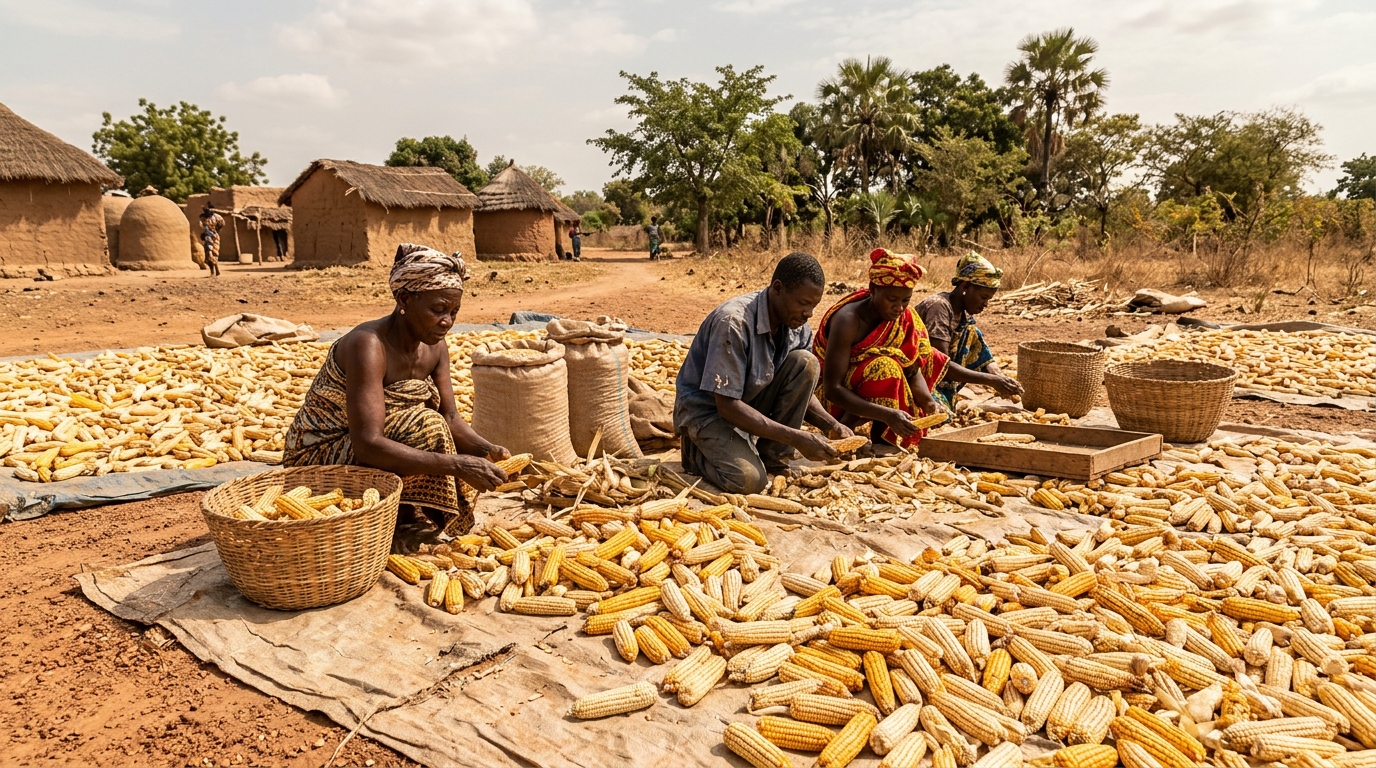
Aflatoxins, the toxic compounds produced by fungi of Aspergillus section Flavi, remain a persistent threat to maize in Ghana, and a new survey of 800 farmers suggests that everyday field and storage routines are keeping the risk alive. The study, carried out in the country’s forest and savannah agroecological zones between September 2019 and March 2020, compared how farmers in the two regions grow, harvest, dry, shell, sort and store their maize, and then related those practices to aflatoxin levels measured in laboratory samples. Its central message is sobering: the interventions known to reduce contamination, from biocontrol products to hermetic storage bags, are used by only a tiny fraction of smallholders.
The research team selected participants through a multistage probability sampling design. Ghana was first stratified into savannah and forest zones; a region was then drawn by lottery from each zone, followed by four districts per region, five communities per district and, finally, individual farmers chosen at random from local lists. Every participant owned at least one acre of maize land. In total, 800 maize growers were interviewed using a semi-structured questionnaire administered in person by trained enumerators, and a one-kilogram sample of freshly harvested maize was collected from ten farmers in each village, yielding 400 samples for laboratory analysis.
The laboratory work took place at the Aflatoxins Laboratory of Kwame Nkrumah University of Science and Technology. Samples were analysed for the four principal aflatoxins, B1, B2, G1 and G2, using high-performance liquid chromatography with post-column derivatisation, following a modified version of the method described by Sirhan and colleagues. Quality control was tight: calibration curves were linear, with correlation values of 0.998 to 0.999, limits of quantification ranged from 0.1 to 0.2 parts per billion, and recoveries in spiked samples reached 97 to 99 percent. Accuracy was confirmed against certified reference material, with a measured value of 20.65 micrograms per kilogram falling within the certified range of 21.0 plus or minus 2.9 micrograms per kilogram.
The demographic picture differed sharply between zones. Farmers in the savannah zone averaged 39.48 years of age, compared with 47.34 years in the forest zone. Men dominated maize cultivation in both regions, accounting for 54 percent of producers in the forest zone and 72.8 percent in the savannah zone, and 63.4 percent overall. Gender differences between zones were statistically significant. Education also diverged: 65 percent of savannah-zone respondents had no formal education, and the difference in educational attainment between zones was highly significant. Average household sizes were similar, at 7.13 in the forest zone and 7.50 in the savannah zone.
Pre-harvest routines revealed both common ground and regional contrasts. Chemical weed control was the most popular approach, used by 64.9 percent of farmers across both zones, ahead of mechanical methods at 58.2 percent and biological methods at just 2.5 percent. Yet the mechanics differed: hoeing was the main mechanical method in the savannah zone, practised by 93.8 percent of farmers there, while slashing dominated the forest zone at 99.6 percent. Fertiliser use was nearly universal in the savannah zone, with 97 percent applying it, against only 31 percent in the forest zone. Pest control followed the opposite pattern, practised by 87 percent of forest-zone farmers but just 49 percent in the savannah zone. Chemical pest control was the dominant method, used by 95.4 percent of those who managed pests.
Two aflatoxin-specific interventions barely registered. Only 3.2 percent of farmers irrigated their maize fields, and just 3.1 percent applied Aflasafe, a biological control product that the authors cite as prior research showing reductions in aflatoxin contamination of maize and groundnuts of 80 to 99 percent across the value chain. The authors attribute the limited uptake of Aflasafe to low awareness of the product, limited availability in local markets, high cost and insufficient technical support from extension services, and note that reliance on rain-fed agriculture, lack of irrigation, cost of labour and limited knowledge of application protocols restrict its effective use.
Post-harvest handling showed equally entrenched habits. The vast majority of farmers, 87.9 percent, allowed their maize to dry fully on the field before harvesting, a practice more common in the savannah zone at 90.2 percent. Among those who did not, drying on bare ground was widespread, particularly in the savannah zone, where 92.3 percent of such farmers used that method. The authors note that Aspergillus flavus lives in the soil, and that drying maize on bare ground can lead to serious contamination of the grain by the fungus. The authors note that the shellers, which moved from farm to farm and were not sanitised or washed after use, could be a medium of contamination of uninfected maize.
Sorting and storage practices added further nuance. About 67.2 percent of farmers sorted their maize after shelling, with forest-zone farmers far more diligent at 90.5 percent than savannah-zone farmers at 44 percent. Savannah-zone farmers were more likely to use damaged grains as food, at 45.8 percent versus 14.9 percent in the forest zone; the authors suggest that the single cropping season in the savannah zone can lead to food scarcity, making farmers more likely to use spoiled grains as food and feed. Storage relied overwhelmingly on polypropylene sacks, used by 69.8 percent of farmers, while only 3.9 percent used Purdue Improved Crop Storage bags, hermetic containers that limit oxygen influx and prevent fungal and insect development. Most savannah-zone farmers stored maize as shelled grain, at 99.6 percent, while 45 percent of forest-zone farmers kept it with the husk, which can hide insect damage and contaminated kernels from view.
The statistical analysis linked several practices and characteristics to aflatoxin levels, though the authors caution that the cross-sectional observational design prevents causal inference and cannot exclude reverse causality. Maize from fields where fertiliser was not applied had significantly higher mean aflatoxin levels, 21.40 nanograms per gram, than maize from fertilised fields, at 15.47 nanograms per gram; the authors suggest this may be attributed to increased plant stress from nutrient deficiencies, which makes maize more susceptible to fungal infection and aflatoxin production. Farmers who controlled pests recorded a higher mean aflatoxin level than those who did not, and farmers who sorted their maize before storage also showed higher levels than those who did not; the authors suggest that pest management alone was insufficient to mitigate contamination, and that sorting using visible criteria may not remove aflatoxin-contaminated kernels that appear visually sound. In this study, farmers who cleaned their stores before storage had higher mean aflatoxin levels than those who did not, and farmers who stored other products together with their maize had lower mean aflatoxin levels than those who stored only maize; the authors discuss cleaning before storage as a practice correlated with decreased aflatoxin levels and note that storing maize with other susceptible produce can promote aflatoxin infestation. Age was positively associated with contamination, and household size and harvest quantity negatively so, though the model explained only about 10 percent of the variation in aflatoxin levels.
The authors conclude that extension services should intensify training on integrated aflatoxin management, covering timely weeding, proper fertiliser use, correct Aflasafe application, safe drying off the bare ground, and improved storage technologies such as PICS bags. Policy measures, they argue, should include subsidising aflatoxin control inputs, promoting small-scale irrigation, improving access to extension support, and discouraging the use of contaminated maize as food or animal feed. With maize accounting for about 40 percent of grain production in sub-Saharan Africa and more than 80 percent consumed directly, the authors state that aflatoxin contamination threatens food safety and food security, public health, and food trade and market competitiveness, and that the findings can inform policy measures to safeguard food safety and improve maize value chains in Ghana.
Subject of Research: Pre- and post-harvest maize practices and aflatoxin contamination in Ghana's forest and savannah agroecological zones
Article Title: Pre- and post-harvest practices, aflatoxin risk, and food security under two agroecological zones in Ghana
Article References: Kaburi, S. A., Otoo, G. S., Azumah, L. C., Ewudzie, N. K., Nyame, B., Kodape, A., Lamptey, F. P., Appiah, F., & Teye, E. (2026). Pre- and post-harvest practices, aflatoxin risk, and food security under two agroecological zones in Ghana. Food Safety and Risk, 13(1), Article 21. https://doi.org/10.1186/s40550-026-00148-y
Image Credits: AI Generated
DOI: 10.1186/s40550-026-00148-y
Keywords: aflatoxins, maize, Ghana, food safety, agroecological zones, Aspergillus flavus, Aflasafe, PICS bags, smallholder farmers, post-harvest handling, mycotoxins, food security
News Source: Alan Morgan. (November 5, 2026). Maize farmers in Ghana’s forest and savannah zones use aflatoxin-risky practices. Scienmag.