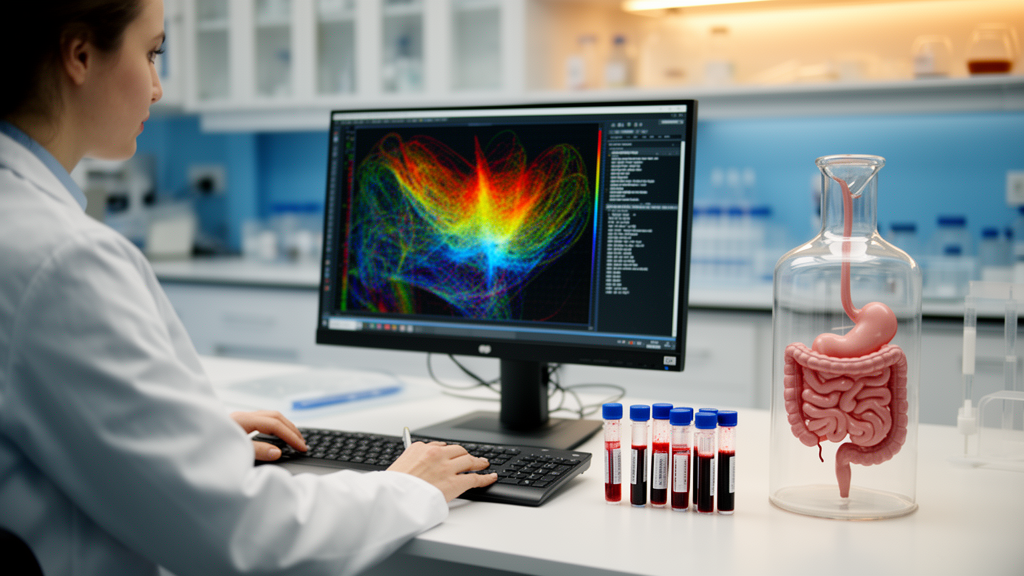
A machine learning pipeline can predict how much of an orally administered drug will actually reach the human bloodstream, achieving an accuracy that outperforms both previous computational models and direct correlations with animal measurements, according to a study published in AAPS Open. The work, led by Yusuf Ali Mohammed and Moe Elbadawi with colleagues, reports that a model trained on 192 FDA-approved compounds reached a coefficient of determination (R2) of 0.766, with a root mean squared error of 16.13 percentage points, when evaluated with five-fold cross-validation repeated 100 times. That figure exceeds the best single-species correlation reported in the study, the non-human primate comparison at R2 = 0.691, and all previously published machine learning models for this task, which had ranged from an R2 of -0.36 to 0.50.
Oral bioavailability, abbreviated %F, describes the rate and extent to which an active pharmaceutical ingredient is absorbed and becomes available at its site of action. It is a key determinant of drug efficacy and a critical decision-making parameter in early-stage drug development, and poor bioavailability is a major contributor to attrition in the development of oral drug candidates. Achieving adequate bioavailability is inherently complex, requiring optimisation within a drug’s therapeutic window while accounting for physiological barriers such as gastrointestinal pH, enzymatic degradation and first-pass metabolism. Currently, predicting human oral %F relies on animal models, including small animals and non-human primates, but these approaches suffer from poor correlation to human values, high costs and ethical concerns, and recent regulatory changes are pushing toward animal-free research methods.
Previous attempts to apply machine learning to this problem have largely stumbled. Many studies treated the prediction as a binary classification task, labelling compounds as either “high” or “low” %F using an arbitrary 50% cut-off. The authors of the new study argue that such imprecision obscures clinically meaningful differences: a compound with 5% bioavailability and one with 45% are treated as equivalent, and a compound misclassified near the decision boundary could be prematurely deprioritised or advanced with an inappropriately designed dosing regimen. Regression attempts fared little better. One study using molecular descriptors reported an R2 of 0.08 and pivoted to classification, while another using structural fingerprints obtained R2 values ranging from -0.3575 to 0.2623, with negative values indicating predictions worse than random guessing.
The new analysis began with a dataset curated by a 2014 systematic literature review, comprising 184 orally administered small-molecule drugs with experimental human oral %F values and corresponding preclinical measurements in mouse, rat, dog and non-human primate. Two compounds were removed because their canonical chemical notation was identical despite different human %F values, since the pipeline does not distinguish between enantiomers, leaving 182 compounds. The team then searched public repositories including ChEMBL, which contained 19,423 entries with oral %F measurements, and identified compounds with human %F data, measurements in at least two animal species, and low human bioavailability, a region underrepresented in the original dataset. Ten additional compounds, including bortezomib, aliskiren, buspirone and nintedanib, were added, bringing the final dataset to 192 compounds spanning a diverse chemical space that the authors say improves coverage relative to the 3,229 approved drugs in the ChEMBL database.
The pipeline’s performance emerged from a sequence of pre-processing steps rather than a single algorithmic leap. An initial model using physico-chemical descriptors and animal %F data managed only an R2 of 0.15. A two-pass cross-species imputation strategy, in which Bayesian ridge regression models predicted missing species values first from molecular features and then from an augmented feature set exploiting inter-species correlations, raised the R2 to 0.37. Recursive feature elimination then pruned 392 features down to 22, lifting performance to 0.67, and a logit transformation of the imputed non-human primate values, applied because the data were skewed, pushed it to 0.73. The final boost came from two engineered components: a pre-trained kernel ridge regression model that generated a compound-level prediction of human %F from a broader independent population of 2,071 compounds, and a CYP-aware feature that adjusted how much the model relied on structural versus animal data depending on whether a compound was likely to be metabolised by the CYP2D6 enzyme.
The CYP-aware feature was introduced after the researchers noticed that the 20 poorest predicted compounds were cytochrome P450 substrates. Tetrabenazine, for example, showed a rat %F of 84% but a human %F of only 5%. The blend feature weights a compound’s predicted value toward structure-based predictions when its probability of being a CYP2D6 substrate is high, reflecting that %F is likely governed by CYP-mediated first-pass metabolism, and toward animal %F when the probability is low, since interspecies variation tends to be less pronounced for non-CYP substrates. The authors note that this is mechanistically coherent, as CYP-mediated first-pass metabolism in the liver and gut wall represents the primary enzymatic barrier to oral bioavailability for the majority of drug candidates.
Perhaps the most consequential finding concerns which animal species are actually needed. When the model used purely structure-activity features with no animal data, it achieved an R2 of 0.57 ± 0.02, which itself exceeds previously reported performance. Adding mouse %F had no measurable effect, while rat or dog %F individually improved the R2 to 0.62 ± 0.02 and 0.68 ± 0.02 respectively. Combining rat and dog %F raised the R2 to 0.72 ± 0.016, with no further improvement from adding a third species. The inclusion of non-human primate data, whether imputed or experimentally derived, consistently improved performance, although the available NHP dataset comprised only 46 compounds. The authors conclude that accurate prediction of human oral %F can be achieved without reliance on non-human primate studies, and that mouse data may be omitted entirely, since it does not contribute to predictive performance.
Permutation feature importance analysis identified the CYP-aware feature, the pre-trained model’s predictions, lipophilicity (MolLogP) and imputed non-human primate %F as the top four predictors among the top 20 features, which were dominated by structure-activity descriptors. The authors caution that the CYP-aware feature is partially derived from the pre-trained model’s output, and the two features showed a moderate Pearson correlation of 0.65, meaning shared information may redistribute or attenuate their individual importance scores. The prominence of lipophilicity and surface area descriptors is consistent with experimental evidence on factors influencing oral bioavailability. To guard against overfitting, all pre-processing steps were fitted exclusively within training folds during cross-validation, the procedure was repeated 100 times, and the model was evaluated on an independent held-out test set of 38 compounds excluded from model development, where it achieved an R2 of 0.73 ± 0.08 and an RMSE of 16.65 ± 2.36% across 10 independent train-test splits.
The authors frame the work as a potential alternative to expensive non-human primate studies, particularly when rat and dog %F data are available, noting that such animal studies are costly and time-consuming and difficult to use for high-throughput screening. They suggest the model could help researchers rank and triage candidate compounds, set expectations for clinical dose requirements and make more informed decisions during lead optimisation, with input features obtainable from open-access software such as RDKit or public repositories such as ChEMBL at no additional cost. They also highlight the demonstration that comprehensive pre-processing can be a major driver of model accuracy rather than a routine technical step, transforming existing data into more informative input without requiring new data collection.
Important limitations remain. The authors state that the pipeline should not be interpreted as providing patient-specific estimates, nor assumed to generalise across demographic groups, because CYP2D6 is polymorphic in humans and differences in metaboliser phenotype can produce inter-individual variability that was not captured in the source data. The dataset, while spanning diverse chemical space and all four Biopharmaceutics Classification System classes, consists of 192 compounds, mostly small molecules with molecular weights below 500 Da, and the authors note that future work should test the pipeline on more structurally diverse compounds and explore whether non-animal preclinical data could eventually eliminate animal testing altogether. The study was conducted entirely on retrospective data, and the authors describe the reported performance as a benchmark for future studies rather than a validated clinical tool, positioning the pipeline as a framework that could be integrated into existing preclinical drug development workflows to reduce attrition and accelerate the translation of drug candidates to the clinic.
Subject of Research: Machine learning prediction of human oral drug bioavailability from preclinical animal and molecular data
Article Title: Animal versus human oral drug bioavailability: machine learning says yes – they correlate
Article References: Mohammed, Y. A., Heaton-Ward, M., Gaisford, S., & Elbadawi, M. (2026). Animal versus human oral drug bioavailability: machine learning says yes – they correlate. AAPS Open, 12(1), Article 54. https://doi.org/10.1186/s41120-026-00193-z
Image Credits: AI Generated
DOI: 10.1186/s41120-026-00193-z
Keywords: oral bioavailability, machine learning, drug development, pharmacokinetics, preclinical data, kernel ridge regression, CYP2D6, non-human primates, FDA-approved drugs, regression modelling, feature engineering, AAPS Open
News Source: Teresa Odom. (October 28, 2026). Machine learning predicts human oral drug bioavailability from animal data. Scienmag.