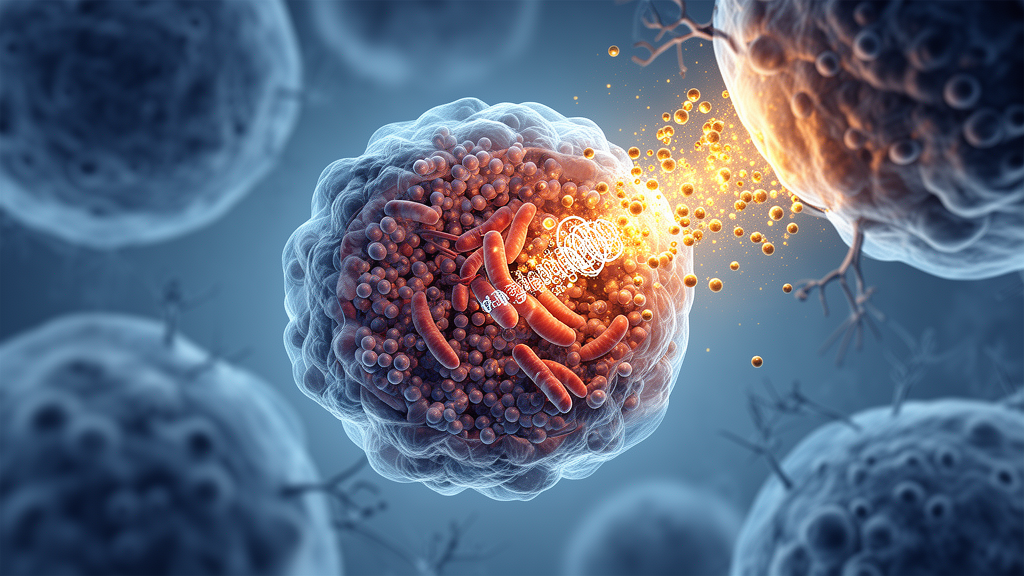
Protein lactylation links the abundant lactate produced by glioblastoma cells to processes associated with tumor growth, stemness, immune escape and treatment resistance, according to a 2026 review of experimental studies in glioblastoma and broader glioma models. The review concludes that lactylation may be a regulatory interface between metabolic reprogramming and malignant behavior, but emphasizes that the evidence remains preclinical and uneven in quality. Site-specific mechanisms have been validated for several histone and non-histone targets, while other findings derive from conventional cell lines, lactate interventions without direct detection of lactylation, or computational analyses of lactylation-related gene expression. Its value as a clinical biomarker or therapeutic target in patients with glioblastoma therefore remains unproven.
Glioblastoma is an aggressive primary malignant brain tumor characterized by diffuse invasion, rapid progression and resistance to conventional therapy. Although maximal safe resection followed by radiotherapy and temozolomide remains standard care for newly diagnosed disease, durable control is difficult and recurrence is almost inevitable. A major reason is the tumor’s metabolic plasticity. Many glioblastoma cells favor aerobic glycolysis, converting glucose-derived pyruvate into lactate even when oxygen is available, while poorly organized blood vessels create hypoxic regions that further stimulate glycolysis. This combination produces pronounced lactate accumulation and regional metabolic heterogeneity. Lactate can move among tumor regions and cell populations through monocarboxylate transporters, particularly MCT1 and MCT4, allowing metabolic cooperation between hypoxic, lactate-producing cells and better-oxygenated cells that may take it up as fuel.
Lactate’s effects are not confined to energy metabolism and extracellular acidification. Protein lactylation is the covalent addition of a lactyl group to lysine residues. In the canonical pathway, lactyl-CoA serves as the activated donor for this reaction, connecting cellular metabolism to chromatin regulation and protein function. Histone lactylation can alter transcriptional programs, whereas modification of non-histone proteins can influence protein stability, enzyme activity, DNA binding and signal transduction. The enzymes involved remain incompletely resolved. GTPSCS and ACSS2 have been implicated in generating lactyl-CoA, and p300 and KAT2A have been implicated as writers. A distinct, ATP-dependent route involving AARS1 and AARS2 can modify proteins without lactyl-CoA as an intermediate, although direct evidence for that route in glioblastoma is lacking. Sirtuins and histone deacetylases can remove lactyl groups, indicating that lactylation is reversible rather than permanent.
Glioblastoma does not simply generate more lactylation when glycolysis intensifies. Lactate abundance depends on the balance among production, uptake, export and use, while modification also depends on activated-donor availability, writer and eraser activity, and whether a particular lysine is accessible in the relevant protein. Accordingly, the review classifies the literature into tiers of mechanistic confidence. The strongest evidence involves a defined non-histone lactylation site validated through mass spectrometry, site-specific assays, competitive peptides, mutation or rescue. Histone mechanisms receive an intermediate classification when a specific site, enrichment at a regulatory region and functional perturbation are demonstrated. Effects linked only to lactate exposure, metabolic inhibition or global histone lactylation are considered suggestive. This distinction is important because reducing lactate can also change energy production, redox balance, acidity and signaling independent of lactylation.
Several histone pathways connect lactylation to glioblastoma growth. In preclinical glioma systems, hypoxia-associated HIF-1α signaling and H3K18 lactylation have been linked to increased YTHDF2 expression, BNIP3-dependent mitophagy and transcriptional programs that favor proliferation and hypoxic adaptation. Nuclear GTPSCS has been reported to generate lactyl-CoA and cooperate with p300, increasing H3K18 lactylation at the GDF15 promoter in models that also showed tumor growth and radioresistance. Separately, SUCLG2 knockdown reduced lactate and H4K16 lactylation, with the remaining H4K16 signal enriched at regulatory regions associated with proliferation and apoptosis. Another study linked H4K8 lactylation at the NUPR1 promoter to autophagosome–lysosome fusion and protective autophagy in glioblastoma cells, patient-derived material and in vivo models. These observations provide mechanistic support, but mutation of each histone residue was not used to prove causality in all cases.
Lactylation may also sustain glioma stem cells, the self-renewing malignant populations associated with recurrence. H3K18 lactylation has been reported to increase USP4 transcription, which stabilizes ANXA2 through deubiquitination and supports stem-cell phenotypes. Another study found that histone lactylation increased LINC01127 transcription, allowing this long noncoding RNA to regulate MAP4K4 in cis and activate JNK signaling associated with self-renewal. Non-histone modification can reinforce this metabolic state: lactylation of PTBP1 at lysine 436 stabilizes PFKFB4 messenger RNA, increases glycolytic flux and lactate production, and creates a positive-feedback loop between lactate accumulation and stem-cell maintenance. Site-specific non-histone evidence is particularly important here because the number of validated lactylated substrates in glioblastoma remains limited.
Treatment resistance is one of the clearest areas of convergence. Lactate-induced H3K9 lactylation at the MLH1 locus promotes an RNA-splicing event that reduces mismatch repair and is associated with temozolomide resistance. Reduced SIRT6 activity has also been linked to increased H3K9 lactylation at the MGMT promoter, greater MGMT expression and diminished temozolomide sensitivity. These associations involve both histone and non-histone substrates. In ALDH1A3-high glioma stem cells, lactylation of XRCC1 at lysine 247 increases its binding to importin-alpha and nuclear translocation, supporting single-strand-break repair after radiotherapy or temozolomide exposure. HAT1-catalyzed lactylation of RPA1 at lysine 88 enhances its binding to single-stranded DNA and homologous recombination, while a competitive peptide increased radiosensitivity in preclinical models. A separate pathway involving KU70 lactylation at lysine 317 enhances non-homologous end joining, reduces cytosolic DNA and limits cGAS–STING signaling. Blocking lactate transfer from tumor-associated macrophages to glioma stem cells or targeting KU70 lactylation improved responses to immune checkpoint blockade in immunocompetent intracranial models.
The microenvironment extends these effects beyond tumor cells. Lactate taken up by macrophages through MCT1 has been associated with H3K18 lactylation at the TNFSF9 promoter, M2-like polarization and glioma progression. Enhanced glucose metabolism has also been linked to immunosuppressive histone-lactylation programs in monocyte-derived macrophages. In glioma stem-cell and myeloid co-culture models, CBX3 was reported to bias p300 toward lactyl-CoA-dependent histone lactylation, increasing transcription of CD47 and limiting phagocytosis by microglia and macrophages. Another route links lactate to H3K18 lactylation at the ARNTL promoter and BMAL1 lactylation at lysine 123, increasing VEGFA expression and reducing bevacizumab sensitivity in cell, xenograft, animal and clinical-cohort analyses. These results implicate lactate exchange and lactylation in immune suppression, but lactate can also influence immune cells through acidity, receptor signaling and metabolic substrates independently of protein modification.
Therapeutic experiments have therefore targeted several points along the pathway. In glioblastoma models, inhibiting lactate dehydrogenase with stiripentol reduced lactate production and tumor growth, while MCT1 inhibition decreased glioma stem-cell viability and proliferation. Neither is specific to lactylation. Other preclinical strategies reduce lactate or alter its regulatory machinery, including PPARα activation, SIRT6 activation, GTPSCS knockdown and inhibition of a TREM1-dependent pathway. One site-directed approach used a competitive peptide against RPA1 lysine 88 lactylation and increased radiosensitivity in preclinical models. Separately, oxamate, an upstream intervention that reduces lactate production, enhanced CAR-T-cell activity in glioma xenografts while reducing H3K18 lactylation and immune-suppressive metabolic programs. These findings suggest possible combinations with radiotherapy, chemotherapy, anti-angiogenic therapy or immunotherapy, but they do not establish clinical efficacy. Major barriers include delivery across the blood–brain and blood–tumor barriers, possible effects on normal brain metabolism, incomplete understanding of lactylation writers, readers and erasers, and a lack of standardized site-specific measurements.
Translation also requires better biological and methodological resolution. Glioblastoma contains plastic malignant-cell states and distinct metabolic niches, so lactylation probably varies with oxygen availability, cell state and neighboring cell types. Spatial transcriptomics generally reveals expression associated with lactate metabolism rather than protein lactylation itself; direct spatial mapping will require modification-specific antibodies, spatial proteomics or site-resolved mass spectrometry. Existing patient-stratification models largely analyze lactylation-related gene expression in public transcriptomic datasets and have not demonstrated that they predict treatment response in actual clinical cohorts. Normal brain physiology also includes lactate metabolism and lactylation, raising safety questions if lactate production or the modification is broadly inhibited. The review’s central conclusion is therefore one of promise and restraint: lactylation is a credible mechanism connecting glioblastoma metabolism with progression and resistance, but clinically useful targeting will require site-specific interventions, patient-derived and immunocompetent models, direct biomarker measurement, standardized assays and prospective validation in patients.
Subject of Research: Protein lactylation in glioblastoma metabolism, malignant progression and treatment resistance
Article Title: Lactylation in glioblastoma: mechanisms and therapeutic perspectives
Article References: Huang, L., Huang, B., Kuang, S., & Yan, Y. (2026). Lactylation in glioblastoma: mechanisms and therapeutic perspectives. Frontiers in Cell and Developmental Biology, 14, Article 1940871. https://doi.org/10.3389/fcell.2026.1940871
Image Credits: AI Generated
DOI: 10.3389/fcell.2026.1940871
Keywords: glioblastoma, lactylation, lactate metabolism, cancer metabolism, epigenetics, glioma stem cells, treatment resistance, tumor immunity, DNA repair, brain tumor, mechanisms, therapeutic
News Source: Daisy Hatcher. (October 20, 2026). Lactylation links glioblastoma metabolism to progression and resistance. Scienmag.