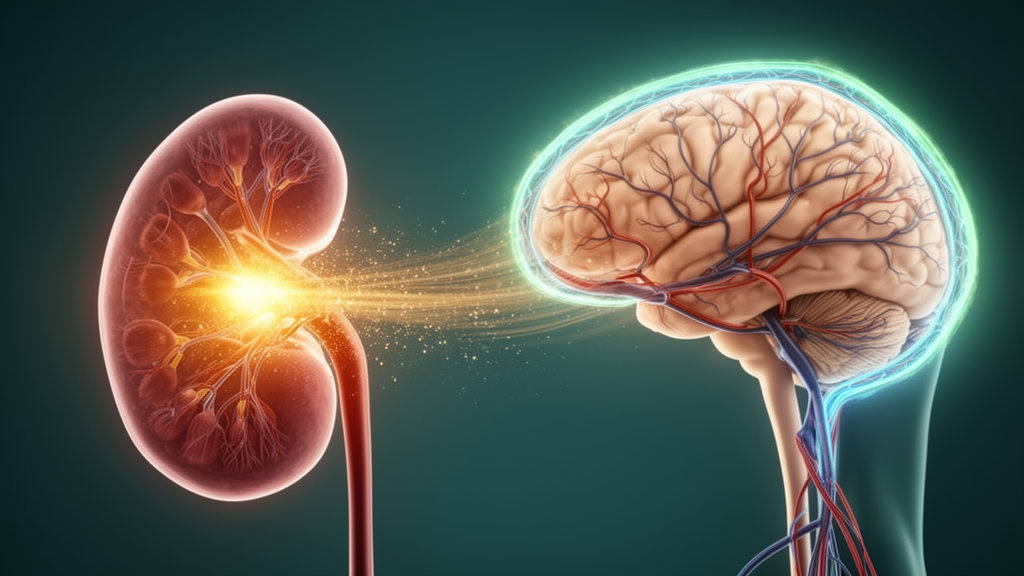
Two molecules that rarely share the same scientific conversation may together explain how kidney disease quietly sets the stage for brain vascular decline. A review published in Frontiers in Neuroscience proposes a stress-resilience framework in which elevated homocysteine, a metabolic abnormality strongly tied to declining renal function, represents the injurious burden carried through the circulation, while α-Klotho, a protein whose expression falls as the kidney falters, represents a candidate measure of biological reserve. The authors, a clinical laboratory research group from Zhuhai, China, argue that neurological vulnerability may depend not simply on how much systemic stress the brain’s blood vessels face, but on how well vascular and neural tissues can tolerate and recover from that stress. Crucially, the review is explicit that this is a hypothesis-generating conceptual model, not an established molecular pathway, and that the decisive test remains whether Klotho actually modifies the neurovascular consequences of a given homocysteine burden.
Homocysteine sits at the center of the proposed model, but the review is careful about what it is and is not. The molecule is produced throughout the body during methionine and one-carbon metabolism, not specifically by the kidney. Plasma concentrations depend on remethylation and transsulfuration pathways, on the availability of folate, vitamin B12, and vitamin B6, on genetic background, aging, and renal function. As kidney function declines, plasma homocysteine rises, and hyperhomocysteinemia is particularly common in patients with advanced chronic kidney disease. Yet reduced filtration alone cannot explain the entire association, because chronic kidney disease also alters vitamin handling, inflammatory status, oxidative balance, protein metabolism, and metabolic clearance. The authors therefore interpret hyperhomocysteinemia as a systemic metabolic disturbance associated with renal dysfunction rather than a kidney-derived signal, a distinction that matters for how the kidney-to-brain axis is understood.
The metabolic context surrounding homocysteine may be as important as its concentration. Disturbed one-carbon metabolism affects the balance between S-adenosylmethionine and S-adenosylhomocysteine, influencing methylation, redox balance, and sulfur-amino-acid metabolism. The transsulfuration pathway connects homocysteine to the production of cysteine, glutathione, and hydrogen sulfide, so disruption can compromise antioxidant defenses even when the effect on plasma homocysteine itself is limited. Abnormal metabolism can also generate homocysteine-thiolactone and N-homocysteinylated proteins, metabolites associated with endothelial damage, protein modification, inflammation, and thrombosis. This biochemical heterogeneity may partly explain why similar total homocysteine concentrations can be linked to different vascular phenotypes, and why simply lowering plasma homocysteine does not necessarily reverse established neurovascular injury.
Once elevated in blood, homocysteine is presented directly to the luminal surface of cerebral endothelial cells, providing a plausible route from systemic metabolic disturbance to cerebral microvascular stress. Experimental evidence supports this vascular route. At moderate levels, homocysteine has been reported to impair endothelial cell migration and proliferation, alter mitochondrial respiration, and induce adaptive stress responses rather than acute cytotoxicity alone. In human induced pluripotent stem cell-derived endothelial models, disturbances in homocysteine metabolism linked to MTHFR variation have been associated with abnormal mitochondrial morphology, defective mitophagy, and endothelial dysfunction. In human brain microvascular endothelial monolayers, homocysteine increases permeability and reduces the tight-junction protein ZO-1, with inhibition of the NLRP3 inflammasome partly attenuating this response. Other models have connected hyperhomocysteinemia with adhesion-molecule expression, loss of tight-junction proteins, endoplasmic-reticulum stress, and enhanced amyloid-β-associated endothelial apoptosis and barrier dysfunction.
The clearest molecular link between hyperhomocysteinemia and Klotho comes from the kidney, not the brain. In renal podocytes, elevated homocysteine increased HDAC9 expression, reduced H3K9 acetylation at the KL promoter, lowered Klotho transcription, and worsened podocyte injury. This finding establishes that homocysteine can regulate Klotho in a specific renal cell type through an epigenetic mechanism. However, the review stresses that the same interaction has not been demonstrated in cerebral endothelial cells or other components of the neurovascular unit, nor has reduced circulating Klotho been shown to mediate the cerebral effects of hyperhomocysteinemia. Brain microvascular endothelial cells show a different homocysteine-sensitive epigenetic response, involving Cacna1c/Cav1.2 signaling, altered calcium handling, reactive oxygen species production, tight-junction degradation, and cognitive impairment in experimental models. Two epigenetic effects of homocysteine in renal and cerebral vascular settings do not yet add up to a common homocysteine-Klotho pathway.
Klotho, meanwhile, is treated as a candidate resilience factor rather than a validated biomarker. α-Klotho is a transmembrane protein with an established role in fibroblast growth factor 23 signaling, and proteolytic cleavage generates soluble forms detectable in blood and urine. The kidney is the major peripheral site of expression, and chronic kidney disease is commonly associated with reduced renal Klotho expression. Experimental and translational studies implicate Klotho in antioxidant responses, mitochondrial homeostasis, endothelial protection, anti-inflammatory signaling, and cellular senescence restraint. Exogenous Klotho has enhanced FOXO3a/catalase-related antioxidant responses in astrocytes and proteostatic capacity in neurons, while renal and peripheral models implicate Klotho in mitophagy and Nrf2/HO-1-associated protection. Yet the review emphasizes that these protective effects have been reported across different models and cell types, and direct evidence that Klotho specifically rescues homocysteine-induced injury in cerebral endothelial cells remains limited.
Compartmentalization is a core interpretive constraint of the framework. Renal membrane Klotho, urinary Klotho, serum soluble Klotho, cerebrospinal fluid Klotho, and locally produced central nervous system Klotho represent related but non-equivalent biological compartments. A reduction in circulating Klotho should not be read as direct evidence of reduced brain Klotho activity. Klotho is expressed within the central nervous system, particularly in the choroid plexus and certain neural cell types, where lower CSF Klotho has been associated with choroid plexus enlargement. The choroid plexus and blood-cerebrospinal fluid barrier may represent an additional brain-facing pathway in kidney-to-brain communication, one that circulating measurements cannot capture. Serum soluble Klotho is also sensitive to assay platform, sample handling, and renal function, and no currently available measurement fully represents the multidimensional concept of Klotho-related resilience in humans.
Clinical evidence supports individual components of the proposed kidney-circulation-BBB/NVU-brain continuum, but not the complete causal sequence. In chronic kidney disease, cognitive impairment is frequent, particularly in attention and executive function, and BBB imaging in end-stage kidney disease has shown greater barrier permeability associated with poorer cognitive performance. Observational studies have linked higher homocysteine with white-matter hyperintensities, microbleeds, enlarged perivascular spaces, lacunes, cognitive impairment, and progression from mild cognitive impairment to dementia. Lower Klotho-related measures have been reported in association with vascular dementia, lacunar infarction, leukoaraiosis, greater cerebral small-vessel disease burden, and unfavorable outcomes after ischemic stroke. Elevated homocysteine has also shown a stronger association with post-stroke cognitive impairment among individuals with lower estimated glomerular filtration rate, consistent with the idea that the cerebral consequences of a given homocysteine burden depend on the systemic environment in which it occurs. These associations, however, remain vulnerable to confounding by renal function, age, B-vitamin status, vascular disease, and inflammation, and human studies directly testing homocysteine-by-Klotho interaction effects are still lacking.
Translational implications are framed with similar caution. Homocysteine is readily modified through folate and B-vitamin pathways, yet meta-analyses suggest modest or context-dependent effects of homocysteine-lowering on cognition and stroke prevention, and a recent meta-analysis of randomized trials in chronic kidney disease found little evidence that homocysteine-lowering substantially improves major cardiovascular outcomes or mortality. The limited benefit may reflect the persistence of a broader abnormal vascular environment, including uremic toxin retention, mineral imbalance, vascular stiffness, oxidative stress, chronic inflammation, and Klotho deficiency, though current evidence does not show that Klotho deficiency explains the limited response. No clinical trial has established whether Klotho status influences the neurological effects of homocysteine-lowering treatment, and Klotho-targeted approaches, including drugs that increase Klotho production, recombinant Klotho, Klotho-derived peptides, and gene-based treatments, remain largely experimental. The review explicitly rejects any diagnostic or therapeutic homocysteine-Klotho ratio, cut-off, or validated risk score at this stage.
The research agenda that follows is concrete. The authors call for cell-specific perturbation studies testing whether homocysteine exposure alters KL transcription, promoter methylation, histone acetylation, chromatin accessibility, and Klotho shedding in cerebral endothelial cells, choroid-plexus epithelial cells, pericytes, astrocytes, microglia, and neurons, with rescue experiments to determine whether Klotho restoration attenuates homocysteine-induced barrier injury. They propose longitudinal human cohorts using standardized, compartment-resolved Klotho measurements alongside homocysteine and related metabolites, with explicit adjustment for kidney function, albuminuria, B-vitamin status, inflammation, and vascular risk. Multimodal neuroimaging, including dynamic-contrast-enhanced MRI for BBB permeability, arterial-spin-labeling for perfusion, and functional MRI for neurovascular coupling, could bridge peripheral biology and cerebral outcomes before dementia or stroke becomes clinically evident. Interventional testing would then examine whether reducing homocysteine produces different changes in neurovascular phenotypes according to baseline Klotho status. Until evidence converges across these levels, the combined high-homocysteine, low-Klotho state should be regarded as a candidate metabolic stress-resilience phenotype, a testable kidney-to-brain framework rather than an established molecular axis, and a reminder that the neurological effect of renal and metabolic dysfunction may depend both on the intensity of systemic injury and on the capacity of vascular and neural tissues to maintain and restore homeostasis.
Subject of Research: Hyperhomocysteinemia and Klotho in kidney-to-brain neurovascular signaling
Article Title: Hyperhomocysteinemia and Klotho in kidney-to-brain signaling: a metabolic stress-resilience framework for neurovascular dysfunction
Article References: Zhou, D., Zhao, Y., Zheng, Y., Xu, J., Xie, B., Zhou, Y., & Zhang, Y. (2026). Hyperhomocysteinemia and Klotho in kidney-to-brain signaling: a metabolic stress-resilience framework for neurovascular dysfunction. Frontiers in Neuroscience, 20, Article 1989720. https://doi.org/10.3389/fnins.2026.1989720
Image Credits: AI Generated
DOI: 10.3389/fnins.2026.1989720
Keywords: hyperhomocysteinemia, homocysteine, Klotho, kidney-brain axis, chronic kidney disease, blood–brain barrier, neurovascular unit, cerebral small-vessel disease, cognitive impairment, cerebral endothelium, epigenetic regulation, biological resilience
News Source: Cassandra Pierce. (October 26, 2026). Kidney metabolic stress and Klotho resilience converge on the brain’s vasculature. Scienmag.