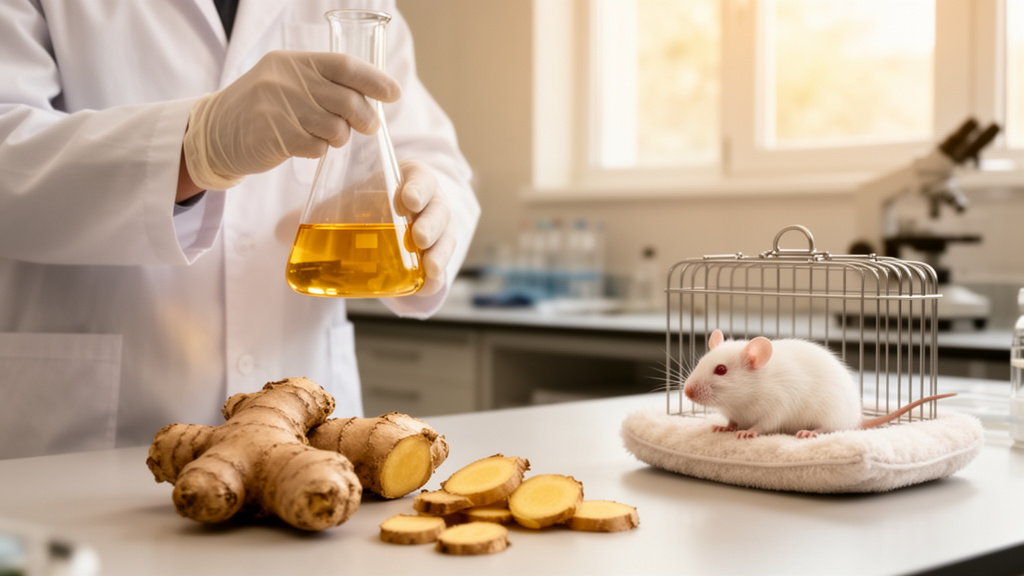
Researchers have synthesized silver nanoparticles using ginger extract and reported that the particles show selective toxicity toward cancer cells in laboratory cultures and shrink tumors in mice bearing Ehrlich ascites carcinoma. The study, published in Medical Oncology, combined chemical characterization, cell-line assays, and animal experiments to evaluate ginger-derived silver nanoparticles (G-AgNPs) as a potential anticancer agent.
The team used gas chromatography–mass spectrometry to profile the ginger extract, identifying 36 phytochemicals. The major components were α-zingiberene at 37.88 percent, β-sesquiphellandrene at 15.65 percent, 6-gingerol at 10.68 percent, α-farnesene at 8.04 percent, β-bisabolene at 7.83 percent, α-curcumene at 6.96 percent, with smaller amounts of 8-gingerol and 6-shogaol. Ginger is a common spice with therapeutic potential due to its bioactive compounds, and the extract served as the biological medium for the green synthesis of the nanoparticles.
Characterization confirmed the formation of well-defined particles. Ultraviolet–visible spectroscopy and Fourier-transform infrared spectroscopy verified nanoparticle formation and surface chemistry, while transmission electron microscopy showed spherical particles with an average diameter of 10.44 nanometers. Zeta-potential analysis yielded a value of −46.17 ± 1.42 millivolts, indicating a strongly negative surface charge associated with high colloidal stability.
In cytotoxicity assays across three cell lines, the nanoparticles inhibited the viability of the liver cancer line HepG-2 and the breast cancer line MCF-7 more strongly than that of WI-38, a non-cancerous lung fibroblast line. The IC₅₀ values were 1.20 ± 0.03 micromolar (4.51 ± 0.11 micrograms per milliliter) for HepG-2 and 1.49 ± 0.05 micromolar (5.60 ± 0.19 micrograms per milliliter) for MCF-7, compared with 2.49 ± 0.07 micromolar for WI-38 cells. This pattern suggests a preliminary preferential effect on the cancer cells, particularly HepG-2, though the authors note that further toxicological work is needed to establish safety.
Mechanistic assays pointed to apoptosis as a likely route of cell death. Treatment raised caspase-3–associated protein levels in both cancer lines, reaching 13.81 ± 0.35 nanograms per milligram of protein in HepG-2 and 42.83 ± 1.47 nanograms per milligram in MCF-7, while reducing the anti-apoptotic protein Bcl-2 to 2.12 ± 0.14 and 3.17 ± 0.03 nanograms per milligram, respectively. The researchers caution that MCF-7 cells are known to lack functional caspase-3, so the observed increase in that line likely reflects caspase-3–immunoreactive protein rather than active enzyme.
The nanoparticles also displayed antioxidant behavior in cell-free tests. Free radical scavenging activity yielded an IC₅₀ of 28.96 micrograms per milliliter, weaker than ascorbic acid at 14.03 micrograms per milliliter but still substantial. The particles additionally showed significant intercalation into calf-thymus DNA in vitro.
In the in vivo experiments, mice bearing Ehrlich ascites carcinoma that received G-AgNPs showed significantly reduced abdominal circumference, ascitic fluid volume, and viable tumor cell counts relative to untreated tumor-bearing animals. The treatment increased the percentage increase in lifespan by 93.3 percent, a striking survival benefit in this aggressive transplantable tumor model.
Blood chemistry and tissue analysis suggested the treatment was comparatively gentle on healthy organs. Treated mice showed improved liver and kidney function markers, elevated hepatic levels of glutathione, superoxide dismutase, total antioxidant capacity, and catalase, and reduced oxidative stress markers including malondialdehyde and nitric oxide, all relative to untreated EAC-bearing mice. Histopathological examination of liver tissue showed amelioration of tumor-related damage, and the nanoparticles produced fewer adverse effects than the chemotherapy drug cisplatin in the same model.
The authors conclude that ginger-derived silver nanoparticles possess potential anticancer activity and preliminary differential cytotoxicity toward HepG-2 cells compared with non-cancerous cells. They emphasize, however, that these are early findings from cell cultures and a single mouse tumor model, and that further toxicological and in vivo investigations are required before any therapeutic applicability in humans can be established.
Subject of Research: Green synthesis of ginger-derived silver nanoparticles and their anticancer activity in vitro and in vivo
Article Title: Characterization and anticancer activity of green-synthesized and highly stable ginger-derived silver nanoparticles: In vitro and in vivo studies
Article References: Elghaznawy, M. M., El Sadda, R. R., & Saad, E. A. (2026). Characterization and anticancer activity of green-synthesized and highly stable ginger-derived silver nanoparticles: In vitro and in vivo studies. Medical Oncology, 43(11), Article 361. https://doi.org/10.1007/s12032-026-03461-w
Image Credits: AI Generated
DOI: 10.1007/s12032-026-03461-w
Keywords: silver nanoparticles, green synthesis, ginger, anticancer, HepG-2, MCF-7, apoptosis, Ehrlich ascites carcinoma, antioxidant, nanomedicine, phytochemicals, Medical Oncology
News Source: Nathaniel Bowman. (October 26, 2026). Ginger-Derived Silver Nanoparticles Show Anticancer Activity in Lab and Mouse Studies. Scienmag.