

• HOME
  • NEWS
  • EXPLORE
    • CAREER
      • Companies
      • Jobs
    • EVENTS
    • iGEM
      • News
      • Team
    • PHOTOS
    • VIDEO
    • WIKI
  • BLOG
  • COMMUNITY
    • FACEBOOK
    • INSTAGRAM
    • TWITTER
Thursday, September 10, 2026
BIOENGINEER.ORG
No Result
View All Result
  • Login
  • HOME
  • NEWS
  • EXPLORE
    • CAREER
      • Companies
      • Jobs
        • Lecturer
        • PhD Studentship
        • Postdoc
        • Research Assistant
    • EVENTS
    • iGEM
      • News
      • Team
    • PHOTOS
    • VIDEO
    • WIKI
  • BLOG
  • COMMUNITY
    • FACEBOOK
    • INSTAGRAM
    • TWITTER
  • HOME
  • NEWS
  • EXPLORE
    • CAREER
      • Companies
      • Jobs
        • Lecturer
        • PhD Studentship
        • Postdoc
        • Research Assistant
    • EVENTS
    • iGEM
      • News
      • Team
    • PHOTOS
    • VIDEO
    • WIKI
  • BLOG
  • COMMUNITY
    • FACEBOOK
    • INSTAGRAM
    • TWITTER
No Result
View All Result
Bioengineer.org
No Result
View All Result
Home NEWS Science News Technology

KAUST Researchers Create Wearable Tech to Monitor Medicines in Real Time

Bioengineer by Bioengineer
July 15, 2026
in Technology
Reading Time: 2 mins read
0
Share on FacebookShare on TwitterShare on LinkedinShare on RedditShare on Telegram

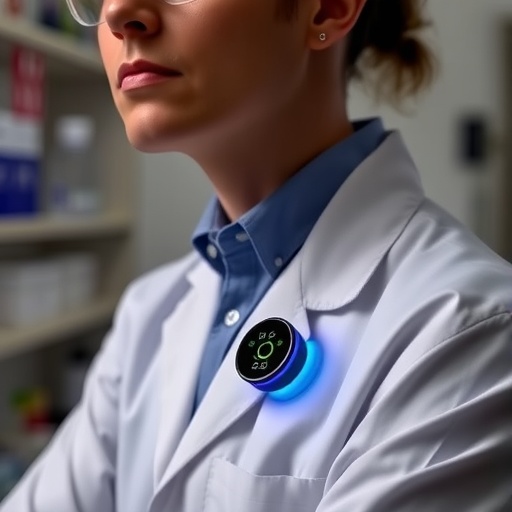
Wearable health technology is getting a new job: measuring how medicines behave inside the body. Researchers at King Abdullah University of Science and Technology (KAUST) have built a microneedle patch designed to continuously track drug concentrations beneath the skin and stream the results to a smartphone in real time. The work highlights a shift from intermittent blood testing toward ongoing therapy monitoring.

The platform targets a long-standing limitation in drug management. Many medicines with tight dosing windows are monitored through periodic blood draws and lab analysis, which provide only a partial snapshot of drug levels. Delays in processing can further obscure how concentrations change over hours—exactly the information clinicians may need to optimize treatment.

At the core of the device is an array of tiny microneedles that reach interstitial fluid just under the skin. Interstitial fluid contains drug molecules that correlate with systemic concentrations, enabling the patch to sense drug levels with minimal invasiveness. The microneedles are coupled to miniaturized electrochemical biosensors that convert chemical information into measurable electrical signals.

Built-in electronics handle sensor readout and wireless data transfer. Instead of requiring a bulky instrument, the patch uses Bluetooth connectivity to transmit continuous measurements to a smartphone display. This design supports near real-time visualization of drug concentration trends, enabling users or clinicians to monitor therapy without frequent clinic visits.

The system was demonstrated using vancomycin, an antibiotic commonly prescribed for serious infections. Vancomycin is a particularly suitable test case because safe and effective outcomes depend on maintaining drug concentrations within a narrow range. Tracking the rise and fall of this antibiotic provided a practical benchmark for continuous drug monitoring.

In laboratory experiments and preclinical studies, the wearable platform successfully followed changing vancomycin concentrations over several hours. The complete device weighs 6.7 grams and integrates microneedle sensing, electrochemical detection, onboard circuitry, wireless communication, and smartphone visualization into a single wearable module.

Although still early-stage, the results establish feasibility for continuous wireless monitoring using a minimally invasive sensing approach. Future development will focus on longer monitoring duration, improved long-term stability of the sensing elements, and validation across broader medical applications.

If these challenges are solved, microneedle-based monitoring could support more personalized medicine—providing clinicians with continuous feedback on how a patient’s body responds to therapy rather than relying solely on periodic measurements.

Image Credits: © 2026 King Abdullah University of Science and Technology (KAUST)

Keywords

Wearable sensors; microneedle patch; wireless drug monitoring; vancomycin; electrochemical biosensors; interstitial fluid; smartphone connectivity; personalized medicine; Bluetooth; real-time healthcare diagnostics


Share12Tweet7Share2ShareShareShare1

Related Posts

Simulating Emergency Knowledge Spread Through Weighted Small-World Networks

Simulating Emergency Knowledge Spread Through Weighted Small-World Networks

September 10, 2026
Metabolic traits and surgical outcomes in Turner syndrome patients with heart defects

Metabolic traits and surgical outcomes in Turner syndrome patients with heart defects

September 10, 2026

Moss surveys show airborne microplastics deposited widely across the UK

September 10, 2026

Carbon nanotube network boosts vanadium-based composite for supercapacitors

September 10, 2026

POPULAR NEWS

  • Mapping cell-type-specific co-expressed transcription factors in soybean

    29 shares
    Share 12 Tweet 7
  • Janus palladium membrane enables selective CO2 reduction via directed hydride transfer

    29 shares
    Share 12 Tweet 7
  • Molecular Dynamics Reveal How a Fungal Biocontrol Enzyme Grips Chitin

    29 shares
    Share 12 Tweet 7
  • Gut microbial metabolite imidazole propionate drives sclerosing cholangitis through p38 signaling

    29 shares
    Share 12 Tweet 7

About

We bring you the latest biotechnology news from best research centers and universities around the world. Check our website.

Follow us

Recent News

Mapping cell-type-specific co-expressed transcription factors in soybean

Janus palladium membrane enables selective CO2 reduction via directed hydride transfer

Molecular Dynamics Reveal How a Fungal Biocontrol Enzyme Grips Chitin

Subscribe to Blog via Email

Enter your email address to subscribe to this blog and receive notifications of new posts by email.

Join 85 other subscribers
  • Contact Us

Bioengineer.org © Copyright 2023 All Rights Reserved.

Welcome Back!

Login to your account below

Forgotten Password?

Retrieve your password

Please enter your username or email address to reset your password.

Log In
No Result
View All Result
  • Homepages
    • Home Page 1
    • Home Page 2
  • News
  • National
  • Business
  • Health
  • Lifestyle
  • Science

Bioengineer.org © Copyright 2023 All Rights Reserved.