• HOME
  • NEWS
  • EXPLORE
    • CAREER
      • Companies
      • Jobs
    • EVENTS
    • iGEM
      • News
      • Team
    • PHOTOS
    • VIDEO
    • WIKI
  • BLOG
  • COMMUNITY
    • FACEBOOK
    • INSTAGRAM
    • TWITTER
Wednesday, November 11, 2026
BIOENGINEER.ORG
No Result
View All Result
  • Login
  • HOME
  • NEWS
  • EXPLORE
    • CAREER
      • Companies
      • Jobs
        • Lecturer
        • PhD Studentship
        • Postdoc
        • Research Assistant
    • EVENTS
    • iGEM
      • News
      • Team
    • PHOTOS
    • VIDEO
    • WIKI
  • BLOG
  • COMMUNITY
    • FACEBOOK
    • INSTAGRAM
    • TWITTER
No Result
View All Result
Bioengineer.org
No Result
View All Result
Home NEWS Science News Chemistry

Kaolin and sheep wool composite removes nearly all hexavalent chromium from water

by
November 5, 2026
in Chemistry, Technology
Reading Time: 2 mins read
0
Kaolin and sheep wool composite removes nearly all hexavalent chromium from water

Kaolin and sheep wool composite removes nearly all hexavalent chromium from water

Share on FacebookShare on TwitterShare on LinkedinShare on RedditShare on Telegram

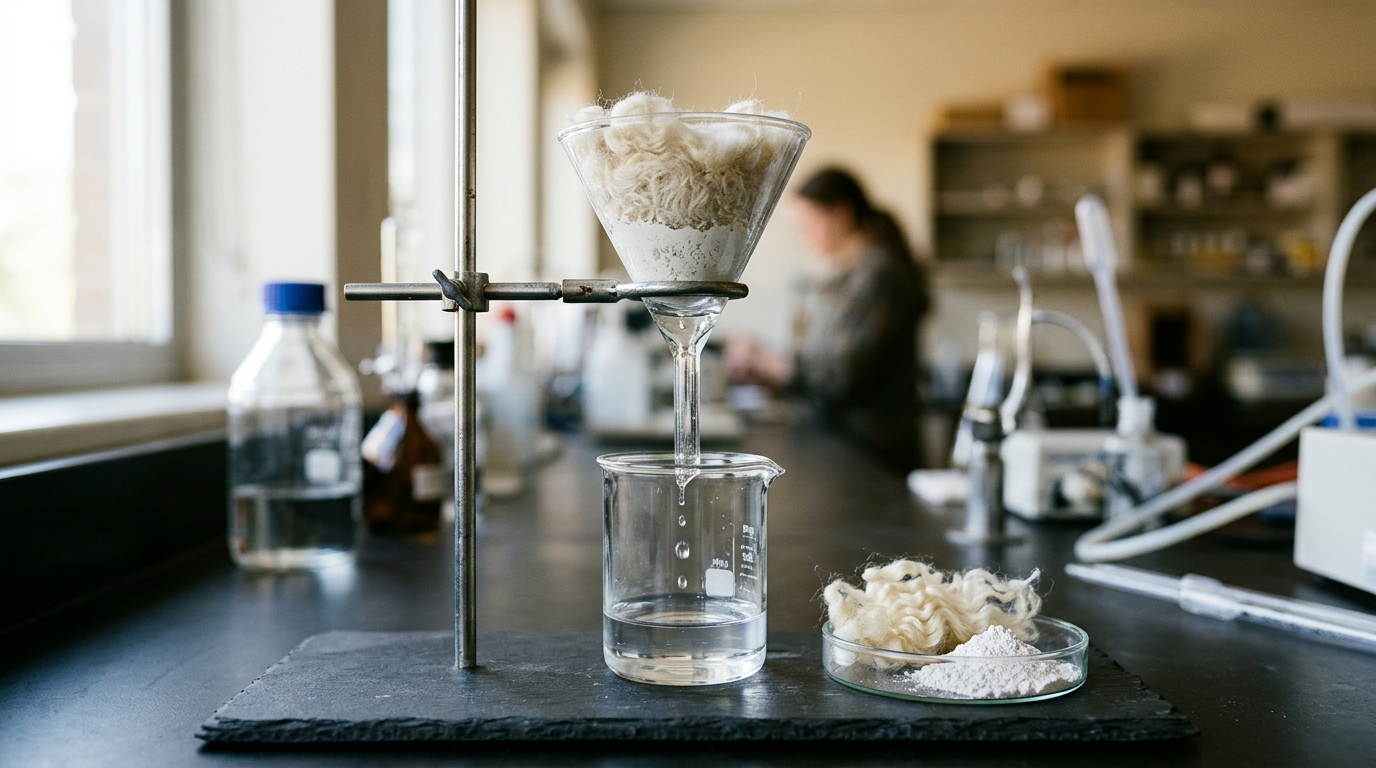
Researchers have developed a magnetized composite adsorbent from locally available raw kaolin and waste sheep wool that removed up to 99.97% of hexavalent chromium from water in batch experiments. The study, published in Discover Chemical Engineering, reports the development and systematic characterization of the material along with batch adsorption tests designed to evaluate how contact time, adsorbent dosage, temperature, pH, initial chromium(VI) concentration and particle size affect removal efficiency.

Characterization of the composite using FTIR, SEM and XRD analyses indicated successful integration of functional groups, a heterogeneous surface morphology, and a stable structural matrix that the authors describe as highly favorable for metal binding.

The batch experiments identified a set of optimized conditions under which performance peaked: an adsorbent dosage of 2.5 grams per liter, a temperature of 20 degrees Celsius, a pH of 2, a contact time of 210 minutes, and a particle size of 63 micrometers. Under those conditions the composite achieved its maximum reported removal efficiency of 99.97% for Cr(VI).

Equilibrium studies revealed a maximum adsorption capacity of 2.48 milligrams per gram, reached at an initial Cr(VI) concentration of 10 milligrams per liter.

The equilibrium data were best described by the Freundlich isotherm model, with a coefficient of determination of 0.961. The Freundlich model assumes multilayer adsorption on a heterogeneous surface, so the fit suggests that binding occurred on varied surface sites rather than a uniform single layer. Kinetic analysis showed the data adhered to the pseudo-second-order model, with an R² of 0.999, which the authors interpret as signifying chemisorption as the rate-limiting mechanism.

Thermodynamic parameters confirmed that the adsorption process was spontaneous and exothermic, with a standard enthalpy change of −37.82 kilojoules per mole.

The authors conclude that the composite serves as an outstanding and environmentally sustainable adsorbent.

As with any newly characterized adsorbent, the reported figures describe performance under the specific optimized conditions tested in the study.

Subject of Research: Development of a locally sourced kaolin–sheep wool composite adsorbent for removing hexavalent chromium from water

Article Title: Hexavalent chromium removal performance of a locally sourced kaolin sheep wool composite adsorbent

Article References: Birhanu, M., Worku, Z., & Habtu, N. G. (2026). Hexavalent chromium removal performance of a locally sourced kaolin sheep wool composite adsorbent. Discover Chemical Engineering. https://doi.org/10.1007/s43938-026-00153-9

Image Credits: AI Generated

DOI: 10.1007/s43938-026-00153-9

Keywords: hexavalent chromium, adsorption, kaolin, sheep wool, composite adsorbent, water treatment, Freundlich isotherm, pseudo-second-order kinetics, thermodynamics, magnetized adsorbent, Hexavalent, chromium

News Source: Bethany Barker. (November 5, 2026). Kaolin and sheep wool composite removes nearly all hexavalent chromium from water. Scienmag.


Tags: adsorptionchromiumcomposite adsorbentFreundlich isothermHexavalenthexavalent chromiumkaolinmagnetized adsorbentpseudo-second-order kineticssheep woolthermodynamicswater treatment
Share12Tweet7Share2ShareShareShare1

Related Posts

Low Cost Accelerometers Reveal Distinct Activity Cycles in Critically Endangered Turtles

Low Cost Accelerometers Reveal Distinct Activity Cycles in Critically Endangered Turtles

November 11, 2026
Decentralized Framework Cuts Charity Decision Rounds and Cross-Shard Blockchain Overhead

Decentralized Framework Cuts Charity Decision Rounds and Cross-Shard Blockchain Overhead

November 11, 2026

ChatGPT Accurately Identifies STEMI on ECGs and Guides Reperfusion Decisions

November 11, 2026

Complete Genome of Rahnella aceris HPDA25 Sequenced from Gastrodia elata Mycorrhizosphere

November 11, 2026

POPULAR NEWS

  • Coconut Rhinoceros Beetle Larval Frass Enhances Plant Growth as Direct Fertilizer

    Coconut Rhinoceros Beetle Larval Frass Enhances Plant Growth as Direct Fertilizer

    29 shares
    Share 12 Tweet 7
  • Affective and Emotion Terms Reflect Divergent AI Education Research Orientations

    29 shares
    Share 12 Tweet 7
  • Bifidobacterium Enzyme PNGaseA Unlocks Specialized Breast Milk Sugars in Infants

    29 shares
    Share 12 Tweet 7
  • HIPEC Treatment Proxy Shows Limited Incremental Prognostic Value in Appendiceal Cancer

    29 shares
    Share 12 Tweet 7

About

We bring you the latest biotechnology news from best research centers and universities around the world. Check our website.

Follow us

Recent News

Low Cost Accelerometers Reveal Distinct Activity Cycles in Critically Endangered Turtles

Multimodal CT Model Outperforms Standard Radiology in Thymic Tumor Risk Stratification

Artificial Intelligence and Synthetic Biology Converge to Accelerate Crop Improvement

Subscribe to Blog via Email

Enter your email address to subscribe to this blog and receive notifications of new posts by email.

Join 87 other subscribers
  • Contact Us

Bioengineer.org © Copyright 2023 All Rights Reserved.

Welcome Back!

Login to your account below

Forgotten Password?

Retrieve your password

Please enter your username or email address to reset your password.

Log In
No Result
View All Result
  • Homepages
    • Home Page 1
    • Home Page 2
  • News
  • National
  • Business
  • Health
  • Lifestyle
  • Science

Bioengineer.org © Copyright 2023 All Rights Reserved.