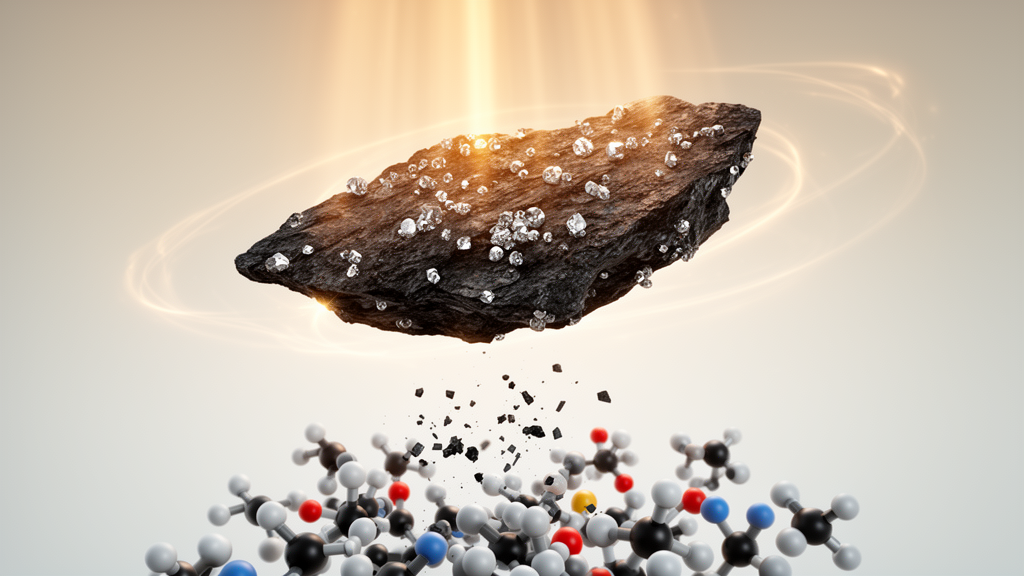
Researchers have reported a new iron-functionalized photocatalyst, Fe-AC/AgI, that degraded about 89.77% of the antibiotic tetracycline under visible-light irradiation in laboratory tests. The composite was synthesized through a simple co-precipitation approach, combining activated carbon, silver iodide, and iron, and is presented as a candidate material for removing pharmaceutical contaminants from wastewater.
Structural and morphological analyses using X-ray diffraction and field-emission scanning electron microscopy confirmed the formation of a well-crystallized material with a stable structural framework and a uniform morphology of well-interconnected particles. Optical and electrochemical characterization showed that the AgI component possesses a band structure suitably aligned for visible-light activation, with a measured optical band gap of 2.53 eV, allowing the material to harvest the visible portion of the solar spectrum rather than only ultraviolet light.
A key feature of the design is the role of the introduced Fe2+ ions, which act as effective electron-trapping sites. By capturing photogenerated electrons, the iron suppresses the rapid recombination of electrons and holes that ordinarily limits photocatalytic efficiency. This separation of charge carriers promotes the generation of reactive oxygen species, particularly hydroxyl (⋅OH) and superoxide (⋅O₂−) radicals, which the authors identify as playing a decisive role in breaking down tetracycline molecules.
Beyond the single-cycle degradation efficiency, the Fe-AC/AgI photocatalyst retained its catalytic activity over multiple reuse cycles, an important practical consideration for any material proposed for water treatment, where catalyst recovery and repeated use determine real-world viability. The authors conclude that the Fe-AC/AgI system is a promising and practical photocatalyst for wastewater treatment, offering an efficient strategy for the ultimate removal of pharmaceutical contaminants. As the findings derive from laboratory degradation experiments reported in the study’s abstract, performance at larger scales and in complex real wastewater matrices remains to be demonstrated.
Subject of Research: An iron-functionalized activated carbon–AgI photocatalyst for visible-light degradation of the antibiotic tetracycline in wastewater.
Article Title: Fe-Functionalized Activated Carbon-AgI Photocatalyst: A Sustainable Strategy for Efficient Wastewater Remediation
Article References: Singh, A., Sharma, S., Sonu, S., Raizada, P., Ahamad, T., Kaya, S., Maslov, M. M., & Singh, P. (2026). Fe-Functionalized Activated Carbon-AgI Photocatalyst: A Sustainable Strategy for Efficient Wastewater Remediation. Catalysis Letters, 156(11), Article 309. https://doi.org/10.1007/s10562-026-05553-8
Image Credits: AI Generated
DOI: 10.1007/s10562-026-05553-8
Keywords: photocatalysis, tetracycline, wastewater treatment, AgI, activated carbon, iron doping, reactive oxygen species, visible light, antibiotic degradation, nanocomposite, Fe-Functionalized, Activated
News Source: Bethany Barker. (October 29, 2026). Iron-Boosted Carbon–Silver Iodide Photocatalyst Degrades Tetracycline Under Visible Light. Scienmag.