

• HOME
  • NEWS
  • EXPLORE
    • CAREER
      • Companies
      • Jobs
    • EVENTS
    • iGEM
      • News
      • Team
    • PHOTOS
    • VIDEO
    • WIKI
  • BLOG
  • COMMUNITY
    • FACEBOOK
    • INSTAGRAM
    • TWITTER
Friday, October 30, 2026
BIOENGINEER.ORG
No Result
View All Result
  • Login
  • HOME
  • NEWS
  • EXPLORE
    • CAREER
      • Companies
      • Jobs
        • Lecturer
        • PhD Studentship
        • Postdoc
        • Research Assistant
    • EVENTS
    • iGEM
      • News
      • Team
    • PHOTOS
    • VIDEO
    • WIKI
  • BLOG
  • COMMUNITY
    • FACEBOOK
    • INSTAGRAM
    • TWITTER
No Result
View All Result
Bioengineer.org
No Result
View All Result
Home NEWS Science News Chemistry

Seventeen water molecules form the smallest cage that traps a single water molecule

by
October 29, 2026
in Chemistry
Reading Time: 2 mins read
0
Seventeen water molecules form the smallest cage that traps a single water molecule

Seventeen water molecules form the smallest cage that traps a single water molecule

Share on FacebookShare on TwitterShare on LinkedinShare on RedditShare on Telegram

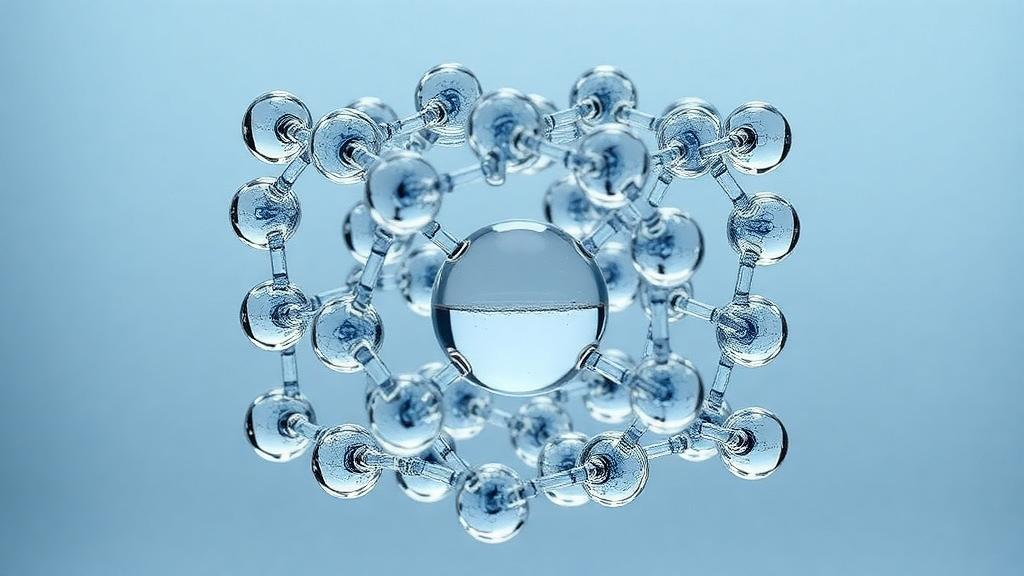
How few water molecules does it take to build a cage around a single water molecule? Researchers led by Prof. JIANG Ling and Assoc. Prof. LI Gang of the Dalian Institute of Chemical Physics (DICP) of the Chinese Academy of Sciences, working with Prof. LI Jun’s team at Tsinghua University, have now answered that question experimentally: 17. The study was published in the Journal of the American Chemical Society.

Determining the minimum size of an endohedral water cage matters because it bears on how scientists understand liquid water, hydrophobic solvation, and ice nucleation. Yet the minimum number had remained an open question, and the new result addresses a long-standing debate about the molecular limit of a solvation shell.

To reach the answer, the DICP team used a home-built neutral-cluster infrared spectroscopy station based on the Dalian Coherent Light Source (DCLS) to measure the infrared spectrum of neutral (H2O)17 clusters. The Tsinghua University group then carried out high-precision quantum chemical calculations to interpret the measured spectrum.

Together, the experiment and calculations identified three lowest-energy structural models for the 17-molecule cluster: an endohedral water cage, a fused pentagonal prism, and a fused cube. Among these candidate structures, the endohedral cage was found to be dominant, providing experimental evidence that (H2O)17 forms the smallest endohedral water cage.

The cage’s oxygen-atom framework turned out to be an irregular polyhedron with four quadrilateral faces, four pentagonal faces, and two hexagonal faces. This geometry differs from the classical Platonic, Archimedean, and Johnson solids, raising new questions about whether classical geometric constraints are sufficient to describe the structures that hydrogen-bonded systems can form.

Beyond settling the size question, the work offers insights into the hydrogen-bond network in the first coordination shell of liquid water, the immediate molecular neighborhood that surrounds individual molecules in the liquid. The researchers suggest the findings could inform how the molecular-scale structure of water is understood in contexts ranging from solvation to the earliest stages of ice formation.

Subject of Research: The smallest endohedral water cage, formed by 17 water molecules

Article Title: Researchers identify smallest endohedral water cage: 17 water molecules

Article References: Researchers identify smallest endohedral water cage: 17 water molecules. Original publication (Bibliographic details unavailable.)

Image Credits: AI Generated

DOI: Not provided

Keywords: water clusters, hydrogen bonding, endohedral cage, infrared spectroscopy, solvation shell, ice nucleation, hydrophobic solvation, quantum chemistry, Dalian Coherent Light Source, Journal of the American Chemical Society, Researchers, identify

News Source: Bethany Barker. (October 29, 2026). Seventeen water molecules form the smallest cage that traps a single water molecule. Scienmag.
Tags: Dalian Coherent Light Sourceendohedral cagehydrogen bondinghydrophobic solvationice nucleationidentifyinfrared spectroscopyJournal of the American Chemical Societyquantum chemistryResearcherssolvation shellwater clusters
Share12Tweet7Share2ShareShareShare1

Related Posts

Computational screen flags five natural compounds that bind a tuberculosis virulence enzyme

Computational screen flags five natural compounds that bind a tuberculosis virulence enzyme

October 30, 2026
Gut bacterium Blautia sp. MRG-PMF1 cleaves bulkier isoflavone ether bonds

Gut bacterium Blautia sp. MRG-PMF1 cleaves bulkier isoflavone ether bonds

October 30, 2026

Fluorine–silicon acrylate sizing agent boosts specialty paper strength and water resistance

October 30, 2026

Filamentous fungi reshape kombu chemistry and aroma in solid-state fermentation study

October 30, 2026

POPULAR NEWS

  • Microbial Sources and Stress Shape the Hidden Endophytes of an Invasive Plant

    Microbial Sources and Stress Shape the Hidden Endophytes of an Invasive Plant

    29 shares
    Share 12 Tweet 7
  • Firebreaks Leave Lasting Scars in Grasslands While Wildfire Heals Fast

    29 shares
    Share 12 Tweet 7
  • ZNF207 shields glutamine transporter ASCT2 from degradation to fuel liver cancer growth

    29 shares
    Share 12 Tweet 7
  • Systematic review maps sustainability tensions in offshore wind development

    29 shares
    Share 12 Tweet 7

About

We bring you the latest biotechnology news from best research centers and universities around the world. Check our website.

Follow us

Recent News

Microbial Sources and Stress Shape the Hidden Endophytes of an Invasive Plant

Firebreaks Leave Lasting Scars in Grasslands While Wildfire Heals Fast

ZNF207 shields glutamine transporter ASCT2 from degradation to fuel liver cancer growth

Subscribe to Blog via Email

Enter your email address to subscribe to this blog and receive notifications of new posts by email.

Join 86 other subscribers
  • Contact Us

Bioengineer.org © Copyright 2023 All Rights Reserved.

Welcome Back!

Login to your account below

Forgotten Password?

Retrieve your password

Please enter your username or email address to reset your password.

Log In
No Result
View All Result
  • Homepages
    • Home Page 1
    • Home Page 2
  • News
  • National
  • Business
  • Health
  • Lifestyle
  • Science

Bioengineer.org © Copyright 2023 All Rights Reserved.
