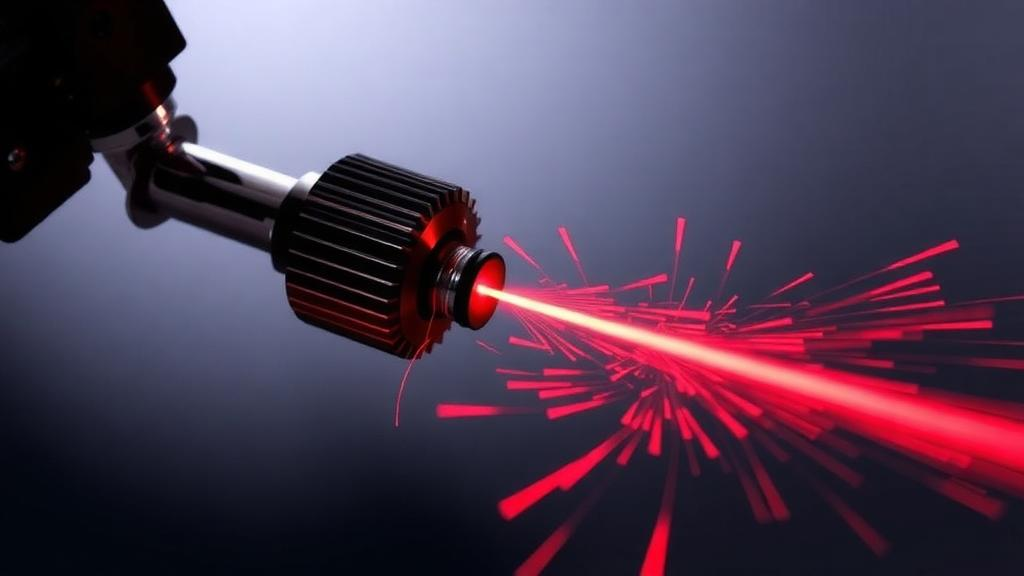
But turning this ceramic matrix composite into useful hardware demands one deceptively simple step: drilling microscale cooling holes without wrecking the material around them. A new open-access study in Applied Physics B reports a systematic head-to-head comparison of two laser drilling approaches, and the results favor a technique that fires the laser through a hair-thin jet of high-pressure water.
The research team, led by Dianzheng Wang and Yulu Zhang with colleagues including Shengzhi Sun, machined 3-millimeter-thick Cf/SiC plates supplied by the Institute of Engineering Thermophysics of the Chinese Academy of Sciences. The composite was built around a 3D needled carbon fiber preform, coated with a boron nitride interface layer, and infiltrated with a silicon carbide matrix by chemical vapor infiltration. Micro-CT imaging showed a void volume fraction of 13.83 percent and a SiC matrix fraction of 72.12 percent, a composition the authors note helps lower thermal conductivity during laser processing.
The challenge is well known in the machining world. With a hardness near 2800 HV and pronounced interlaminar anisotropy, Cf/SiC defeats conventional tools, which tend to pry fibers away from the matrix and seed microcracks. Worse, both the SiC matrix and the BN interphase oxidize at high temperature, and that oxidation degrades the interfaces responsible for the composite’s toughness. Nanosecond lasers, though flexible and non-contact, remove material mainly by melting and vaporizing it, which piles heat into the workpiece, drives severe oxidation, and leaves recast layers behind.
Water-jet guided laser processing, or WJGL, takes a different route. The team used a five-axis FN-X500 system coupling a 532 nm nanosecond Nd:YAG laser into a fine, high-pressure waterjet. Total internal reflection at the boundary between the water jet and the surrounding helium flow traps the beam inside the jet, so the water acts simultaneously as an optical waveguide, a coolant, and a debris-flushing channel. For a fair comparison, the researchers matched the pulse energy delivered to the workpiece surface at 5 mJ for both methods, with an effective processing diameter of 60 micrometers, corresponding to a fluence of roughly 176.8 J/cm².
Before pitting the two methods against each other, the team tuned the water pressure, sweeping it from 10 to 35 MPa while drilling holes with target diameters from 200 to 1000 micrometers. Circularity responded nonlinearly. The largest holes held roughly 90 to 100 percent circularity across the range, but smaller holes of 200 to 400 micrometers improved markedly between 15 and 30 MPa, where the jet stays stable and collimated enough to confine the laser energy symmetrically. At 35 MPa, circularity dropped again as turbulence and jet impact disturbed the energy distribution. High-speed camera footage at 20,000 frames per second captured the transition from a fluctuating jet at 10 MPa to a well-collimated column at 20 MPa and visibly turbulent flow at 35 MPa. Taper, by contrast, stayed within a narrow 0.19 to 0.57 degrees across all pressures.
The headline capability figure is striking: drilling into the 3-mm-thick sample, the process produced microholes as small as 200 micrometers in diameter with a maximum aspect ratio of 15:1, with entrances showing only minor edge breakage and exits sharply defined. That kind of deep, narrow hole in a hard, anisotropic ceramic composite is exactly what cooling-hole manufacturing struggles to deliver.
When the two laser methods were compared directly on 1000-micrometer holes at scanning speeds from 1 to 9 mm/s, the efficiency gap was large. At 5 mJ and 1 mm/s, WJGL reached a material removal rate of 14.05 mm³/min against 4.12 mm³/min for dry nanosecond processing, roughly 3.4 times higher, a 240 percent increase. The authors attribute the dry laser’s poor low-speed performance to its inability to clear chips at slow scan rates and the need to continuously reposition the focus, whereas the waterjet extends the effective focal length to 80 to 100 mm and blasts molten material away dynamically without focal adjustment.
The chemical evidence for oxidation suppression was equally clear. Under identical laser parameters, dry nanosecond processing left cross-sections littered with spherical clusters and micrometer-scale deposits; EDS analysis showed elevated oxygen, large roughly 25-micrometer oxidized silica particles, and fiber apparent diameters swelling from about 10 to nearly 30 micrometers under thick silica and resolidified melt layers. Under water confinement, oxygen signals dropped sharply and carbon dominated, with fibers at 30 MPa retaining pristine morphology. Raman spectra showed a much weaker silica peak at 503 cm⁻¹, and XPS revealed dominant Si-C and Si-Si bonding plus preserved B-N interphase bonds in WJGL samples, versus Si-O species and enhanced B-O signals after dry processing. The team proposes three coupled mechanisms: rapid heat extraction that shortens high-temperature residence time, partial isolation from ambient oxygen, and dynamic removal of molten oxides before they redeposit.
Those chemical differences translated into mechanical performance. In room-temperature reciprocating wear tests against a silicon nitride ball under a 100 N load for one hour, corresponding to 10,800 sliding cycles over 108 meters, the WJGL-processed surface stabilized at a friction coefficient near 0.5 and showed a wear rate of 5.79 × 10⁻⁶ mm³/(N·m), only 46.6 percent of the dry-laser sample’s 1.242 × 10⁻⁵ mm³/(N·m). Wear tracks on the WJGL surface were superficial, with grinding marks but no deep damage, while the dry-processed surface, coated in soft SiO₂ far softer than either the counterface ball or the original SiC matrix, accumulated abrasive debris and spalled. The nanosecond-processed samples also wore roughly 10 micrometers deeper.
The study’s conclusions are practical as well as mechanistic. Moderate water pressures of 15 to 30 MPa stabilize energy transmission and hole geometry, while excessive pressure induces turbulence and edge chipping. Under optimized parameters of 5 mJ, 1 mm/s, and 25 MPa, the water-guided process delivered its peak removal rate. Because the water suppresses oxidation, the SiC matrix and BN interface survive machining intact, and that preserved integrity is what carries through to better wear resistance.
Subject of Research: Comparative laser drilling of carbon fiber reinforced silicon carbide ceramic matrix composites with and without a guided water jet
Article Title: A comparative study of water-jet guided laser and dry nanosecond laser processing of Cf/SiC composites
Article References: Wang, D., Zhang, Y., Du, Z., Dai, Y., & Sun, S. (2026). A comparative study of water-jet guided laser and dry nanosecond laser processing of Cf/SiC composites. Applied Physics B, 132(9), Article 99. https://doi.org/10.1007/s00340-026-08709-x
Image Credits: AI Generated
DOI: 10.1007/s00340-026-08709-x
Keywords: water-jet guided laser, Cf/SiC composites, laser drilling, ceramic matrix composites, thermal oxidation, microholes, material removal rate, tribology, BN interface, SiC matrix, wear resistance, nanosecond laser
News Source: Denise Maddox. (October 29, 2026). Research report: A comparative study of water-jet guided laser and dry nanosecond laser processing of Cf/SiC composites. Scienmag.