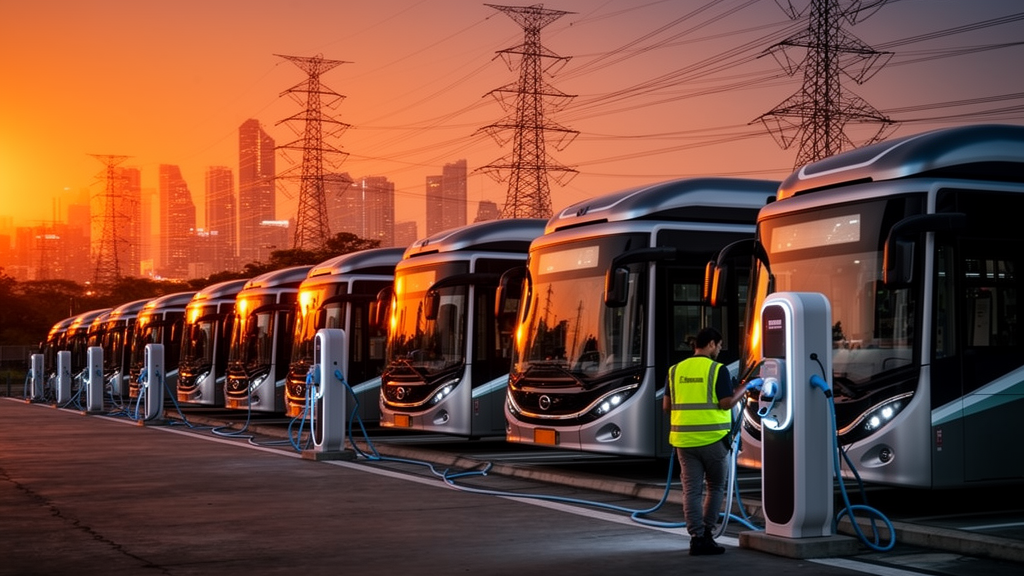
A theoretical modelling study of Jakarta’s electric bus fleet suggests that municipal transit vehicles, often treated as a burden on the electricity grid, could be turned into decentralised power plants that feed electricity back into the network during peak demand hours. The analysis, published as a Brief Report in the journal Carbon Neutral Systems, formulates an optimisation framework for vehicle-to-grid (V2G) operation of a commercial bus depot and tests it in an illustrative techno-economic case study of a 100-bus TransJakarta depot.
Rather than modelling high volumes of electric vehicles as an inflexible extra load on local distribution networks, as the author says much of the current literature does, the framework treats the depot fleet as a decentralised Virtual Power Plant, a coordinated pool of batteries that can discharge to the grid when it is most valuable.
The technical constraints are demanding. Buses must depart each morning with at least 95 percent state of charge to guarantee transit readiness, so any grid discharge has to be scheduled around strict service timetables. The model also accounts for energy losses, assuming 85 percent round-trip efficiency for the charge-discharge cycle, which penalises the economics of arbitrage.
In the illustrative case study, the depot’s 324 kWh batteries deliver a peak-shaving capacity of 4.25 MWh over a two-hour window. Because the model assumes 85 percent round-trip efficiency, the operation still generates positive net arbitrage revenue under the tariff scheme proposed in the paper, and it avoids an estimated 2.89 metric tons of CO2 daily while satisfying the 95 percent departure charge constraint.
A key innovation is the proposed Dynamic Feed-In Tariff, or D-FiT, a theoretical pricing mechanism designed to incentivise peak shaving. The author notes that prior feasibility studies have found commercial V2G integration financially unviable under static tariff structures; the dynamic tariff simulation is what shifts the depot’s V2G operations into a viable grid asset in the model, yielding an illustrative net operating profit of 2,875,000 IDR per day.
To make the constraint management operational, the paper proposes a three-layered artificial intelligence orchestration combining XGBoost, an adaptive neuro-fuzzy inference system (ANFIS), and particle swarm optimisation (PSO). The aim of this software-defined architecture is to provide the dynamic constraint management needed to satisfy the strict requirement that buses leave the depot with at least 95 percent state of charge, while AI-driven forecasting is positioned as an implementation strategy for smoothing grid load dynamics without compromising transit availability.
The choice of battery chemistry matters to the economics. The framework couples the software architecture with lithium iron phosphate (LFP) batteries, which the author cites for their robust cycle life. The report suggests that by leveraging depot fleets in this way, Indonesia has the potential to mitigate capital-intensive physical grid expansions, an attractive proposition for an archipelagic nation where distribution network upgrades are costly.
The author is careful to frame the findings as theoretical. The paper states that the study explores the feasibility of using commercial fleets as decentralised Virtual Power Plants without compromising transit readiness, and the data availability statement confirms that no datasets were generated or analysed during the study. The numbers presented, including the 4.25 MWh peak-shaving capacity, the daily profit figure and the CO2 estimate, are outputs of an illustrative simulation rather than measurements from a real depot.
Several knowledge gaps remain before the framework could move from model to depot. The conclusion identifies two priorities: future empirical research must quantify LFP battery degradation under tropical V2G cycling, and computational studies should explore multi-agent reinforcement learning for coordinating massive-scale fleets. Both are acknowledged as necessary steps to transition the theoretical framework into operational reality.
Even so, the report offers a concrete pathway for emerging archipelagic economies grappling with the operational challenges that electric vehicle transition poses for power system planners. By reframing idle transit batteries as dispatchable grid assets, constrained by real service schedules and incentivised through dynamic tariffs, the study sketches how a bus depot in Jakarta might one day help keep the lights on, at least on paper.
Subject of Research: Vehicle-to-grid integration of electric municipal bus fleets as decentralised virtual power plants in Indonesia
Article Title: Transforming Indonesian transit fleets from liabilities to assets via vehicle to grid integration
Article References: Pranata, N. (2026). Transforming Indonesian transit fleets from liabilities to assets via vehicle to grid integration. Carbon Neutral Systems, 2(1), Article 16. https://doi.org/10.1007/s44438-026-00036-0
Image Credits: AI Generated
DOI: 10.1007/s44438-026-00036-0
Keywords: vehicle-to-grid, TransJakarta, electric buses, virtual power plant, dynamic feed-in tariff, peak shaving, LFP batteries, state of charge, Indonesia, grid flexibility, techno-economic modelling, CO2 emissions
News Source: Denise Maddox. (October 28, 2026). Indonesian bus fleets could double as grid power plants, model study finds. Scienmag.