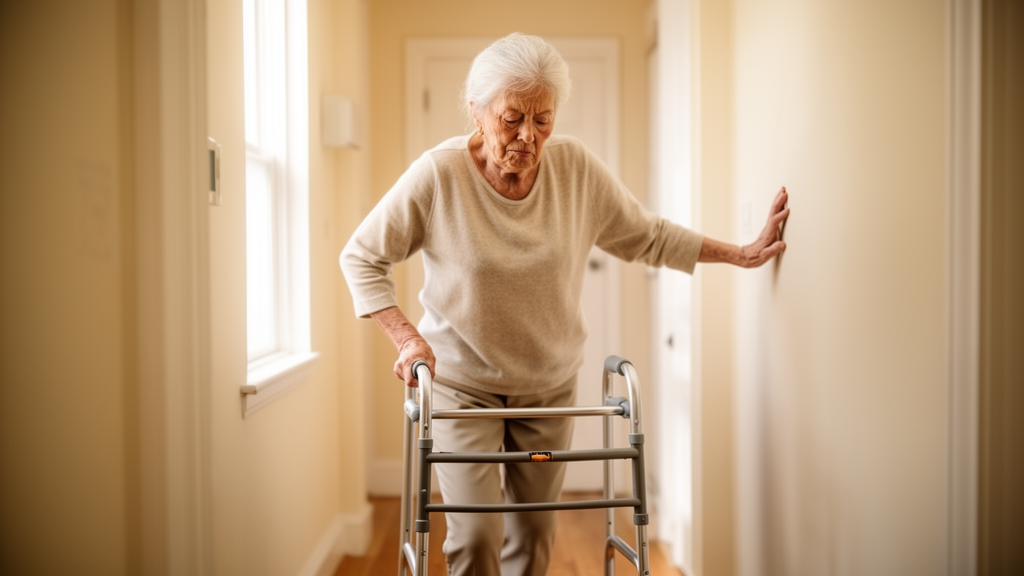
Older adults who use walking aids such as rollators and wheeled walkers are among the most common recipients of mobility prescriptions, yet a new scoping review concludes that the evidence base connecting age-related muscle strength decline to fall risk in this specific population is strikingly thin. The review, published in the European Review of Aging and Physical Activity, systematically mapped biomechanical and clinical studies published between January 2000 and March 2026 and found that only a small fraction of the existing literature actually focuses on walking aid users as a primary study population.
The paradox motivating the review is well recognized in geriatric research: walking aids are prescribed to enhance stability and prevent falls, but walking aid use itself has repeatedly been identified as a marker of elevated fall risk. The authors note that age-related muscle strength decline may alter the biomechanical strategies required for safe walking aid–assisted ambulation, while also emphasizing that walking aid use is multifactorial, reflecting cognitive, sensorimotor, and device-competence factors as well as underlying frailty.
Methodologically, the review followed the Joanna Briggs Institute methodology for scoping reviews and was reported according to the PRISMA-ScR guidelines. The team searched PubMed/MEDLINE, Scopus, and the Web of Science Core Collection, applying a Population–Concept–Context framework in which the population was older adults aged 60 years or older using rollators or other walking aids, the concept encompassed muscle strength decline and fall risk or incidence, and the context included all care settings. Two independent reviewers performed title/abstract and full-text screening, supported by a calibration exercise, pilot screening, and structured consensus procedures, with inter-rater reliability quantified using Cohen’s kappa.
From 328 identified records across the three databases, 262 unique records remained after deduplication. Following title and abstract screening of those 262 records and full-text assessment of 159, the review included 93 studies. The included studies enrolled older-adult populations consistent with the eligibility threshold: reported mean ages ranged from approximately 59 to 83 years, and individual study age ranges spanned roughly 60 to 98 years. The authors note that pooled participant totals could not be precisely aggregated because of heterogeneous reporting, a limitation they flag explicitly.
The study designs were dominated by observational work. The majority were cohort studies (26 studies, 28.0 percent) and cross-sectional studies (12 studies, 12.9 percent), with 12 randomized controlled trials accounting for 12.9 percent. Data were charted using a standardized 76-variable extraction form with biomechanical variables predefined a priori, and critical appraisal used JBI checklists matched to study design alongside AMSTAR 2 for reviews.
Six thematic domains emerged from the mapping. Clinical and predictive evidence was the largest, covering 77.4 percent of studies, followed by assessment tools (73.1 percent), exercise and intervention research (57.0 percent), technology and devices (47.3 percent), biomechanics (26.9 percent), and sarcopenia or dynapenia (4.3 percent). The distribution itself tells a story: the biomechanical and sarcopenia-focused strands that would directly address how strength decline interacts with assisted ambulation remain among the smallest bodies of work.
Perhaps the most consequential finding concerns population focus. Only 15 studies, or 16.1 percent, focused primarily on walking aid users; the remaining 78 studies, 83.9 percent, addressed walking aid use merely as a covariate. The evidence mapping also revealed no randomized controlled trials addressing strength- or sarcopenia-specific interventions in walking aid user populations, meaning that the most direct test of whether strength-based programs reduce falls in this group has never been run.
The authors conclude that limited and fragmented evidence exists at the intersection of muscle strength decline and fall risk in older walking aid users. While walking aid use is consistently associated with elevated fall risk, they stress that this association is multifactorial and that dedicated, population-specific evidence, particularly regarding muscle strength interventions, remains scarce. They recommend that findings be interpreted alongside contemporary multifactorial fall-prevention frameworks rather than in isolation.
For future research, the review’s message is direct: the field should prioritize population-specific trials evaluating strength-based fall prevention in walking aid users. Until such trials exist, clinicians and researchers must rely on evidence drawn largely from broader older-adult populations in which walking aid use appears only as one variable among many, leaving open the question of how best to protect the strength and stability of the people who depend on these devices every day.
The article is published open access, and the version shared at publication is the peer-reviewed, accepted manuscript carrying a permanent DOI, subject to further edits before the final Version of Record replaces it.
Subject of Research: Muscle strength decline and fall risk in older adults who use walking aids
Article Title: Muscle strength decline and fall risk in older walking aid users: a scoping review of biomechanical and clinical evidence
Article References: Dharmansyah, D., Rahayuwati, L., Pramukti, I., & Mutyara, K. (2026). Muscle strength decline and fall risk in older walking aid users: a scoping review of biomechanical and clinical evidence. European Review of Aging and Physical Activity. https://doi.org/10.1186/s11556-026-00436-8
Image Credits: AI Generated
DOI: 10.1186/s11556-026-00436-8
Keywords: scoping review, walking aids, rollators, fall risk, muscle strength decline, older adults, sarcopenia, biomechanics, PRISMA-ScR, Joanna Briggs Institute, randomized controlled trials, frailty
News Source: Beatrice Stafford. (October 28, 2026). Scoping review finds scarce evidence linking muscle strength decline to falls in older walking aid users. Scienmag.