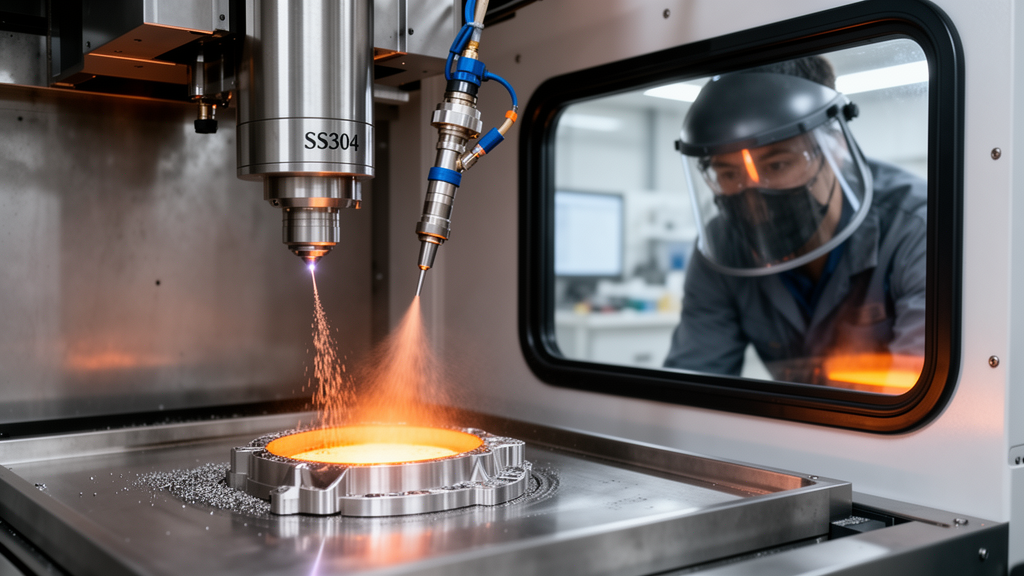
A hybrid additive manufacturing study has combined laser powder bed fusion (LPBF) with laser-directed energy deposition (LDED) to fabricate SS304 stainless steel, and the resulting data show a clear split between corrosion performance and tensile strength. The research team characterized hybrid samples alongside purely LPBF-processed and purely LDED-processed specimens, examining microstructural evolution, mechanical properties, and electrochemical corrosion behavior in both as-deposited (AD) and heat-treated (HT) states.
The microstructural contrast between the two process zones was pronounced. The as-deposited LDED region displayed columnar and cellular dendrites containing 2.5 to 3 percent delta-ferrite. The as-deposited LPBF material, by contrast, showed a microstructure roughly five times finer, combining cellular, columnar, and equiaxed dendrites with no detectable delta-ferrite.
Heat treatment reshaped both zones. The thermal process promoted grain coarsening, dissolved the dendritic features, and produced a more homogeneous microstructure across the hybrid part, replacing the distinct as-deposited signatures of each region with a uniform structure.
Those microstructural differences were reflected in mechanical measurements. As-deposited LPBF samples exhibited higher hardness than their as-deposited LDED counterparts, an effect the authors attribute to the finer dendrites and greater dislocation density in the LPBF material.
Tensile testing of the hybrid specimens told a different story. The hybrid samples showed lower yield strength and ultimate tensile strength than literature values reported for standalone LDED- or LPBF-processed SS304. The researchers traced this shortfall primarily to a higher fraction of lack-of-fusion porosity on the LPBF side of the hybrid build.
Not every interface measurement was unfavorable. Scratch tests performed on both as-deposited and heat-treated hybrid samples confirmed the absence of visible delamination or cracking, indicating favorable interfacial continuity between the LPBF and LDED regions. The mechanical penalty observed in tension therefore arose from porosity within the LPBF zone rather than from separation at the junction between the two process regions.
Corrosion testing delivered the study’s strongest result. In electrochemical measurements, the as-deposited LPBF material exhibited superior corrosion resistance, achieving the lowest corrosion current density of 0.00067 mA/cm² and a charge transfer resistance of 1 x 10⁶ Ω·cm². The authors attribute this performance to the fine dendritic microstructure, higher dislocation density, and greater grain boundary density, which enhanced ion diffusion and passive film stability.
Heat treatment worked in the opposite direction for corrosion. The heat-treated samples displayed lower corrosion resistance than their as-deposited counterparts, which the study links to the grain coarsening that homogenized the microstructure. The same thermal process that produced a uniform structure across the hybrid part therefore reduced the fine-scale features associated with the as-deposited LPBF zone’s protective behavior.
Taken together, the study maps both the promise and the limitations of hybrid LPBF-LDED fabrication of SS304. The approach produced a continuous interface free of visible delamination, an as-deposited LPBF zone with high hardness and superior corrosion resistance, and a heat-treated state with a homogeneous but less corrosion-resistant microstructure. The tensile shortfall relative to standalone processing, driven by lack-of-fusion porosity on the LPBF side, remains an open challenge. The findings are limited to the specific processing conditions and test methods reported, and the tensile comparison relies on literature values for standalone processes rather than matched control specimens, so the results serve as a microstructural and electrochemical baseline for this manufacturing route rather than a demonstration of optimized performance.
Subject of Research: Hybrid LPBF-LDED additive manufacturing of SS304 stainless steel and its microstructure, mechanical, and corrosion properties
Article Title: Hybrid LPBF-LDED processing of SS304: interfacial microstructural evolution and its influence on mechanical and corrosion performance
Article References: Sasindran, J., Balla, S. K., Narayanan, J. A., Mallaiah, M., Hebbar, H. S., & Bontha, S. (2026). Hybrid LPBF-LDED processing of SS304: interfacial microstructural evolution and its influence on mechanical and corrosion performance. Journal of Materials Science. https://doi.org/10.1007/s10853-026-13956-6
Image Credits: AI Generated
DOI: 10.1007/s10853-026-13956-6
Keywords: hybrid additive manufacturing, LPBF, LDED, SS304 stainless steel, microstructure, delta-ferrite, lack-of-fusion porosity, hardness, tensile strength, electrochemical corrosion, heat treatment, passive film stability
News Source: Denise Maddox. (October 26, 2026). Hybrid LPBF-LDED printing of SS304 shows fine microstructure and corrosion trade-offs. Scienmag.